George's Old Bookcase
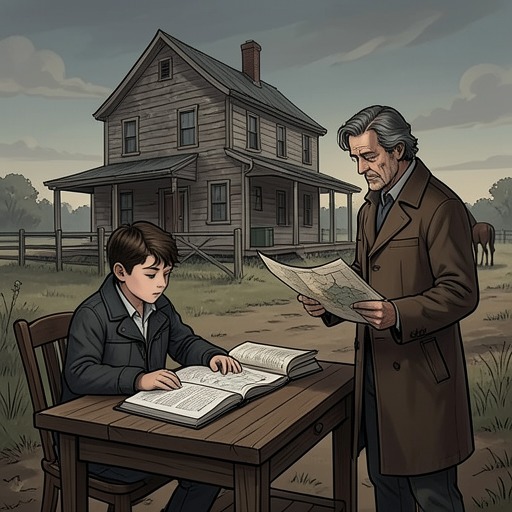
The Power of the Dog (Thomas Savage Edition)George's Old Bookcase is both a repository of an earlier version of George Burbank and an object whose removal unsettles Phil Burbank. Long neglected in Phil's room, it is given to Peter Gordon for the books left by Peter's father. That practical transfer connects two generations through their reading, but it also reveals how differently the brothers understand the case: George sees a useful gift, while Phil had treated it as part of a shared past and imagined a future use for it of his own.
Original Contents and Meaning
The case stood opposite one of the two brass beds in Phil Burbank's room, a glass-fronted counterpart to Phil's own case. It had been there for years. Behind its glass were stacked copies of St Nicholas Magazine and American Boy, the children's magazines George had read before he took up the Saturday Evening Post. No one had opened the case for a long time; its contents had become a record of an earlier reading life left in place rather than an actively used collection.
Phil regarded the bookcase as a miniature of George's life. In his view, George's life consisted largely of what he read, and George had few opinions of his own. The judgment is Phil's, not an objective inventory of his brother's character. Its importance lies partly in that difference: the books and the closed case supply Phil with a material shorthand for George, but the shorthand also exposes Phil's tendency to read his brother through his own interpretation. What George has kept, and what he has left unopened, seem to Phil to tell a whole story.
The bookcase also occupied a distinctive place in Phil's room beside Phil's very different display case. Phil's shelves held no books or magazines. Instead they displayed arrowheads, fossils, a wolf skull, a mounted stone marten, and specimens of rock and quartz. The contrast makes the brothers' cases more than matching furniture: one preserves reading matter, the other objects selected, arranged, and mounted by Phil. The bookcase's contents mark George's former interests; Phil's display turns his own interests into a deliberate arrangement.
Removal from Phil's Room
One June afternoon, Phil noticed that something in his room had changed. George's Old Bookcase was gone, and the dusty patch on the floor showed where it had stood. The gray dust, accumulated over years, made the object's absence newly visible. In that bare space Phil found two boys' marbles, the kind called chinks. He closed his hand around them as though playing again and remembered that he had been an expert.
The marbles give the discovery an intimate, physical detail: the case's removal brings an overlooked trace of childhood into view. Phil picks them up and puts them in his pocket. His response is not only to the missing furniture; the empty place and the marbles draw him toward a past shared with George, when the brothers were young. The case had stood quietly in the room for so long that its significance becomes legible to Phil most sharply when it is no longer there.
Phil goes to find George and asks where the bookcase is. George is in the garage, bent over the raised hood of the old Reo. He initially does not understand what Phil means, then explains that he told Rose's boy to take the case for his father's books. Phil says he had planned to make it into a gun case. George answers that it seems to be put to good use now, then turns back to the car. The exchange sets Phil's private plan against George's practical judgment without resolving the disagreement: the brothers assign different futures to the same object.
A Gift for Peter Gordon
The bookcase's new purpose is to hold the medical books left by Peter Gordon's father. Its transfer therefore joins the old case, once filled with George's childhood magazines, to a collection that carries a father's knowledge and memory. The object does not simply change rooms or owners; its contents and use change with it. What had been a closed container for a superseded reading life becomes a place for books Peter wants to keep.
George later tells Phil that Peter likes his room and that giving him the case was a good thing to do. In another conversation, George describes himself as conscious of being a stepfather: he believes that a stepfather must try harder than a father and that a boy has little reason to like one unless he makes the effort. The gift fits that stated effort. The case offers a concrete way to make Peter's room more his own and to accommodate the books connected to his father, although the narrative does not present it as a cure for the distance inherent in their new family relationship.
Significance
The bookcase's movement brings its meanings into contrast. For Phil, it was an object he had incorporated into his sense of George's history and intended to remake as a gun case. For George, it could be taken from a room where it had stood unopened and redirected toward Peter's needs. That difference gives a familiar piece of furniture narrative force: while it remains in place, its old contents can seem inert; once removed, the case reveals competing attachments and intentions.
Its successive uses also hold together two kinds of inheritance. The magazines preserve a glimpse of George as a boy, while Peter's father's medical books bring a different father's legacy into the Burbank household. George's gift does not erase either history. Instead, the old case becomes the means by which one household's stored past is made useful to a new member of the family. Phil's discovery of the dust and marbles, meanwhile, shows that even an object he thought he understood could contain a personal history he had not been attending to.