Gordon family poverty
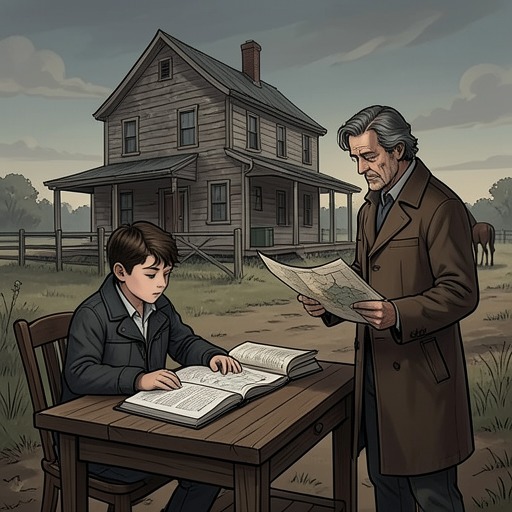
The Power of the Dog (Thomas Savage Edition)Gordon family poverty is presented as a condition of limited and uncertain income rather than as a lack of care or effort. Johnny Gordon gives medical help without insisting on payment, serving farmers who themselves struggle to survive, while The Inn / Red Mill relies on passing commercial travelers and occasional cattle buyers to pay its bills. The contrast between the family’s service to its neighbors and the fragile means supporting its household defines its economic position.
Johnny Gordon’s Practice and Its Limits
Johnny Gordon is faithful to the Hippocratic oath and answers calls for help whether or not a fee is available. His patients are dryland farmers behind the hills, people whose prospects resemble his own: railroads had drawn them west with promises of cheap land, but the rain needed to make that land productive did not come. The region’s larger ranchers, who controlled the creeks and river, prospered; the farmers did not. Johnny’s willingness to treat them without payment makes his practice a source of help but not a dependable source of household income.
His work ranges from setting broken bones and treating injuries caused by farm machinery or animals to attending births. The families prepare water so he can clean his instruments, and he offers congratulations and humor after deliveries. Payment follows no fixed schedule: he reassures Rose Gordon Burbank that patients will pay when they can, and eventually they do. That delay matters. The practice serves a community whose inability to pay promptly is itself part of the hardship, leaving the Gordons to wait for fees rather than count on them as they are earned.
The Inn as Economic Support
The Inn / Red Mill provides a second, more commercial source of income, but its condition suggests a business operating on narrow margins. The sign bearing Johnny’s name has weathered until it can no longer be read, the deer horns above the entrance have fallen, and the exterior needs painting. Inside, however, the rooms are kept clean and the windows shine. The contrast distinguishes neglect caused by limited resources from indifference to the inn’s guests or standards.
The bills are not paid by Johnny’s patients. Instead, the inn depends on salesmen traveling with dry goods and notions, along with the occasional cattle buyer who stops for a night and a meal. These customers provide the cash that the medical practice cannot reliably supply. The family’s finances therefore depend on two different kinds of work: Johnny’s care for neighbors who may pay late, and the inn’s ability to attract travelers whose purchases help cover expenses.
The Meaning of Their Hardship
The Gordons’ position is shaped by a wider rural economy in which the people most in need of medical attention are often least able to pay for it. Johnny’s patients are not portrayed as refusing their obligations; they pay when they can. His practice is sustained by trust and delayed reciprocity, but that arrangement transfers the uncertainty of the farmers’ lives into his own household finances.
The inn’s worn exterior and spotless interior make that pressure visible without reducing the family to deprivation. The Gordons continue to work, provide care, and maintain the rooms, yet their stability depends on modest fees arriving eventually and on travelers stopping by. Their poverty is thus an ongoing economic constraint, held in tension with Johnny’s professional generosity and the family’s continued effort to keep its home and business in order.