Homophobia in Ranch Society
The Power of the Dog (Thomas Savage Edition)Homophobia in Ranch Society operates through everyday judgments about how men and boys should look and behave, not only through explicit hostility. In The Power of the Dog, masculine conformity is enforced by ridicule, exclusion, and the threat of losing respect. Phil Burbank helps enforce this code even as the novel’s afterword connects his hostility to the same-sex desire he has suppressed. Peter Gordon’s treatment shows how its reach extends beyond Phil, into school and the ranch workforce.
The social code and its costs
The novel presents masculine authority as a standard against which difference is publicly measured. At school, Peter is hazed and mocked for his manner; the insult directed at him is so persistent that it becomes part of the surrounding social atmosphere. Yet he reacts most decisively when the boys call his father a drunk. Surrounded by classmates who turn his resistance into a game, Peter recognizes a repeating pattern: one group singles out an outsider, as earlier generations had done and as future ones might. His response is not to imagine acceptance from the boys but to decide that he must oppose them on terms of his own choosing.
That distinction matters. Peter’s isolation is not simply a private difficulty between him and individual classmates. He sees the taunting as an inherited group practice, sustained by the security of those who stand together. His anger at the insult to his father also reveals how closely his sense of family is bound to his own identity. The boys attack the image of the Gordons that Peter is trying to preserve; their mockery therefore deepens his resolve to define himself outside their approval.
Phil as enforcer and product of the code
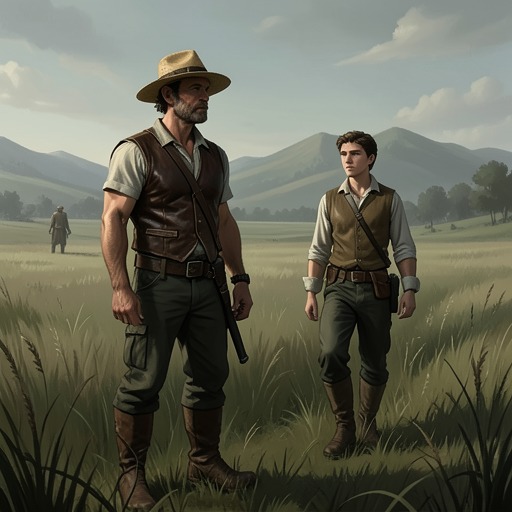
Phil’s conduct gives the social standard its most forceful expression. He despises what he regards as weakness and is particularly hostile to boys whose manner seems insufficiently masculine. The afterword situates that hostility beside Phil’s suppressed same-sex desire: rather than openly confronting what he knows about himself, he remakes himself as an unmistakably rough, capable rancher. His dirty appearance, damaged hands, deliberately informal speech, riding skill, and work braiding rawhide all reinforce a performance of cowboy masculinity. The persona does not merely distinguish him from Peter; it helps protect Phil from the possibility that others might judge him by the very standard he applies to them.
The afterword also cautions against reducing Phil’s cruelty to grief over Bronco Henry. His attachment to his former mentor helps illuminate the depth of his private conflict, but the account identifies his cultivated hardness and homophobic behavior as part of a larger effort to conceal his own desire in a ranch culture where such desire is treated as intolerable. His cutting remarks can therefore function as pre-emptive attacks: by ridiculing perceived difference in others, he directs scrutiny away from himself. The novel presents this strategy as both socially powerful and personally constraining.
Phil’s treatment of Johnny Gordon shows that his contempt is not limited to gender nonconformity. He humiliates Johnny, a doctor who is vulnerable to alcohol, and Johnny later dies by suicide. The novel and its afterword connect the humiliation to tragic consequences, while distinguishing Phil’s broader revulsion at weakness from his particular hostility toward Peter. This distinction keeps the pattern in view: Phil enforces a harsh hierarchy of masculine worth, and his treatment of different people takes different forms within it.
Peter on the ranch
When Peter arrives for the summer, Phil prepares the ranch hands to see him as an object of ridicule, describing his manner and his paper flowers. The prejudice thus moves beyond Phil’s private opinion: his stories set the terms on which the workers encounter the boy. During the roundup, Peter crosses the open space between the tents while Phil braids rawhide. A man whistles at him in a way associated with mocking a girl. Rose stiffens, and George is present, but neither intervenes; Phil recognizes that the workers look to him, rather than George, as the ranch’s authority. The scene makes the code public and collective: the taunt is heard by Peter and by the adults, and the people with standing to stop it do not protect him.
Peter nevertheless continues without pausing. Phil, who has helped prepare the men to mock him, notices the boy’s composure and acknowledges his courage. This response does not undo the humiliation or the failure of the household’s authority to shield Peter. Instead, it complicates Phil’s view of him: the boy whom Phil has tried to present as weak proves difficult to intimidate. The episode becomes one basis for Phil’s later interest in drawing Peter toward him.
Intimacy, manipulation, and the novel’s critique
Phil’s attempt to befriend Peter is inseparable from his hostility toward Rose Gordon Burbank. He imagines that a bond between himself and the boy could separate Peter from his mother, leaving Rose more isolated and increasingly dependent on alcohol. The plan turns masculine affiliation into a weapon: what might appear to be mentorship is also a means of exerting pressure within the family. Phil’s hoped-for closeness with Peter therefore carries the same contradiction as his larger performance—an intimacy he desires is pursued through a code that degrades the qualities he perceives in the boy.
The afterword describes the novel as treating a subject that was rarely discussed in its period: repressed homosexuality expressed as homophobia in a masculine ranch world. That reading gives the pattern a structural dimension without making every insult identical or excusing Phil’s actions. Schoolboys reproduce exclusion through group mockery; ranch hands test Peter against a public ideal of manhood; Phil turns that ideal into both armor and instrument of control. Peter’s steadiness exposes the limits of the performance: the person most fiercely policing masculine difference is also the person whose own concealed desire gives the code its intimate force.