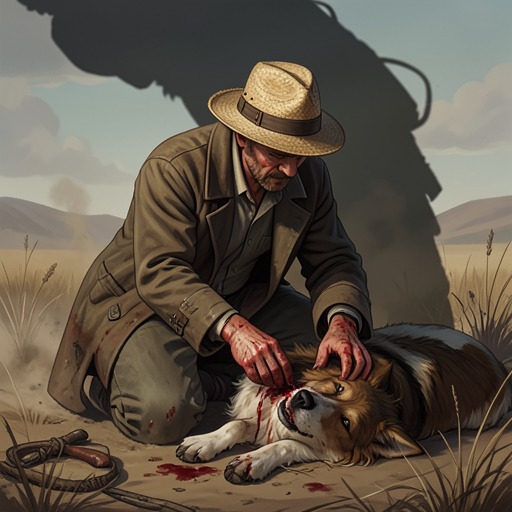
Johnny's confrontation with the rancher
The Power of the Dog (Thomas Savage Edition)Johnny's confrontation with the rancher is a turning point in the account of Johnny Gordon's relationship with his son, Peter Gordon. What begins as a complaint about Beech's neglected appearance becomes a conflict over Peter, and the encounter leaves Johnny struggling to speak plainly about what has hurt him. Its importance lies not only in the rancher's attack, but in the later admission that Johnny's concern for his son had been hidden even from himself.
Background and the dispute
Johnny has been pursuing what the narration calls the latest phantom in his mind: Beech's lack of civic pride. He presses the case that the schoolhouse should be painted, that trash should not be dumped on the hill for everyone to see, and that the beautiful countryside should not be desecrated. His complaints concern a shared public world, but their intensity also gives the rancher an opening to belittle him. The rancher responds by sending Johnny back to his little school and mocking the word Johnny has used for a flower, saying that it belongs on graves. The exchange turns a disagreement about the town's appearance into an attack on Johnny's education and standing.
The encounter takes place against a wider ranch culture in which physical toughness carries social weight. Ranch hands commonly protect their hands with horsehide gloves while roping, fencing, branding, and doing other work; Phil Burbank, by contrast, scorns gloves and the people who wear them. The ranch's work is organized around demanding seasonal labor: Phil oversees haying, equipment, irrigation, and the start of the cutting season, while the mowing-machine drivers handle hazardous equipment and receive extra pay for that work. These details do not establish the rancher's personal motives, but they show a world where strength, competence, and masculine reputation are publicly assessed. Johnny's dispute unfolds in the presence of that code, and the rancher uses it to make vulnerability and gentleness into grounds for ridicule.
The confrontation
The rancher moves from mocking Johnny to insulting both him and Peter. Johnny lunges in response, insisting that the rancher cannot call his son a sissy. The narration marks the choice as foolish in the immediate balance of power: the rancher is able to seize Johnny, shake him, and throw him against the opposite wall. The scene does not make Johnny's defense of Peter effective as a physical challenge. Instead, the rancher repeats the insult, while Johnny is left unable to continue the fight.
After a little while, Johnny gets to his feet and walks across the road toward The Inn / Red Mill. The movement away from the confrontation is quiet, and the surrounding town does not intervene. Magpies disturbed from feeding on a dead gopher cry as he passes. This brief detail sets Johnny's solitary departure beside the ordinary life of the place; the encounter has been public, but its immediate aftermath is his to bear. The rancher's remark has also shifted the argument away from civic pride. From this point, Peter's treatment is at its center.
What Johnny tells Rose
Later, Johnny acknowledges to Rose Gordon Burbank that his earlier explanation was false. He had claimed to be worried about Peter seeing him fight, but now says that this was not the truth. He suggests that he may be unable to endure the truth, then names what he had avoided saying: a good fighter, he reasons, could knock down someone who tears his shirt, knocks him against a wall, and calls his son a sissy. He closes his eyes after finally saying it.
The admission changes the meaning of the fight. Johnny's public complaint about Beech had seemed to be the subject, and his withdrawal from the encounter could be mistaken for simple defeat. His later words disclose that the insult to Peter had become the decisive issue, and that his concern about his son had shaped his response more deeply than his stated fear of being seen fighting. The disclosure does not undo the rancher's victory or make Johnny's lunge successful. It does, however, let Johnny identify the emotional stake he had concealed.
Aftermath and significance
Rose tends to Johnny after the confrontation, fixing a towel and watching him until he sleeps. She expects that he will ask for a drink when he wakes, and for the following days she carefully portions out enough alcohol for him to function. He does not ask for more than she considers necessary. Her practical care follows the confrontation into the home, where the consequences are not resolved by the public encounter's end but managed day by day.
During the next year Johnny does not drink. He also stops singing, loses flesh in his face, and becomes withdrawn, speaking to few people; the narration notes that no one calls him Johnny anymore. These changes follow in the account after the fight and its aftermath, though they do not establish that the confrontation alone caused them. Late one fall afternoon, Johnny returns from a trip into the hills behind town after delivering a woman of a dead child. The episode thus sits within a longer portrait of a man whose public humiliation, private admission, drinking, and work remain closely entangled. The confrontation matters because it makes Peter's place in Johnny's distress explicit: beneath the dispute over the town's neglected appearance is a father trying, ineffectively but unmistakably, to defend his son.