Liquor from the Burbank Cabinet
The Power of the Dog (Thomas Savage Edition)Liquor from the Burbank Cabinet moves from guarded household luxury to a hidden source of relief for Rose Gordon Burbank, and then to evidence of her secret drinking. Its locked doors and concealed key make the bottles more than provisions: they organize who may drink, who controls access, and what can be concealed inside the Burbank household.
A guarded household reserve
The liquor is kept behind the doors on either side of the buffet, locked away from the ordinary life of the valley. The key hangs hidden inside the china closet. Before the Old Gent leaves for Salt Lake City, he alone uses the key or touches the bottles, a restriction that makes the cabinet part of his authority over the household as well as a store of drink. The selection—Holland gin, Booths, House of Lords, and Chivas Regal—marks it as an unusually fine reserve, unlike the liquor available elsewhere in the valley.
For George Burbank, opening the doors after the Old Gent’s departure brings a small but telling feeling of emancipation. The bottles have been present but inaccessible; now George can handle and serve them. That change does not erase the cabinet’s inherited rules. Its hidden key and the Old Gent’s earlier control remain built into the arrangement, even as a new household use emerges.
Hospitality and changing conventions
The cabinet’s contents serve formal hospitality as well as private drinking. When George and Rose prepare for the Governor and his wife, George offers to make cocktails while Rose talks with their guests. He takes out gin and bitters, sets the bottles on a silver tray, and reaches for a monogrammed silver cocktail shaker of the sort exchanged by people like the Burbanks. The cabinet’s restricted contents thus become part of a carefully staged welcome, with the silver service making the act of pouring as socially legible as the drink itself.
The reserve also reflects a shift in expectations about women’s drinking. The Old Gent opposed women drinking and, like Phil Burbank, disapproved of women cutting their hair and generally acting up. Yet changing times had led him to provide a cocktail called an Orange Blossom for female guests; its recipe appears in the Bartender’s Manual of 101 Drinks, itself kept behind the little door. The cabinet holds both the old prohibition and its accommodation: women’s drinking is still bounded by the household’s rules, but hospitality now requires a drink for them too.
Rose’s secret access
After Rose begins suffering severe headaches, the locked cabinet becomes a private refuge. Remembering that Johnny Gordon once drank despite having vowed to stop, she takes the hidden key from the china cupboard, crouches at the small door, and pauses when she hears Lola on the stairs. When Lola passes into the kitchen, Rose takes whiskey, conceals it in the crook of her arm, and locks herself in the bathroom to drink. The secrecy is physical and laborious: she must manage the key, avoid being seen, and hide the bottle on the way to a closed room.
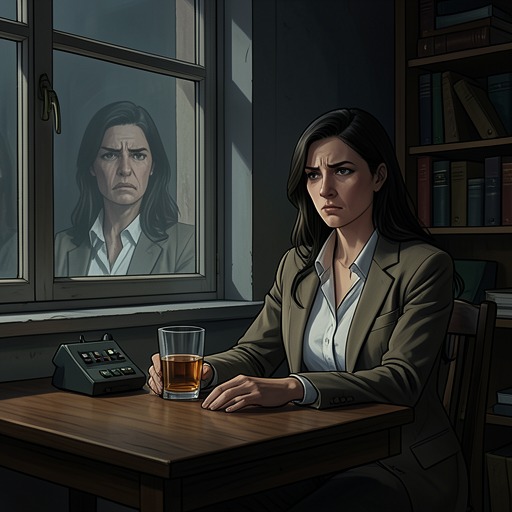
The drink brings immediate relief. Once she has drunk, Rose can look at herself calmly in the mirror; she compares her headaches with the pain of childbirth and finds them lasting and severe. After lunch, she replaces the bottle and locks the cabinet again, ashamed, and tells herself she will not return to it. But that resolve lasts only while the pain is absent. When the headaches recur, walks over Sagebrush Hill help at first, yet the daily prospect of meals with Phil—his silences, crudities, and disregard for her—makes the cabinet’s promise of relief harder to resist. Rose worries about watering the bottles so George will not notice what she has taken.
The concealment grows more deliberate as Rose looks for the courage to speak to Phil. Rather than risk watering the liquor again, she wraps a bottle in a towel and hides it in the bathroom clothes hamper, reasoning that George will not miss one bottle and promising herself she will replace it. She also tells herself that, once she has spoken with Phil, she will confess the theft to George. On the morning of that conversation, she has three drinks over the course of the morning and masks the odor with a mint. She keeps her distance from Peter when he comes downstairs, while the drink leaves her feeling calm enough to face the encounter.
Discovery and household conflict
Phil knows that Rose has been drinking from George’s supply. When he tells her that he dislikes her, he names her access to the liquor as one reason, accusing her of being a schemer who gets into George’s booze. The accusation confirms that her private strategy has not kept the act private. The cabinet has let Rose take the drink without asking, but it has not given her control over who notices or how her use will be interpreted.
Later, Phil’s perspective makes his surveillance explicit: he has checked the bottles, seen that Rose watered them, and knows she has taken a couple. He even wagers that he could find where she has hidden them, and waits for her to expose herself. The same locked reserve therefore supports two competing kinds of secrecy: Rose’s attempt to hide her drinking and Phil’s patient observation of it. In the household’s strained relations, the bottles become a means by which he can accuse and humiliate her.
Significance
The liquor’s meaning changes with access. Under the Old Gent, the locked cabinet enforces a rule; with George, it becomes an instrument of hospitality and a sign of limited release from that rule. For Rose, it is first a concealed remedy for pain, then part of a cycle of relief, shame, concealment, and renewed need. The hidden key, diluted bottles, and missing liquor give material form to pressures she cannot openly resolve. What appears to be a household luxury becomes an intimate source of conflict because the cabinet makes drinking possible while keeping it exposed to judgment.