Paper Flowers
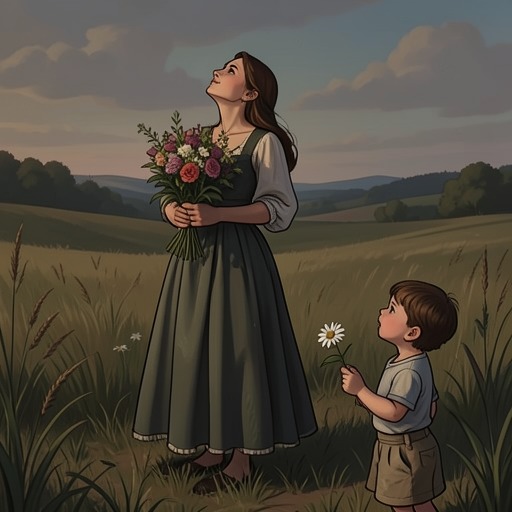
The Power of the Dog (Thomas Savage Edition)Paper Flowers are handmade decorations that carry the knowledge and care of Peter Gordon and his mother into the winter months. They begin as a practical answer to the absence of fresh flowers, but acquire a sharper significance when Phil Burbank singles them out at a Beech table in 1924 and uses them to provoke Peter. Their movement from the family’s winter table to a public scene of mockery makes an ordinary craft object a measure of who recognizes its work and who chooses to belittle it.
Materials and Winter Use
The flowers belong to two related practices described by Johnny Gordon. In fall, his wife and Peter go onto the flats outside town to gather plants that other people might call weeds. They dye these gathered plants so that flowers remain available through winter, when, as Johnny points out, there are no fresh ones. The work turns overlooked growth into a seasonal decoration and keeps the family’s table furnished beyond the flowering season.
Paper Flowers are a separate, additional form of that winter provision. Johnny explains that Peter twists crepe paper into artificial flowers, which are placed on the dinner table during the winter months. The distinction matters: the dyed plants are gathered and transformed, while the paper posies are made directly from a manufactured material. Both practices depend on labor and ingenuity, and both preserve the appearance of flowers when natural blooms are unavailable. Johnny presents the paper work alongside Peter’s study of anatomical drawings and demanding reading, insisting that the boy’s manual skill and intellectual ability belong together.
The flowers therefore arrive in the story not as precious ornaments but as useful, made things with a domestic purpose. Their importance rests partly in their repeatable presence: they help the family sustain a floral table through a season in which the surrounding landscape cannot provide fresh flowers. Johnny’s account also connects them to his wife’s expertise, since she taught Peter how to make them and has a particular aptitude for flowers.
The Flowers at the Beech Table
The object returns at a roadside eating place where George Burbank and Phil arrive with their party. Paper flowers stand on a table in a bottle painted so that it will not look like a milk bottle. The room also has candles set in old wine bottles, making its decorations visibly improvised from ordinary containers. For Phil, the paper flowers are conspicuous enough to draw attention amid the unfamiliar company and the table settings he already regards with contempt.
At a festive table in Beech, around eight on a fall evening in 1924, Phil reaches across and lifts the flowers from the painted bottle. His action brings the decoration out of its ordinary role as part of the table setting and puts it on display. He asks who made the pretty posies and leans toward them as if to smell them. The performance turns a small decoration into an invitation for the others to watch how Peter will respond.
Peter does not blush. He crosses over and says that he made the flowers and that his mother taught him; he adds that she has a way with flowers. His answer supplies the object’s history in the moment when Phil has tried to make it seem merely ridiculous. It also shifts the exchange from an anonymous ornament to evidence of a particular relationship and a learned skill.
Handling and Humiliation
After Peter identifies himself as the maker, Phil elaborately puts the flowers back and pretends to arrange them. He offers an apology while winking broadly at the company. The gesture does not undo the provocation: returning the object becomes another part of the performance, and the wink makes clear that the apology is directed as much to the watching audience as to Peter. The flowers remain on the table, but their handling has made them the center of a social test.
The episode sets Peter’s composure against Phil’s attempt to control the meaning of his work. Peter’s answer is direct and attributes the craft to both his own making and his mother’s teaching. Phil, by contrast, treats the flowers as props for teasing, first lifting them and then arranging them theatrically. The contrast gives the paper posies a role beyond decoration: they disclose Peter’s practical ability and family connection while exposing the contempt with which Phil approaches them.
Significance
Paper Flowers connect seasonal resourcefulness with the family’s everyday life. Their handmade form extends the mother’s knowledge through Peter’s hands, and their place on the winter dinner table gives an artificial object a steady domestic use. In Beech, the same kind of decoration appears in a public eating place, assembled among repurposed bottles and candles. The recurring object thus moves between family practice and public display without losing its modest, handmade character.
The flowers’ significance changes with the way they are seen. Johnny treats them as proof of what Peter can make; Peter identifies them plainly as his work and names his mother as his teacher. Phil handles them as an occasion to embarrass the boy. Their artificiality does not make them empty or meaningless: their materials carry the time, instruction, and care invested in them, even when Phil’s performance tries to reduce them to a joke. In that brief exchange, a small table ornament makes the difference between making something with care and using it to diminish someone visible.