Peter Gordon
The Power of the Dog (Thomas Savage Edition)Peter Gordon is the son of Johnny Gordon and Rose Gordon Burbank, a delicate, observant boy whose reserve masks a fierce independence. His life is shaped by exclusion and by a private habit of turning what he sees into knowledge: first in the scrapbook through which he imagines a different future, and later in the medical learning that enables him to protect his mother and kill Phil Burbank. The apparent intimacy between Peter and Phil is therefore both a relationship and a screen for Peter’s purpose.
Identity and Early Life
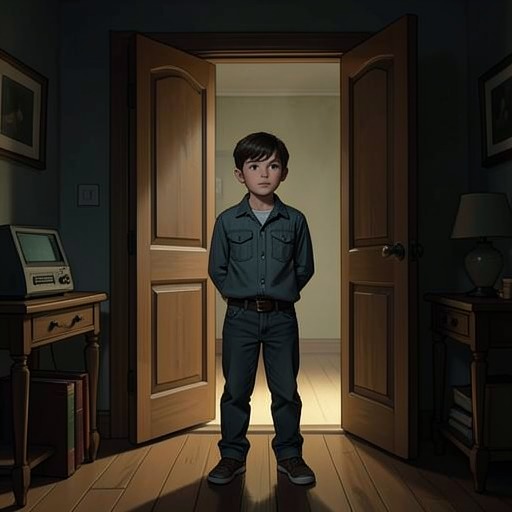
Johnny delivered Peter himself and shared the wonder of his birth with Rose, caring for her and reading Byron at her bedside. They named their son Peter after Rose’s father, whose own name had been shortened to Pete. From the beginning, Peter’s development differed from what his parents expected. He walked and spoke late; when he did, his gait was stiff and his measured speech carried a slight lisp. By four he could read. The recurring cycle of poppies blooming and dying marks the passage of his early years, while his parents quietly worry over his development.
Illness made Peter physically frail through childhood, and he did not complain or demand attention. Instead, he learned early what it meant to be an outsider. He preferred books and solitude to ballgames, and sunlight troubled his eyes. At night, after Beech had gone dark, he liked to leave the house; when Rose or Johnny asked what he had been doing, he answered that he had done nothing. That silence establishes a pattern: Peter keeps important parts of his inner life beyond the reach of even those closest to him.
Private Worlds and Ambition
At school, Peter faced taunts and jibes. The experience did not make him seek acceptance on the other boys’ terms. Watching classmates who seemed richer, more secure, or more socially confident, he decided that he would oppose them according to his own standards. His hostility extended beyond particular tormentors to those who might insult the private image he had formed of his family.
That image took material form in a scrapbook assembled from photographs, drawings, and advertisements in old magazines, including Town and Country, International Studio, Mentor, and Century. Peter selected pictures of ocean liners, trains, jewels, country houses, fine luggage, and fashionable automobiles. Yet the book was not simply a catalogue of wealth. Its figures suggested imagined versions of his parents: Rose in a cultivated landscape, Johnny welcomed at a grand hotel. Against the family’s poverty and the wind that seemed to surround their lives, the scrapbook became Peter’s blueprint for a future in which he would be a great surgeon and his parents would be admired for their own qualities.
He also built a more practical refuge in a shed attached to The Inn / Red Mill. Shelves there held Johnny’s medical books, alongside Peter’s specimens, beakers, and other scientific equipment. The shed offered an escape from the daily hostility of school and a place to pursue his own interests. Peter’s attention to medicine and natural life was patient and exact; the afterword also notes his curiosity about wild plants and his detailed drawings of their leaves and roots. His father’s library thus becomes more than an inheritance of objects: it is the source of knowledge that eventually gives Peter the means to act.
Family and the Move to the Ranch
Peter’s bond with Rose is affectionate but unusually formal. He calls her Rose rather than Mother, and his speech often sounds stilted. After Johnny’s death, Rose remains the central figure in the imagined world Peter has preserved in his scrapbook. When she considers marrying George Burbank, Peter understands that the marriage would give her something she deserves. He does not regard George as a rival; Rose’s happiness matters more to him than keeping their lives unchanged.
That understanding does not make their later separation easy. When Rose moves to the Burbank ranch while Peter stays in Herndon for school, the distance leaves her exposed to the household’s tensions and to Phil’s hostility. Peter eventually joins her at the ranch, where Phil’s attention shifts from antagonism toward a show of mentorship. Peter notices Rose’s drinking and recognizes that it is new, but he does not openly challenge her or reveal all he knows. As in childhood, silence gives him room to observe while withholding his own intentions.
Phil Burbank and the Appearance of Trust
Phil approaches Peter through shared work, stories of Bronco Henry, and demonstrations of skills associated with ranch life. During a lunch break beside a stack of old poles, Phil draws Peter’s attention to a Cottontail rabbit and turns the animal’s presence into a test of patience. When the poles collapse and the rabbit is hurt, Peter picks it up while Phil treats the incident as a lesson in toughness. The episode exposes a contrast in their ways of looking: Phil makes suffering serve his philosophy of endurance; Peter responds to the animal directly and quietly.
Phil also asks Peter to see the running dog in the distant hillside. Peter says he had seen it when he first arrived. The answer unsettles Phil, who had associated this way of seeing with Bronco Henry. Peter’s perception gives Phil a sense of recognition and helps deepen the connection between them, but it also shows that Peter has been watching the landscape and its people from the beginning.
Their growing closeness becomes more evident when Phil speaks to Peter about Rose’s drinking. Peter’s reaction shows that the subject affects him, while his admission that Rose did not used to drink confirms his awareness of the change. Later, he touches Phil’s arm and says he has cut rawhide to finish the rope Phil is making. Peter’s gesture and request appear to affirm Phil’s teaching and kindness. Phil accepts the rawhide and promises to finish the rope; Peter watches as he works despite a fresh wound on his hand. To Phil, this is a moment of trust. The reader, however, has already been given reason to understand that Peter’s attention to Phil’s hand and the hide has another consequence.
Knowledge, Purpose, and Ending
Peter’s decisive advantage is his ability to join observation to medical knowledge. One August afternoon, he learned from Johnny’s medical books that anthrax, called blackleg locally, can pass from an infected animal to a person through a cut or break in the skin while handling a diseased hide. Phil, working with rawhide despite his wounded hand, supplies the circumstance that makes this knowledge consequential. Peter’s actions lead to Phil’s death from anthrax.
The ending also recasts the emotional meaning of Peter’s apparent dependence on Phil. Phil believes he is drawing the boy into a future of shared skills and protection; Peter has his own concealed plan. The afterword describes this as a chilling reversal of the balance between them: the man who had bullied and manipulated others does not understand the danger approaching through the intimacy he welcomes. Peter’s calm reserve, long presented as a response to isolation, proves compatible with deliberate action.
After Phil’s death, Peter considers the words from the Book of Common Prayer about deliverance from the power of the dog as a final addition to his scrapbook. The thought joins the book’s earliest function—preserving an imagined future for his parents—to the outcome he has made possible. He understands Rose as delivered, and recognizes that this has come through his father’s sacrifice and the knowledge preserved in the medical books. Peter’s ending is therefore not a simple escape from vulnerability: the boy who once built a private world against rejection has become its quiet author, protecting his mother through a plan almost no one around him could see.