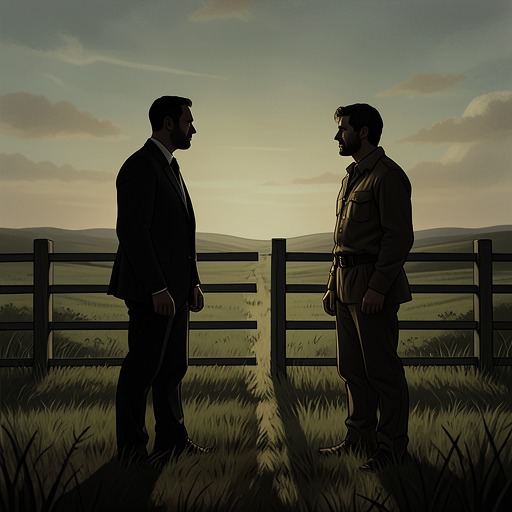
Phil Burbank–George Burbank: Sibling Tension After George Marries Rose
The Power of the Dog (Thomas Savage Edition)Phil Burbank and George Burbank are brothers, business partners, and companions since childhood, but their shared life rests on a marked difference in temperament and work. For years they divide the running of the Burbank Ranch between them and even share a bedroom by tradition and habit. That arrangement is disrupted when George secretly marries Rose Gordon Burbank. Phil’s resentment of the marriage turns the brothers’ old balance into open strain: George has made a life with Rose, while Phil directs sustained hostility at his new sister-in-law.
Shared Background and Daily Life
The brothers run the Burbank Ranch in southwestern Montana after their parents, The Old Gentleman Burbank and The Old Lady Burbank, retire to a hotel suite in Salt Lake City. The elder Burbanks are wealthy easterners who had maintained a comparatively luxurious life on the ranch. Their departure followed an undescribed conflict with Phil, leaving the two sons to manage the operation. At the story’s opening in 1924, Phil is forty and George is thirty-eight; they continue to share a bedroom as they have since childhood, a closeness presented as the product of long habit as much as choice.
Their different temperaments shape the atmosphere of ordinary routines. George is a heavy sleeper and, even in earlier years, tends not to appear at meals until the others are seated and eating. Phil’s morning energy contrasts with George’s quiet, and George’s silence can become contagious. Phil sometimes grows irritated with his brother and needles him. The teasing is a small but recurring sign of their intimacy and imbalance: Phil is the more forceful presence, while George’s steadiness does not prevent him from being the target of Phil’s impatience.
A Partnership Divided by Work
The ranch’s scale makes the brothers’ division of labor essential. George keeps the books, deals with buyers and bankers, writes letters, answers the telephone, maintains the Reo, and handles meetings that include those with the governor. Phil oversees the hands-on work: haying, roundups, ranch labor, and trailing cattle to the railroad. The contrast places George in charge of business and administration and Phil in charge of the daily physical operation of the spread, including work among the cowboys.
Haying shows how much practical responsibility falls to Phil. He inspects and repairs eight mowing machines, four John Deeres and four McCormack-Deerings, as well as six buck rakes, six sulky rakes, two derricks, and the cookshack and dining shack, which are small buildings dragged from camp to camp on sledges. He also has twelve canvas tents brought out and checked for tears, directs the early-summer diversion of water from the main creeks for irrigation, watches the hay’s growth, and sets the start of haying for as soon as possible after the Fourth of July. The sequence of tasks makes Phil’s role more than a performance of cowboy identity: the ranch depends on his planning, inspection, and oversight of a large seasonal workforce.
The labor he supervises is dangerous as well as organized. Mowing-machine drivers work with a seven-foot cutter bar whose sliding sections can cause severe accidents; the men sharpen the bars after work and receive extra pay and privileges for their risk and skill. The ranch hands’ work also includes roping, fencing, branding, pitching hay, and riding. Most protect their hands with gloves, but Phil refuses them, scorns their use, and accepts blisters, cuts, and splinters. This difference captures a broader contrast in the brothers’ relationship to ranch life: George manages its business structure, while Phil’s authority and self-image are bound to direct labor and physical endurance.
Temperament and Standing Among the Hands
George is phlegmatic, slow to learn but possessed of a good memory. He feels sorry for people, does not readily blame them, and speaks little. Phil is described in contrast as volatile and cruel, while George is steady and kind. These contrasts can make the brothers seem like simple opposites, but their characterization resists that reduction: the apparent pairing of good and evil, weak and strong, or normal and peculiar does not fully account for either man.
Phil takes pride in his rapport with the cowboys and believes George makes them uncomfortable. The distinction matters to their partnership because it suggests that their authority is not interchangeable. George’s responsibilities place him among buyers, bankers, and the ranch’s business affairs; Phil spends much time in the bunkhouse with the hands, recalling the older ideal of ranch workers as real men and invoking Bronco Henry as its leading example. The brothers operate the same enterprise, but they inhabit different social worlds within it. Phil’s confidence among the hands does not erase his dependence on George’s management, just as George’s business authority does not give him Phil’s standing in the ranch’s laboring community.
George’s Marriage and the Brothers’ Rupture
The decisive change comes when George takes an interest in Rose Gordon Burbank, a doctor’s widow, and secretly marries her. His choice is a departure from the brothers’ established shared domestic life. George and Rose move into the large master bedroom previously used by their parents, while Phil resents the marriage and views Rose as a schemer seeking Burbank money. That judgment sets the terms of his hostility, but the evidence establishes his suspicion as Phil’s perception, not as a fact about Rose’s intentions.
After the marriage, Phil devotes himself to making Rose’s life difficult through repeated mocking and covert acts. His treatment of her eventually drives her to drink in secret. The resulting pressure falls on the new household George has formed, and therefore tests his longstanding partnership with Phil as well. The brothers’ conflict is not described as a single break or a formal end to their business; instead, the marriage exposes how fragile their old arrangement has become. Phil’s resentment is directed at Rose, but it originates in a change George has chosen and cannot simply absorb back into their childhood pattern.
Significance of the Relationship
The brothers’ relationship is built from both dependence and asymmetry. Their shared bedroom, inherited routines, and joint management bind them together, while their sharply separated duties let each exercise a different kind of authority. Phil’s teasing of George belongs to the ordinary intimacy of that arrangement; his reaction to the marriage reveals its limits. George’s new commitment to Rose alters the household, and Phil answers that alteration not by accepting a changed family structure but by making Rose its target.
The contrast between them is consequently more than a simple opposition of personalities. George’s steadiness and sympathy coexist with his capacity to make a consequential choice that Phil resents; Phil’s practical competence and recognized standing among the hands coexist with cruelty toward those he sees as intruding on his domain. Their partnership can sustain the ranch’s division of labor, but it cannot prevent conflict when George’s marriage changes the terms of their shared life. The strain after the marriage brings the brothers’ underlying arrangement into view: long familiarity has held them together, yet it has never meant that they want the same kind of life.