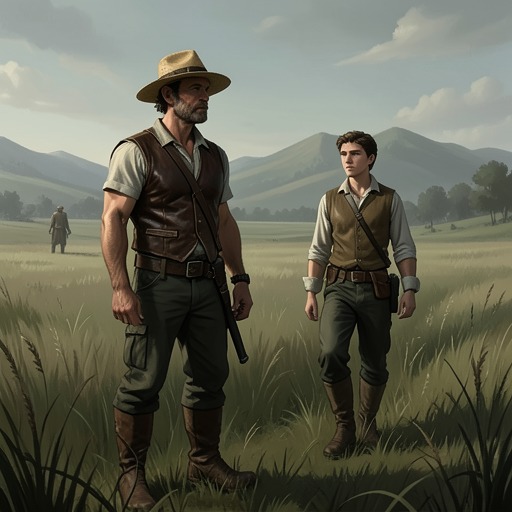
Phil begins befriending Peter and promises him a lariat
The Power of the Dog (Thomas Savage Edition)Phil Burbank begins courting Peter Gordon’s friendship at the hay camp, where the boy’s steady passage through the ranch hands’ mockery catches Phil’s attention. He promises Peter the lariat he is braiding and offers to teach him ranch skills. The gesture is not simple generosity: Phil intends to win Peter away from Rose Gordon Burbank, and he sees the rope as a bond that can serve that purpose. Peter smiles and returns to the wagon, leaving the new connection tentative but established.
Circumstances and Setting
The encounter takes place amid the seasonal labor organized by Phil. While George Burbank handles the books, buyers, letters, telephone, and ranch vehicle, Phil directs the practical preparations for haying: he inspects and repairs the machinery, checks the tents and equipment, oversees irrigation, and decides when cutting will begin. He aims to start as soon as possible after the Fourth of July. The scene therefore unfolds in a camp structured by Phil’s authority and expertise, not in a neutral setting for a private conversation.
Haying also gathers workers whose lives are governed by the season. Before the long stretch of labor, the men recall the Independence Day celebrations in Herndon, including the band, rodeo, and fireworks; some return to the ranch after being jailed overnight for disorderly conduct or vagrancy. In the camp, the mowing-machine operators hold a distinct place. Their equipment is dangerous, their work demands care, and their skill earns them extra pay, newer tents, and first choice of the meat. This hierarchy helps explain the social world Peter crosses: the open tents are occupied by men accustomed to being heard and deferred to.
Peter Crosses the Camp
Phil first sees Peter looking toward a willow where Magpies have built a nest. The boy starts across the open space, apparently to investigate it. As he passes the tents, the stiff denim of his overalls and his slight, feminine movement draw the men’s attention. One whistles at him in the manner used to taunt a girl. Rose Gordon Burbank, standing apart while George Burbank speaks with the cook, stiffens at the sound.
Peter does not pause or falter. He appears not to hear the men, and once past them he looks up toward the nest and the young birds. Phil registers both the insult and the boy’s composure. His response is double-edged: he believes the ranch hands’ scorn makes Peter vulnerable in this environment, yet he also credits the boy with uncommon courage for continuing without giving them the reaction they sought. The moment is thus both a public humiliation and, in Phil’s reading, an opening for a different kind of approach.
Phil Turns Observation into a Plan
Phil does not understand Peter’s conduct as a reason to leave him alone. Instead, he imagines that the boy would welcome friendship with a man and wonders whether he can draw Peter away from his mother. He also anticipates that Rose Gordon Burbank, feeling deserted, will depend more heavily on alcohol. The plan joins two aims: to gain Peter’s attachment and to deepen Rose’s isolation. The scene makes clear that the promised kindness is calculated, even as Phil’s admiration for Peter’s nerve appears genuine.
At that moment Phil is braiding rawhide strips. The work fits his practiced relationship to ranch labor: he is known for leaving his hands unprotected while other men wear gloves for tasks that risk rope burns, splinters, cuts, or blisters. His hands are described as powerful and lean, and their dexterity lets him keep working while watching Peter. As the idea takes hold, he sees the unfinished rope not merely as equipment but as the means by which he can begin to win the boy over. He imagines it as a bond between them, turning an ordinary act of craft into the instrument of a personal design.
The Promise and Its Immediate Effect
Phil raises the new rope and calls Peter’s attention to it. When Peter addresses him by his first name, Phil treats the change in address as a small success. He promises to finish the rope and give it to Peter, and offers to teach him to rope and ride. He presents the ranch as a lonely place where Peter might as well learn to join in. The offer is practical on its surface: it proposes instruction in skills associated with the work around them. But Phil’s private purpose gives the promise a second meaning. The lariat is both a useful gift and a means of securing a relationship.
Peter smiles at Phil and walks back toward the wagon. The response is limited but important: the boy accepts the exchange warmly enough to smile, though the scene does not establish that he knows Phil’s intention or has decided to turn from his mother. Phil, by contrast, reads the encounter as the beginning of the separation he wants. The gap between Peter’s simple response and Phil’s elaborate plan leaves the friendship unsettled from its first moment.
Narrative Significance
The episode turns on a reversal in Phil’s attention. He has just watched the men subject Peter to ridicule; rather than join them, he recognizes the boy’s composure and converts that recognition into an offer of companionship. Yet the contrast between public cruelty and private tenderness does not make the latter uncomplicated. Phil’s proposed friendship is bound to his hostility toward Rose Gordon Burbank, and he explicitly imagines her drinking worsening as Peter draws away.
The rope concentrates that ambiguity. It belongs to the material world Phil commands—rawhide, skilled hands, ranch work—but he assigns it an intimate purpose as a tie between himself and Peter. His promise can be understood as a genuine invitation to learn, a calculated act of persuasion, and both at once. Peter’s smile gives the scene its small outward movement toward connection; Phil’s concealed design supplies its threat. The encounter establishes the lariat as the object through which Phil will try to turn a moment of recognition into influence over Peter.