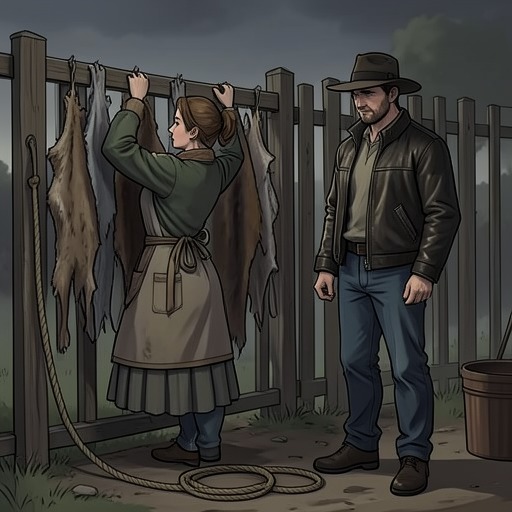
Phil uses the rawhide rope he is making to befriend Peter
The Power of the Dog (Thomas Savage Edition)Phil Burbank’s attempt to befriend Peter Gordon begins with a rope in his hands and a plan in his mind. Watching Peter endure the ranch hands’ scrutiny without retreating, Phil sees an opening: he can offer the boy instruction and companionship, while trying to loosen Peter’s attachment to Rose Gordon Burbank. The rawhide rope becomes both a useful gift and the instrument of this double-edged approach.
Setting and First Impressions
The encounter takes place amid the open tents of the haying camp. Peter, whom Phil privately calls Little Lord F., stands beside his mother, then crosses the space toward a willow where Magpies have built a nest. The boy’s stiff new overalls and white tennis shoes mark him as out of place in the working camp; Phil notices his movement and the slight sway of his hips, which provokes the men’s attention.
As Peter passes the second tent, one of the ranch hands whistles at him in the manner used to attract a girl. Rose watches from a short distance away and stiffens. Phil interprets the whistle as a warning of the contempt Peter will face for seeming unlike the men around him. Yet Peter does not pause or falter. Once beyond the tents, he turns his attention to the nest and the young birds in the willows, apparently undeterred by the men watching him.
Phil’s response contains both judgment and respect. He considers the boy’s willingness to cross the exposed space a kind of courage, even as he describes Peter’s manner in terms shaped by the ranch’s rigid expectations of masculinity. That combination—contempt for what he sees as feminine and admiration for Peter’s composure—helps explain why Phil’s approach is not simple kindness. He sees a quality in Peter that interests him, but imagines friendship as a way to draw the boy into his own world.
The Rope as an Opening
While watching Peter, Phil continues braiding and plaiting strips of rawhide, lifting each strip to let it drain. His hands can keep working while his eyes follow the boy across the clearing. The rope is not yet finished, but Phil suddenly understands it as more than a piece of ranch equipment: it can give him a reason to speak to Peter and a concrete way to invite him closer.
Phil’s plan has a second target. He imagines that if Peter turns toward him, Rose will feel deserted and rely increasingly on alcohol. He also predicts that her drinking will bring an earlier confrontation with George Burbank, who, in Phil’s forecast, will recognize it as evidence that he has failed to make his wife happy. These are Phil’s expectations, not an account of events already brought about by the offer. They reveal how readily he makes Peter’s companionship serve a campaign against Rose as well as a possible bond between the two men.
The rope thus carries a calculated promise. Phil thinks of it as the bond that can begin the courtship of Peter’s friendship, and pauses over the work when that idea takes hold. The gift will be practical—something Peter can use to learn ranch skills—but Phil also invests it with the possibility of changing who Peter turns to for attention and instruction.
From Hostility to Invitation
Phil makes the first approach by lifting the new rope for Peter to see. He acknowledges that the two of them began on the wrong foot, a brief admission that recognizes their earlier antagonism without detailing or undoing it. He then tells Peter that he will finish the rope and give it to him, and offers to show him how to use it.
The offer is framed in terms of Peter’s future on the ranch. Phil proposes that he learn to rope and ride, presenting those skills as a way to enter the rhythm of a lonely place. When Peter calls him Phil, Phil treats the familiar address as a small breakthrough and points it out approvingly. The boy smiles and walks back to the wagon. It is a modest response, but it shows that the invitation has reached him: the exchange moves beyond the initial hostility, even though it does not establish that Phil’s larger design will succeed.
A Growing Companionship
Phil does not finish the rope as soon as it is nearly complete. With only a short length left before it could receive a crown knot or a Turk’s head, he continues braiding and molding it, coming to look forward to Peter’s presence while he works. The rope’s unfinished state allows their conversations to recur. Peter listens as Phil tells stories of earlier days, and Phil finds him so absorbed that the boy seems temporarily transported by the past.
Their relationship develops through practical instruction as well as storytelling. Phil teaches Peter to ride and gives him a gentle bay horse. They ride together into the fields, where Peter helps build pole fences around the haystacks. At noon they share deviled ham sandwiches and apples while Phil tells stories about Bronco Henry. Phil later speaks of the pair as having spent an enjoyable fall together; the evidence makes clear that he, too, enjoys their time.
This later companionship gives the initial gesture a consequence beyond the rope’s promised use. Peter is no longer merely the boy Phil watches cross the camp: he becomes an audience for Phil’s account of the past and a participant in ranch work. Their closeness grows through repeated, ordinary activities—riding, fencing, eating, and listening—rather than through a single dramatic reconciliation. Phil’s calculated wish to draw Peter away from Rose remains part of the episode’s meaning, but it does not cancel the pleasure he takes in Peter’s company.
Significance of the Approach
The episode turns a craft object into a means of relationship. Phil’s skill at braiding the rawhide gives him an offer suited to the ranch world he commands, while his teaching allows him to present companionship as practical preparation for life there. The rope is therefore at once a tool, a gift, and a deliberate point of contact.
The approach also exposes the tension in Phil’s idea of friendship. He recognizes Peter’s resilience in the face of the men’s ridicule and makes room for the boy beside him; at the same time, he imagines that this attachment will isolate Rose and worsen her drinking. The later scenes show a genuine mutual routine forming, but they do not erase the strategic intention with which Phil first conceived the bond. His offer opens a real connection and a contest over Peter’s loyalties at the same time.