Reservation travel-permit requirement
The Power of the Dog (Thomas Savage Edition)The Reservation travel-permit requirement makes departure from the reservation subject to official permission, turning movement beyond its boundaries into an administrative privilege rather than a free choice. Its force in the story comes not only from the rule itself but from the conditions around it: Indigenous people have been removed from their land, permits are narrowly granted, and Edward Nappo and his son find that ancestral ties do not open the way back. Their journey exposes the distance between a recognized history of belonging and the power to act on it.
The Rule and Its Administration
The reservation’s rules govern more than travel. The agent is expected to enforce them, at least at times when men from the Department of the Interior arrive. The qualification matters: enforcement is presented as something applied with discretion, not as an impersonal procedure operating identically in every circumstance. Yet the existence of official discretion does not give those subject to the rules meaningful freedom. The agent may decide when to enforce them; residents still face restrictions imposed from outside their community.
Leaving without a permit is expressly prohibited, and permits are issued only for what the authorities regard as pressing reasons. The stated rationale for the restriction is that Indigenous people have nowhere to go and no friends who will shelter them, so applications are said to arise seldom. This reasoning folds the consequences of dispossession into a justification for continued confinement: lack of access to land and shelter is treated as a reason to limit movement, rather than as an injury the policy might address. The rule therefore controls travel while the social conditions surrounding it help make travel seem unnecessary or impossible.
Other restrictions clarify the broader system in which the permit requirement operates. Alcohol is prohibited, with the rule defended through a racialized assumption about Indigenous people’s capacity to drink. Firearms are forbidden on the grounds that meat is distributed through the government store. Edward Nappo nevertheless keeps a small rifle inherited from his father, the last possession of his father’s that escaped the customary burning after his death. These provisions regulate access to movement, goods, and resources; they place daily life under official oversight even as the government presents its controls as practical arrangements.
Dispossession and the Journey Home
The travel restriction follows the forced removal of the valley’s Indigenous people to the reservation. The government has ceased to treat treaties as a meaningful basis for bargaining, because land has become too valuable and the authorities have less reason to fear Indigenous resistance than to fear white voters. Edward Nappo’s journey is thus not simply a visit to a distant place. It takes place after a political decision has severed people from land that carries family and ancestral meaning.
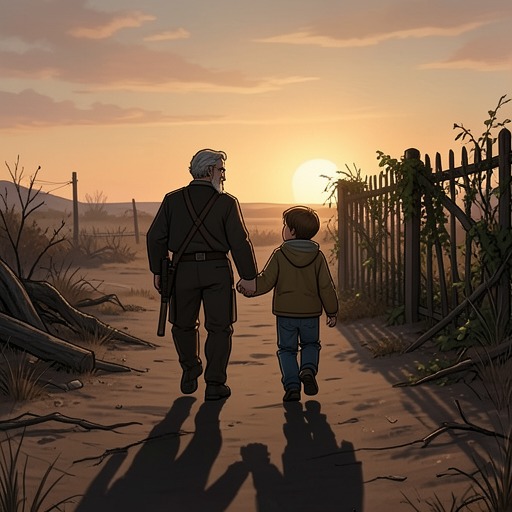
When summer comes, Edward decides to make the journey with his son. He has promised himself and the boy that they will go if their cow survives, and they leave before daybreak without reporting their plans to the agent. Edward believes that doing so might bring trouble. His decision to go anyway reflects the limited choice available under the permit system: seeking permission risks intervention, while leaving without it makes the trip vulnerable to obstruction once they reach a boundary controlled by someone else.
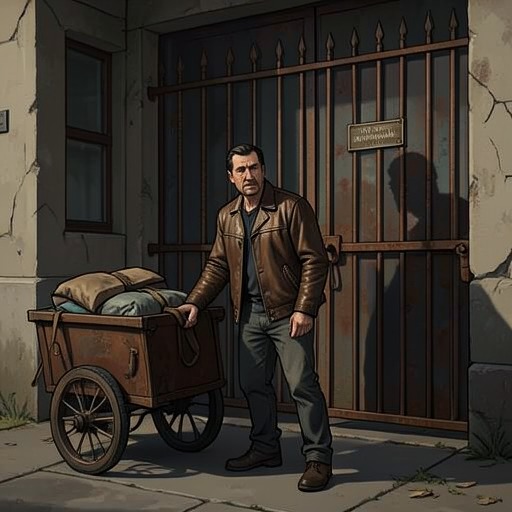
Their preparations and slow progress give the undertaking its material scale. They carry food, including canned beans, canned corned beef, and hard crackers. Because their horse is old, they walk unless dust on the road signals an approaching automobile, when Edward thinks it appropriate to ride in their worn cart. The boy’s school shoes are put away in the cart, and his cap has been padded with newspaper so that it will fit. Edward tells his son that the mountains are three days away. The journey is measured in days, a tired horse, and the possibility of passage—not in the abstract language of permits and official categories.
The Gate and the Refusal
The pair eventually reach a gate Edward cannot remember. At this point the reservation travel-permit rule meets another kind of boundary: the gate is guarded by Phil Burbank, who steps between Edward and the way forward and demands to know where they are going. Edward explains that he and his son want to camp for a few days. He identifies his father as a chief, making family history and inherited standing part of his appeal.
Phil rejects that claim as a reason to let them pass and orders them to turn back. Edward tries to pay for a short stay with a box of gloves, but Phil refuses the offer and says he does not take bribes. The exchange shows that Edward’s obstacle is not merely paperwork. Even the account of his father’s position, and an attempted payment, cannot overcome the authority asserted at the gate. The travel restriction and the private refusal are distinct forms of control: the first governs departure from the reservation, while the second blocks this particular attempt to continue. Together they leave Edward and his son without a route to the place they have come to see.
Edward returns with his son toward the reservation, about two hundred miles away, worrying whether the old horse can make the journey and what will become of the cart if it cannot. He does not look at the boy as he explains that there was nothing he could do. Still, he tells him that they have seen the mountains of his father. The journey ends in retreat, but that statement preserves a limited achievement: they reached the sight of the ancestral landscape even though they could not remain there.
Significance in the Story
The rule’s effects are clearest in the contrast between Edward’s understanding of ancestry and the authorities’ power over movement. He hopes his son will believe that their family name is honored in the country and might open gates. At the actual gate, that hope fails. His father’s status, the boy’s presence, and Edward’s payment do not secure passage. The incident makes the promise of recognition painfully conditional: memory can identify a home, but it cannot by itself restore access to it.
The return journey also prevents the permit requirement from remaining a remote regulation. The story connects administrative limits to concrete decisions—leaving before dawn, avoiding notice, walking beside an old horse, and turning back over a long distance. Later, Rose Burbank sees the Indigenous cart on the road: its occupants move between walking and riding, continuing their way after the failed attempt. The image underscores that the restriction reaches beyond the moment at the gate. It shapes where people may go, how they travel, and the terms on which a return to ancestral land can even be attempted.