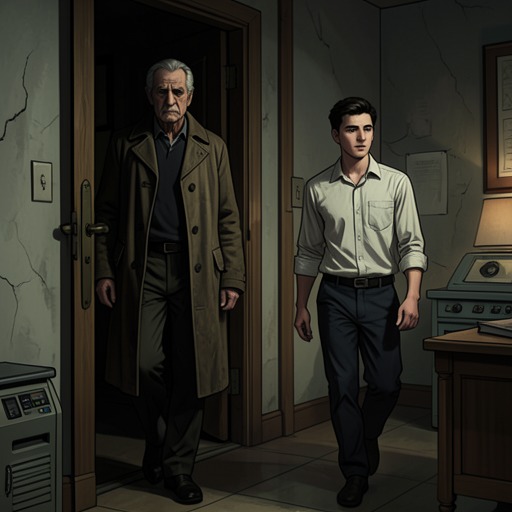
Rose Gordon–Peter Gordon: Peter’s Effort to Protect His Mother
The Power of the Dog (Thomas Savage Edition)Rose Gordon Burbank and Peter Gordon are joined by a watchful, protective mother–son bond tested by Rose’s secret drinking and the hostile household at the Burbank ranch. Peter recognizes that Rose has changed, while Rose’s own actions unexpectedly interrupt a plan he has made. Their relationship is rendered less through open confession than through what Peter notices, withholds, and sees at a distance.
Identity and Emotional Bond
Peter is Rose’s son from her first marriage, and the evidence presents him as acutely attentive to her condition. When Phil Burbank tells him that Rose has been drinking heavily, Peter does not deny it. He confirms that he knows, then makes clear that drinking was not part of her earlier life. His reply gives the change a history: this is not simply a trait he associates with his mother, but a distressing departure from how he remembers her.
Peter’s knowledge does not mean that Rose has explained her drinking to him. In the exchange, Phil is the one who names it, using blunt language to test Peter’s reaction. Peter’s answer is brief but decisive: he sees what is happening and remembers Rose before it began. The scene establishes a bond of observation and concern, while leaving the private conversations between mother and son largely unshown.
Rose’s Drinking and Peter’s Awareness
Rose’s drinking develops amid her isolation in the Burbank household. After George secretly marries her and brings her to the ranch, Phil treats her with persistent mockery and hostility, regarding her as a schemer after the Burbank money. His harassment makes her life there miserable and contributes to her secret drinking. Peter’s awareness therefore places him close to the consequences of a conflict in which he is not the aggressor but becomes one of its targets as well.
Phil attempts to turn that awareness into leverage. He speaks to Peter about Rose’s drinking in an apparently understanding manner, but privately measures the boy’s response, watching for a wince at the word booze. Peter does wince, yet confirms that he already knows Rose has been drinking and that she did not used to do so. Phil treats this disclosure as permission to continue: he decides he has not said too much. The exchange exposes the difference between Peter’s concern and Phil’s use of it. For Peter, the change is evidence of his mother’s distress; for Phil, it is an opening through which to influence him.
Phil’s Attempt to Divide Them
Phil’s intended strategy is to draw Peter away from Rose and make her feel abandoned. He imagines that, as Peter grows closer to him, Rose will rely more heavily on alcohol and George will eventually reject her. He offers Peter the rawhide rope he is making, promises to teach him to rope and ride, and presents himself as a possible friend. The offer reaches Peter through something more complicated than simple trust: Phil has targeted both mother and son, but Peter’s response cannot be reduced to the role Phil has prepared for him.
The tension in this strategy rests on Peter’s ability to see what Phil is doing to his mother. Phil supposes that he can use Peter’s distance from Rose to intensify her loneliness; Peter’s awareness makes that plan precarious. The evidence does not disclose every detail of Peter’s own intentions, but it does say that Rose, in some astonishing way, takes his plan out of his hands. Her action moves him. The reversal matters to their relationship: Rose is not merely the person Peter observes or seeks to protect; she acts in a way that changes what he is able to do.
A New Beginning Seen from the Window
Late one evening, Peter waits at the house while Rose and George are away. When a kitchen worker asks whether their places should be left set, he says yes. He then goes upstairs, washes his hands carefully, wets and combs his hair, and waits for their return. When the dogs begin barking, he opens the window and watches from above. Rose and George first pass in the hill’s shadow, then emerge into the moonlight; Peter sees George stop and kiss her.
Peter regards the moment as the true beginning of his mother’s life. That judgment carries the weight of his memory of his father, Johnny Gordon, who died by suicide and was buried in Beech under paper flowers. Peter imagines the words of the Book of Common Prayer that would have been read over his father, then sets that lost possibility beside the scene of Rose and George together. The contrast does not erase his father from his understanding of family; rather, it makes the sight of his mother’s new beginning more consequential.
Significance of the Relationship
The relationship is defined by a gap between what Peter knows and what he says. He can identify Rose’s drinking as a change, recognize the pressure surrounding her, and observe her happiness without a direct conversation explaining any of it. His careful preparation before watching her return, and his request that her place remain set, give his attention a quiet, practical form; the scene offers no grand declaration between them.
At the same time, the narrative resists treating Rose only as someone Peter must save. Her intervention in his plan demonstrates her agency, while his response shows how deeply her choices matter to him. Against Phil’s effort to make mother and son instruments in a scheme of isolation, the relationship rests on Peter’s sustained attention to Rose and on a reversal that leaves her, unexpectedly, shaping his course.