Tuberculosis infection
The Power of the Dog (Thomas Savage Edition)Anthrax infection is the fatal disease through which Peter Gordon turns medical knowledge inherited from his father into an action that protects his mother. The novel’s final explanation connects an animal disease, a hide, and a break in the skin: Phil Burbank’s illness is presented as the consequence of handling infected rawhide while making a rope. The infection therefore completes a chain of knowledge and events that has been developing through Peter’s studies and his growing connection with Phil.
Medical Knowledge and Transmission
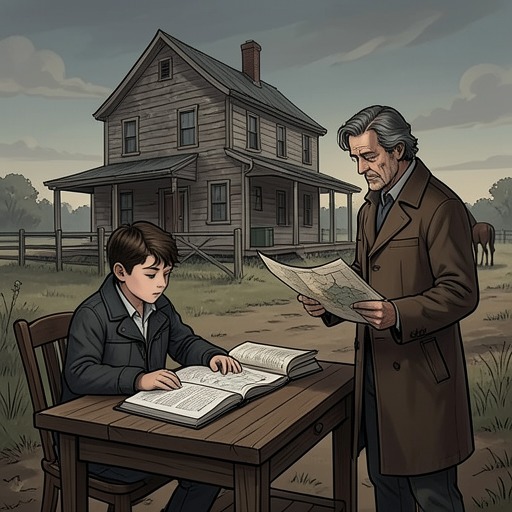
Peter’s understanding begins in the medical books left by his father, Johnny Gordon. His father had been an unusually perceptive diagnostician, and the narrative describes his gift for recognizing illness as something passed on to his son. Peter’s private study continues in a shed at the inn, where Johnny’s medical books share space with his experiments and preserved animal specimens. Away from the taunts he faces at school, he pursues a world organized by observation and inquiry.
The books make a practical difference. One August afternoon, Peter learns that anthrax, locally called blackleg, affects animals and can also be transmitted to humans. The account specifies a route: infection can enter the human bloodstream through a cut or other break in the skin when someone handles the hide of an infected animal. It offers the making of a rope from such a hide, by a man whose hands are damaged, as the telling example. This explanation supplies the medical mechanism behind Phil’s illness without turning the doctor’s later uncertainty into a diagnosis.
The knowledge also has a longer family history. Johnny once watched Peter at work with a microscope slide showing a bacillus that kills rodents, praised his drawing, and remarked on his fine hands. In another conversation, Johnny struggled to express his affection before telling his son that he loved him. The novel thus joins medical inheritance to a rare moment of intimacy: the father’s books preserve knowledge, while his spoken love establishes a bond that helps give that knowledge its later meaning.
The Rope and Phil’s Hands
The infection’s implied route depends on a contrast between Peter’s and Phil’s relationships to their hands. Phil scorns protective gloves and dismisses the precautions other ranch workers take against everyday hazards. The men commonly wear horsehide gloves for roping, fencing, branding, haying, and riding; Phil instead accepts the wear of ranch labor without them. His hands are described as powerful and lean, but the narrative also establishes that they are vulnerable to cuts and other damage.
That vulnerability becomes relevant when Phil and Peter are together. Phil watches Peter calmly handle a rabbit and dispatch it with notable deftness. During the same encounter, Phil has injured his own hand on something sharp and remarks on the blood. The scene brings the boy’s precise handling of animals into the same frame as Phil’s exposed hands, though the connection to anthrax becomes clear only later. Peter’s competence impresses Phil, helping open a relationship that had previously been marked by hostility.
As that relationship changes, Peter tells Phil that he has rawhide ready for the rope and explains that he cut it up because he wants to learn Phil’s braiding craft. He asks Phil to accept the material and tells him that Phil has been good to him. The exchange appears to offer trust and reconciliation: Peter brings the rawhide as a gift and as proof of attention to Phil’s skill. In the light of the closing explanation, however, the hide also carries the means of infection. The narrative’s force comes from that double significance, not from an explicit account of Peter’s thoughts at the moment he gives it.
Diagnosis and Delayed Explanation
When Phil is admitted to hospital, his doctor is mystified. He takes blood samples, cultures them, and sends the resulting culture to the State Hospital, where specialists can investigate it. Phil’s final convulsion is brief but severe; the doctor still expects the test to reveal what has gone wrong. His remark that sending the culture is like locking the barn after the horse has escaped conveys the belatedness of the inquiry: the investigation may establish the cause only after it can no longer change the outcome.
The subsequent explanation sharpens the contrast between professional uncertainty and Peter’s prior knowledge. The culture may tell the doctor the answer, but one person already knows it. Peter has learned from his father’s books that anthrax can pass from an infected animal hide into a person through damaged skin. The reader can therefore connect the disease to the rawhide used for Phil’s rope, even while the doctor waits for laboratory confirmation. Medical knowledge, which began as Peter’s private study, has become decisive outside the shed.
Consequence and Narrative Significance
Phil’s death makes the infection the conclusion of a carefully prepared causal sequence rather than an unexplained illness. The relevant materials and conditions have already appeared: Peter’s medical books, his knowledge of animal disease, Phil’s unprotected hands, and the rawhide brought for the rope. The final account identifies how the disease can travel and lets those details converge. It does not present a separate clinical report confirming the precise exposure; instead, the narrator’s explanation strongly implicates the infected hide and the break in Phil’s skin.
The outcome also completes Peter’s effort to protect his mother. In the closing passage, Peter regards Phil’s death as the result of a sacrifice made by his father and of a sacrifice Peter himself found possible through knowledge in Johnny’s books. The language places the action within a family inheritance: Johnny’s medical learning survives him, and Peter applies what he has learned to a crisis in the present. Anthrax infection consequently carries both biological and narrative weight. It is a transmissible disease with a stated route of exposure, but also the hidden mechanism by which study, craft, vulnerability, and Peter’s purpose meet.