butcher-pen hides
The Power of the Dog (Thomas Savage Edition)The butcher-pen hides are more than discarded animal skins: they move from an eyesore at the ranch to a saleable commodity and then into the rawhide rope at the center of Phil Burbank’s death. Their passage through the story joins domestic unease, ranch labor, and Peter Gordon’s medical knowledge. The hides’ significance lies in that transformation: what appears to be an untidy remnant of ordinary work becomes the material link between Phil’s unprotected hands and the disease Peter understands.
Appearance and Place at the Ranch
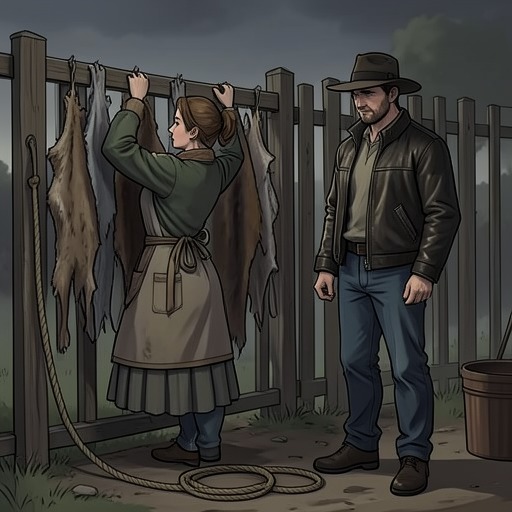
The hides are thrown over the top poles of the butcher pen, where they are visible to people passing the ranch. Rose Gordon Burbank thinks they make a poor impression. Her concern is not simply that the hides are waste; their display makes the ranch’s working life conspicuous to outsiders. Magpies quarrel over bits of flesh nearby, adding another sign of the exposed remains of animal processing. Rose’s attention to how the scene looks contrasts with the ranch’s practical routines, in which such materials are part of the landscape of work.
The hides therefore occupy an uneasy position between useful material and public embarrassment. They belong to the ranch’s ordinary business, but their visibility makes them a matter of social appearance. That tension helps explain why their removal has a meaning beyond the exchange itself: the same object Rose sees as an unattractive feature is also something a trader can value and Phil expects to find where it was left.
Ranch Work and the Meaning of Protection
The hides belong to a world organized around strenuous, seasonal labor. Phil Burbank oversees haying, inspects and repairs the machinery, checks the irrigation and the growth of the hay, and sets the start of the season for as soon as possible after the Fourth of July. His responsibilities include four John Deere and four McCormack-Deering mowing machines, six buck rakes, six sulky rakes, two derricks, and the cook and dining shacks moved between camps. In that work culture, animal products and equipment are handled as practical materials, not as objects set apart from the labor that produced them.
The ranch hands’ use of gloves makes Phil’s different practice especially significant. Workers wear horsehide gloves for roping, fencing, branding, pitching hay, riding, and handling horses or cattle, chiefly to protect their hands. They order the gloves through catalogues and sometimes need help completing the written forms. Phil refuses that protection, disregards the blisters, cuts, and splinters that follow from work, and scorns those who do wear gloves. His hands are described as dry, powerful, and lean. The hides’ later use in rope-making thus enters a material world where Phil’s exposed hands are not incidental: his rejection of protection is a settled part of how he defines his work and himself.
The danger of ranch labor is not abstract. The mowing-machine crews handle difficult teams and work with cutter bars capable of causing severe accidents; their dangerous tasks earn them extra pay and a particular standing among the men. This broader picture of risk clarifies the contrast around the hides. Ranch work routinely involves hazards, but Phil’s refusal of gloves leaves him vulnerable in a way tied specifically to his own contempt for caution.
Sale and Phil’s Discovery
A trader asks whether there are any old hides and offers thirty dollars for them. Rose Gordon Burbank’s unease about their appearance and the trader’s offer place the hides in two different systems of value: for her, they mar the view of the ranch; for him, they are worth money. The hides are subsequently gone from the butcher pen. Their removal turns an inconspicuous feature of the ranch into a breach of Phil Burbank’s expectations.
Phil notices the absence before the riders have even passed the pen. His memory is presented as extraordinarily exact: details that pass before his eyes remain fixed in it. When he realizes that every hide has disappeared, he responds with anger and treats the sale as a serious offense. The moment reveals how closely he attends to the ranch’s material arrangements and how forcefully he reacts when someone else changes them. What Rose regards as an unattractive display has become, to Phil, a visible measure of someone having acted without his consent.
The sale also creates the conditions for the hides’ second function. After the skins are gone, Peter Gordon tells Phil that he has rawhide for finishing the rope. The sequence shifts the object’s meaning from something discarded or sold to something useful in Phil’s hands. The rope offers Phil a reason to accept material from Peter and to draw him closer, even as the material’s origin will make that trust dangerous.
From Hide to Rope and Consequence
Peter Gordon’s knowledge comes from the black medical books left by his father. In one August afternoon of reading, Peter learns that anthrax, called blackleg locally, is an animal disease that can pass to humans through cuts or breaks in the skin when someone handles the hide of an infected animal. The account gives the danger a specific route: a man with damaged hands may handle diseased hide while braiding a rope. That risk converges with Phil Burbank’s habitual exposure of his hands and Peter’s offer of rawhide for the rope.
The hides’ importance is therefore causal as well as symbolic. The story links the animal material to the rope, the rope to Phil’s unprotected hands, and Peter’s medical reading to the danger the material carries. Peter’s offer sounds like assistance with a craft project and serves as a means of bringing him into Phil’s confidence. The object that once lay in public view at the butcher pen is transformed into an instrument concealed within an act of apparent cooperation.
Narrative Significance
The butcher-pen hides gather several opposing values into one object. They are refuse and merchandise, an eyesore to Rose Gordon Burbank and a detail Phil Burbank tracks with exactness, a practical supply for rope-making and a possible carrier of fatal infection. Each change in use alters what the hides mean without changing their material identity. The story’s movement from the pen to the trader and then to Peter’s rope makes ordinary ranch work the setting for a hidden reversal.
Their role also exposes the difference between Phil’s confidence in toughness and the actual conditions of vulnerability. He rejects gloves as needless protection, yet his damaged hands create precisely the opening through which the disease can reach him. Peter, by contrast, attends to both the material and the medical knowledge that makes it dangerous. The hides do not announce their importance when they hang over the pen; their significance emerges through what people do with them, and through the consequences of a seemingly useful offer.