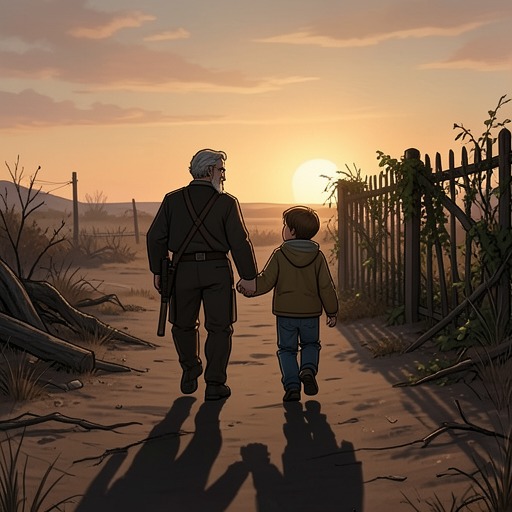
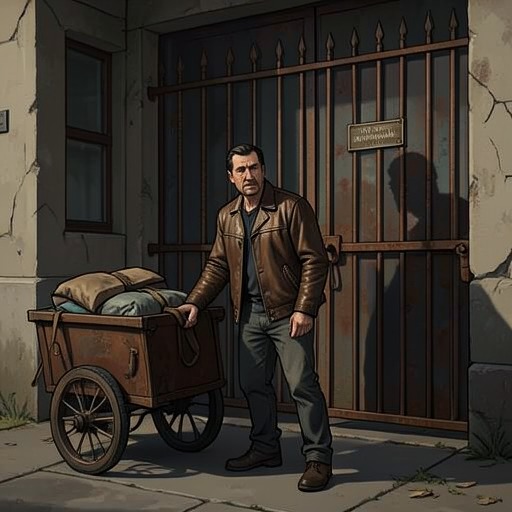
Edward Nappo and his son attempt to return to their ancestral land
The Power of the Dog (Thomas Savage Edition)Edward Nappo and his son attempt to return to the mountains Edward remembers as his father’s land, but a gate and Phil Burbank’s refusal turn their journey back toward the Indian reservation. The episode makes ancestral memory a practical destination—something the father and boy try to reach by cart—while showing how displacement and white control of access frustrate that effort. Its ending is not arrival but the father’s insistence that the journey still mattered because they had seen the mountains.
Dispossession and the Journey’s Purpose
The journey follows the removal of the valley’s Indigenous people from their land. The government no longer treated treaties as meaningful guarantees: land had become too valuable, while officials had less reason to fear Indigenous resistance and more reason to heed white voters. Johnny Gordon had seen people leaving in old buggies and on worn ponies. Edward and his son’s attempted return takes place against this history, rather than as an isolated excursion.
Life on the reservation is constrained by rules as well as geography. Liquor is neither sold nor consumed there, and leaving requires a permit, granted only for a pressing reason. Because the people have nowhere else to go and no friends waiting to shelter them, permission to travel is rarely even sought. Edward, as the son of a chief, does not consider himself bound to report his plan to the Indian agent; he also fears that the agent might obstruct it. The family’s decision to leave is thus an act taken outside a system that regulates movement away from the land to which they hope to return.
The boy is twelve during a long, severe winter, when blizzards bring temperatures as low as forty below and some elders die. Against this deprivation, his father’s stories give the desired destination a precise shape: timber rising toward the tree line, snow that remains through summer, cloud shadows crossing ravines, springs emerging from rock, and drinkable water. Edward has described these mountains for so long that the boy knows them through his father’s account before he sees them. Their journey is therefore both a search for home and an effort to make inherited memory tangible.
Departure and the Road Back
The boy rubs a ring his father made from a horseshoe nail and proposes that they run away. When summer comes, Edward returns to the plan they had tied to the cow’s survival. Food is set aside for the trip: canned beans, canned corned beef from Argentina, and hard soda crackers. They leave before daybreak without informing the Indian agent. The departure turns a private wish into a shared undertaking, planned around the season, their supplies, and the possibility that official notice would bring trouble.
Their destination is not an abstraction to Edward. He recalls his own father’s mountains and the features he has described to the boy, including the springs whose water is sweet and fit to drink. That memory helps explain why the father persists even when the journey is uncertain. The cart must carry them toward a place Edward can identify through family history, while the boy’s knowledge of it comes from repeated stories.
At a gate, Edward reaches a point he cannot remember. Before speaking with the white man there, he tells the boy to sit straight. The boy’s posture is already rigid; he pushes his cap back, while Edward brushes dust from his black hat and smooths it with his palm. Their preparation gives the encounter the gravity of a formal appeal, although the authority to let them pass lies with the man at the gate, not with the travelers.
The Gate and the Refused Gift
Phil Burbank asks where they think they are going and then orders Edward and the boy to turn around and leave. Edward has brought a box of gloves from beneath the seat. Rather than produce the gun the man might expect, he offers the box to Phil, who is poorly dressed and has no gloves. Phil does not accept it; he says he will not take a bribe and will not wear gloves. The exchange ends without passage being granted.
The refusal carries a pointed contrast. Ranch hands generally wear horsehide gloves for work that can burn, cut, or blister their hands, but Phil is the exception: he scorns protective gloves and regards the unprotected toughness of his own hands as a mark of character. Edward’s offer therefore meets not simply a gatekeeper’s suspicion but Phil’s settled contempt for gloves. Whatever Edward’s precise intention in presenting the box, Phil defines it as a bribe and rejects it, leaving the travelers with no way forward through the gate.
Edward climbs back onto the seat with the box. He turns the horse toward the Indian reservation, about two hundred miles away, and wonders whether the animal can make the return journey. He does not look at the boy as he speaks of what they have managed to see: his father’s mountains. That consolation does not undo the refusal or shorten the road back. It gives the failed attempt a limited but real outcome: the mountains have been seen, even though the family cannot reclaim them.
Aftermath and Significance
The journey’s ending joins private loss to the larger structure that produced it. The family has left without a permit because Edward anticipates obstruction; at the gate, Phil’s command makes the limits of their movement immediate. They return to the reservation rather than reach the land Edward has remembered, and the father’s concern shifts to whether the horse can carry them back. The episode thus presents dispossession not only as a past removal but as a continuing restriction on return.
The cart appears again in Rose Gordon Burbank’s view during a storm, when she recognizes it. This later sighting confirms the cart’s recurrence in the valley but does not establish that Edward and his son succeed in reaching their destination. Instead, it lets the failed journey persist in the story’s present: the same vehicle remains visible, while the ancestral home it represents remains inaccessible. The father’s account of having seen the mountains preserves a measure of meaning without disguising the outcome. Their visit is brief and their return imposed, but the boy has encountered the landscape that had previously reached him only through inherited description.