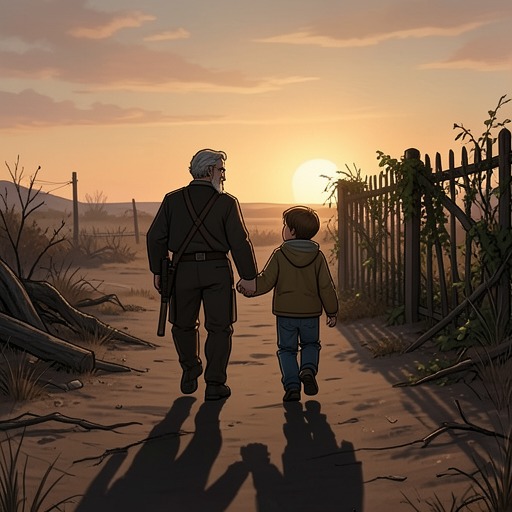
Edward Nappo and his son's journey back to their ancestral land
The Power of the Dog (Thomas Savage Edition)Edward Nappo and his son’s journey back to their ancestral land turns remembered country into a difficult, thwarted return: Edward sets out with his boy for the mountains his father knew, only to be stopped at a gate and sent back toward the reservation. The journey is more than a passage across distance. It exposes how Indigenous memory and family ties persist under forced removal, while permits, private land, and white authority restrict the possibility of return.
Background and inherited memory
Edward’s destination is carried first in stories. He has described a northern country of summer fields, purple lupine, mountains, enduring snow, springs, and water fit to drink. His son listens to these accounts and shares his longing for the place. The stories make the journey imaginable before either of them reaches it: the boy knows the land through his father’s words, while Edward’s memories reach back to the country of his own father.
The journey takes place against the history of the valley’s Indigenous people being driven from their land and sent to the Indian reservation. The removal was not presented as a negotiated exchange: the government had ceased to honor treaties, and white voters’ political power outweighed any concern about Indigenous claims. Edward had seen people leaving in old vehicles and on worn-out horses. His thoughts went to the southern Idaho flats where they were sent, a country he remembered as harsh and poor in water and trees. The contrast between that place and the northern mountains gives his return attempt its practical as well as emotional urgency.
Life on the reservation is constrained by rules that make travel difficult. Alcohol is prohibited, and no one may leave without a permit; permits are issued only for pressing reasons. The stated assumption that Indigenous people have nowhere to go and no one to shelter them helps explain why permission is seldom sought, but it also reveals the circular force of the restrictions. The Nappos’ journey tests those restrictions by acting on a connection to land that the governing system does not recognize.
The decision to leave
Before the journey, the cow on which the household depends becomes sick. Edward and his son tend a fire while they wait to see whether she will recover, and Edward continues telling stories of the northern land. The illness puts their plans in doubt, but when summer comes Edward remembers the bargain he had made with the boy: if the cow lived, they would go. His wife prepares food for the trip, including canned beans, canned corned beef, and hard crackers.
Edward does not report his plan to the Indian agent. As the son of a chief, he does not consider himself bound to do so, and he expects that the agent might obstruct them. The two leave before daybreak. Their departure is quiet and deliberate, but the decision is also an act of refusal: rather than wait for permission from the authority governing their movement, Edward acts on his own understanding of his family’s claim and destination.
The boy carries a ring his father has made from a horseshoe nail. He rubs it as he suggests that they could run away. The small object links their departure to the father’s care and to the boy’s wish to escape the conditions that confine them. Edward, meanwhile, thinks of the country he has described: timber rising toward the snowline, springs coming from rock, and the sounds and silences of the pines. These details establish what the travelers seek without turning the journey into a simple search for scenery; the land matters because it is remembered as ancestral home.
The road blocked
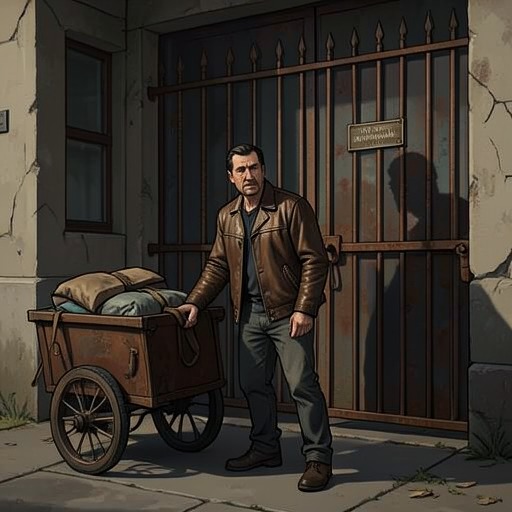
The travelers eventually reach a gate Edward does not remember. The unfamiliar barrier marks the point where a remembered route meets a changed landscape, divided by a boundary they cannot simply cross. Phil Burbank confronts them and demands to know where they are going. When Edward explains the family connection to the land, Phil dismisses that claim and orders him and the boy to leave the property.
Edward climbs back into the cart with a box of gloves and turns the horse around. Their return is not a voluntary conclusion to the journey: the horse must carry them back toward the reservation, two hundred miles away, and Edward wonders whether it can make the distance. He cannot look at his son as he tells him that they have at least seen the mountains of his father. The remark preserves a partial achievement within the defeat. They have not reached or reclaimed the land, but the boy has seen the place that existed for him first as a story.
The stopping of the cart joins official restriction to local power. The permit system controls movement beyond the reservation, while the gate and Phil’s command enforce exclusion on the ground. The return therefore cannot be explained as a failure of courage or preparation: the travelers set out, but a boundary backed by a white landowner’s authority closes their way.
A later encounter and the episode’s significance
The Indian cart appears again later, as Rose Gordon Burbank notices it during a storm. George explains that Phil has gone out to check on one of the riders and expects that he has turned them back. Rose imagines that the travelers may have meant to see a grave and asks George to consider how the boy feels. Her response gives attention to the child’s perspective, which the original confrontation had disregarded.
Rose says that she and George would be proud to have the travelers camp with them. George supports her invitation, and when Phil objects to the Indigenous visitors behind the barn, George tells him that they may stay for a few days. Phil tries to reopen the dispute, but George holds to his decision. The offer does not undo the journey’s obstruction or the larger dispossession; it does, however, make hospitality a concrete counteraction to the exclusion Phil has enforced.
The episode’s movement from inherited stories, to departure, to forced return, and then to an offer of shelter keeps the limits of that counteraction in view. The Nappos’ relationship to the land survives in memory and in the boy’s encounter with the mountains, but their access remains subject to boundaries imposed by others. Rose’s concern and George’s support briefly alter how they are received, without changing the conditions that sent them away.