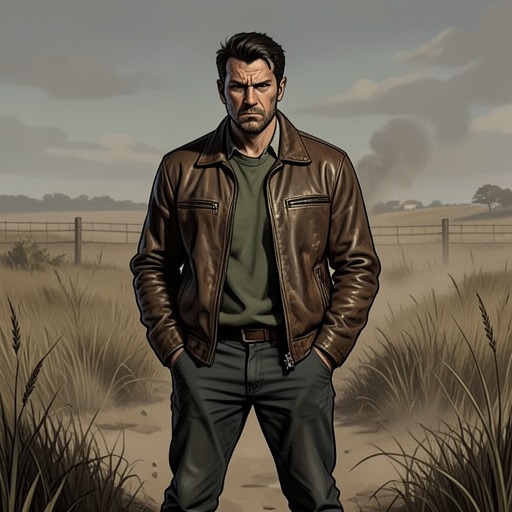
Phil Burbank’s Repressed Same-Sex Desire
The Power of the Dog (Thomas Savage Edition)Phil Burbank’s repressed same-sex desire is conveyed indirectly, through the private spaces he protects and the charged, contradictory bond he develops with Peter Gordon. His secret bathing place offers a rare experience of solitude and bodily privacy; when Peter unexpectedly enters it, Phil reacts with anger. Later, Phil cultivates Peter’s company, presenting their growing closeness as a masculine friendship while also imagining how it might isolate Peter from his mother. The tension between refuge, exposure, mentorship, and manipulation gives this desire its guarded shape.
The Secret Grove and Its Origins
As a boy, Phil and George Burbank built a small hidden shack from pieces of lumber behind the family home. They planted willow cuttings around it, and the brothers used the shelter to smoke, chew, and read magazines they knew the Old Lady would disapprove of. The place began as a shared childhood secret, but George soon lost interest. Phil continued to use the nearby creek swimming hole, sometimes finding himself strangely moved by his reflection.
Over time, the willows consumed the shack: they concealed its walls, barred its entrance, and grew through its floor and roof as the wood rotted into them. Phil and George, and once one other person whose identity is not given, knew the place. The overgrown ruin became, in Phil’s life, more than a childhood hideaway: it remained a secret shrine and a last proof of childhood. The transformation of a structure made by the boys into a refuge almost indistinguishable from its living surroundings mirrors the secrecy of what the place comes to protect.
Solitude, Privacy, and Exposure
The creek opening becomes sacred to Phil, and the swimming hole a place of private ablution. He exposes and bathes his body only there, reaching it through a single passage so overgrown that a person must stoop and crawl. Its difficulty of access preserves what matters to him: this is the one place he can claim as entirely his own. He leaves with a sense of innocence and purity, and the brief communion with himself lightens his step and lifts his spirits.
That protected solitude ends when Phil, preparing to wash, hears movement and sees Peter. Peter flees; Phil has only time to cover himself before the encounter turns from shock to anger. His response is forceful because Peter has crossed more than a physical boundary. The boy has entered a space Phil had kept apart from other people and from ordinary ranch life. The scene makes the importance of bodily privacy explicit without explaining Phil’s feelings in direct terms.
The Encounter Becomes a Secret Bond
Peter does not tell Rose Gordon Burbank what he has seen, and he suspects Phil has kept silent as well. Peter understands their connection as a kind of bond, even if it is a bond founded on hatred, and thinks that one kind of bond may be as useful as another. His recognition does not establish that the two men share the same feelings; it does show that the encounter becomes a private knowledge linking them, despite their hostility.
For Phil, the discovery is followed not by open discussion but by a changed interest in Peter. When he sees the boy walk past the ranch hands without avoiding their attention, Phil credits him with unusual courage. He begins to imagine winning Peter away from his mother and giving him the friendship of a man. But Phil’s scheme is not simply a wish for companionship: he expects Rose’s loneliness to drive her further toward alcohol and anticipates that her drinking will bring a crisis between her and George. The desire to draw Peter close is therefore entangled with a plan to hurt Rose and unsettle the household.
Mentorship and Masculine Performance
Phil builds the connection through instruction, shared work, and stories. He teaches Peter to ride and gives him a gentle bay horse. They ride into the fields, build pole fences around haystacks, and eat deviled-ham sandwiches and apples at noon while Phil tells stories of Bronco Henry. Phil also continues braiding a rawhide rope for Peter, prolonging the work partly because he has come to enjoy the boy’s attentive presence. Peter listens closely to Phil’s accounts of the past, and Phil takes pleasure in having an audience so receptive to them.
Their conversation turns the relationship into a lesson in masculinity. Phil warns Peter against becoming a sissy and contrasts his ideal of manhood with the present. He describes a cliff by a spring where someone carved initials and the date 1805, speculating that the marker might have been left by a member of the Lewis and Clark expedition. He also recalls finding a line of stones behind a hill when he was Peter’s age and proposes that the two of them follow it together. Frontier history, physical exploration, horsemanship, and craft become shared ground on which Phil can offer Peter a place beside him.
Secrecy, Desire, and Control
Phil’s behavior does not resolve into a simple account of affection. His private bathing place and the intensity of its violation suggest a vulnerability he cannot discuss openly; his later attention to Peter creates intimacy, but that intimacy is also shaped by his wish to separate the boy from Rose. He offers a model of manhood that excludes softness even as he seeks Peter’s company and enjoys his unguarded attention.
The narrative thus presents Phil’s same-sex desire through a pattern of concealment and displacement rather than a direct declaration. The childhood shack disappears into the willows, the creek remains accessible only by a concealed passage, and Phil’s feelings emerge through his attachment to a private ritual and his calculated approach to Peter. Their relationship carries both genuine pleasure in companionship and the threat of manipulation. Phil can imagine a shared search, a finished rope, and a boy who admires his stories; he cannot make that closeness separate from the harsh masculine code and domestic conflict that surround it.