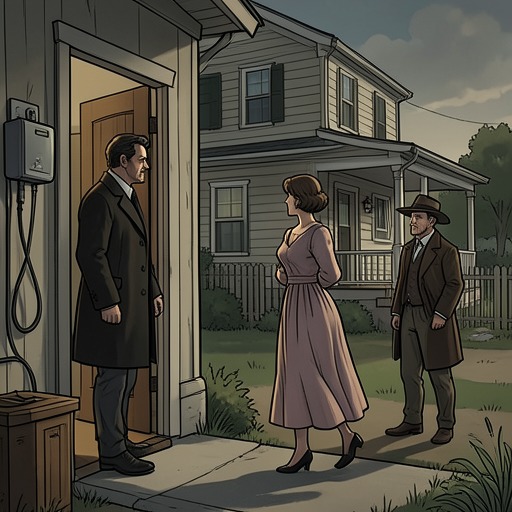
Phil begins targeting Rose and Peter
The Power of the Dog (Thomas Savage Edition)Phil begins targeting Rose Gordon Burbank and Peter Gordon through a pattern of ridicule and exclusion that reaches from a Beech restaurant to the Burbank Ranch. His mockery of Peter’s manner and paper flowers, his refusal to recognize Rose as his sister-in-law, and his influence over the ranch hands give the hostility both a private and a public force. These encounters make the household’s welcome conditional: George Burbank may bring Rose into the ranch, but Phil asserts that he will not accept her place there.
A Code of Toughness
Phil’s hostility is connected to a code of toughness that he applies to himself and others. Ranch hands wore gloves for most jobs to protect their hands from rope burns, splinters, cuts, and blisters; Phil refused them and scorned those who used them. His own hands are described as dry, powerful, and lean. The contrast matters to his treatment of Peter: he judges the boy’s manner against a standard that prizes physical hardiness and treats visible delicacy as an invitation to ridicule.
That code operates within a ranch where Phil has substantial practical authority. George keeps the books, handles buyers and correspondence, answers the telephone, and maintains the Reo; Phil oversees haying, inspects and repairs machinery, manages irrigation preparations, and determines when the work begins. His responsibilities include eight mowing machines, six buck rakes, six sulky rakes, two derricks, and the ranch’s movable cook and dining shacks. The seasonal labor is hazardous: mowing-machine operators face serious risks from the long cutter bars, and their skill and danger earn them extra pay, newer tents, first choice of meat, and deference. Phil’s standing therefore rests not only on his manner but on his command of consequential work.
Mockery of Peter
At a restaurant in Beech, Peter enters in pressed dark trousers and a starched white shirt, carrying a napkin over his arm. He passes the Burbank party on his way to serve a table in the corner. Phil responds with a disparaging remark that treats the boy’s presence as a humiliation for the men at the table. The slight is directed at Peter before he has said anything to the group; his appearance and work as a waiter are enough to make him a target.
Phil’s attention sharpens when he notices Peter’s expression. He resents the boy’s glance and set lips, and the scene makes clear that the hostility is personal as well as a performance for the company. When Phil reaches across the table and removes the paper flowers from a painted milk bottle, their small, handmade form looks incongruous in his large, work-worn hands. He has cut himself opening a sardine can and has not bothered to wipe away the blood. Peter explains that he made the flowers and learned from his mother, who has a gift for them. Phil puts the flowers back, pretends to arrange them, and turns the gesture into a joke for the onlookers. The episode pits Peter’s craft and his mother’s influence against Phil’s show of contempt, making the flowers a small object around which the larger conflict becomes visible.
Peter’s vulnerability to this judgment is not confined to the restaurant. At school, other boys haze and taunt him, calling him a sissy; he reacts especially when they insult his father. After seeing how the boys form a circle around him, Peter resolves to oppose them on his own terms and develops a cold hostility toward people he considers secure and privileged. This is not an episode caused by Phil, but it places Phil’s later scorn within a wider social pattern: Peter is repeatedly assessed against a narrow standard of masculine normality, and the mockery at the ranch echoes what he has already faced elsewhere.
Rose’s Arrival and Rejection
When Rose arrives at the ranch with George, the house feels cold to her. George has gone to put the Reo away, while Phil stands in the middle of the room as she enters. George greets him and reminds him that he knows Rose. Phil offers a brief greeting, but the civility does not last. Later, Rose struggles with trembling and the beginnings of a headache while Phil reads by the lamp. She tries to address him as George’s brother and welcome herself into the household. Phil looks up and smiles before plainly denying that he is her brother.
The rejection is not merely a disagreement over kinship language. Rose has entered the ranch as George’s wife, but Phil’s response makes clear that marriage has not secured her recognition within the household. His calmness intensifies the exclusion: he does not need to raise his voice to tell her that the family relation she hopes to establish is one he refuses. Rose’s effort at a gentle greeting meets a deliberate declaration of distance, and the silence around them leaves her to absorb it without support from Phil.
Ranch Authority and Public Pressure
Phil’s reach extends beyond the rooms of the house. During haying, he braids strips of rawhide while watching Peter cross an opening between the tents. A ranch hand whistles at the boy in a way usually directed at a girl. Rose stiffens as she hears it. Phil recognizes that the whistle follows from the stories he has told, and he reads the men’s response as evidence that they look to him, rather than George, as the ranch’s boss. The incident shows how his influence can set terms for the group’s treatment of Peter without Phil having to confront him directly in that moment. Rose’s presence does not protect her son, nor does George’s authority prevent the men from following Phil’s lead.
Phil’s understanding of women among the drifters reinforces this pressure. He recalls the men’s shocked silence and their division of women into those considered respectable and those denied respect. Rose, seen around the yard and recently occupied with picking up pieces of trash, is understood by them as a respectable woman, not someone to be spoken of in the same terms as the other category. This apparent distinction does not amount to acceptance: Rose remains exposed to the group’s judgment and isolated in the ranch environment. Across these scenes, Phil’s targeting works through ridicule, withheld recognition, and the social authority that lets his attitude circulate among the men.