Phil's Braided Rawhide Rope
The Power of the Dog (Thomas Savage Edition)Phil's Braided Rawhide Rope is at once a practical piece of ranch work, a tribute to the men who taught Phil Burbank to braid, and an intended bond between Phil and Peter Gordon. Phil first makes it to prove his skill to himself, then recasts it as a gift that might draw Peter into ranch life and away from his mother. The rope's material history gives that gesture a darker consequence: its connection to a dead animal and Peter's gloved work with the carcass leads to the anthrax infection that kills Phil.
Material and Craft
Phil begins braiding in the evening with a large handful of rawhide strips soaking in a tin washbasin. Sun-bleached and swollen with water, they look like stout worms. He had meant to make only a foot or two, enough to establish that he could still do the work well. The rope is not simply an improvised tool: dried carefully out of the sun and finished with tallow, Phil believes, rawhide can be as strong as hemp and more accurate in the corral. He imagines it as an intelligent serpent, language that joins its usefulness to the controlled, almost living form it takes in his hands.
The making is also an act of remembrance. Phil braids in homage to Joe and Bronco Henry, each of whom taught him something. He thinks of character itself as something woven from strands, sometimes beautifully and sometimes poorly, and sees the passage of skill from one person to another in the rope's construction. Joe's example gives the work an economic as well as technical ethic: he had refused fifty dollars for a thirty-foot coil kept in a pasteboard suitcase. Phil admires that refusal to sell skilled labor for money, associating it with a respect for time that Joe learned in prison. He places Bronco Henry alongside Joe as another man set apart from ordinary assumptions, in his case by a contempt for death. In this way, the rope carries not just rawhide but a lineage of instruction and values.
A Gift and an Intended Bond
The rope's purpose changes when Phil sees Peter. Phil imagines that George Burbank will eventually recognize his failure to make his wife happy as Rose drinks more, and that the conflict between George and Rose will worsen. At that moment, Phil sees the half-started rope as a possible solution of his own: he can finish it, give it to Peter, and use the gift to begin winning the boy over. The thought possesses him. His hands stop above the rawhide, and the rope becomes, in his mind, the bond that will join them.
Phil calls Peter over and first coaxes him to address him by his given name rather than Mr. Burbank. When Peter does, Phil lifts the new rope for him to inspect and promises to finish it, give it to him, and show him how to use it. He presents roping and riding as ways for Peter to find his place in what he calls a lonely ranch. Peter is interested in the work itself: he watches the strips soaking in the basin and asks how long the rope will take. Phil estimates that he can finish it before Peter returns to school, and invites him to come back and see his progress. The offer therefore has a practical surface, but Phil's private hope gives it a more possessive emotional purpose: he wants the gift to secure Peter's attention and allegiance.
Work, Use, and the Hides
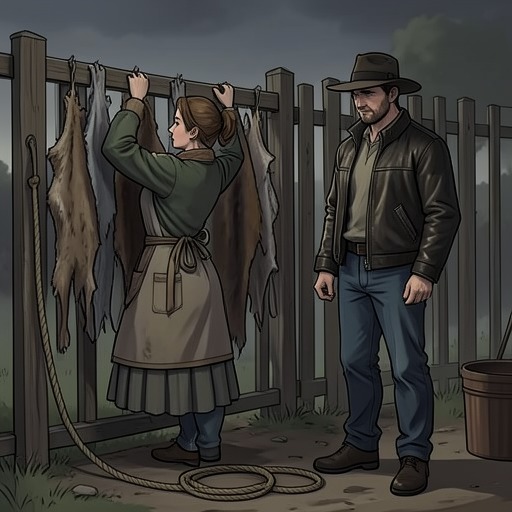
The rope is made possible by hides that Phil had previously treated as worthless. After cattle are butchered, the men throw their skins flesh-side out over a fence pole. They skin carelessly, leaving punctures and bits of flesh; magpies pick at what remains. Most hides are too damaged to be useful to buyers. Phil's usual plan is to leave them drying and shrinking in the weather until, perhaps a year later, the men pile them up, soak them with kerosene, and burn them. The heaps may reach twenty hides, and their burning makes a powerful stink.
Each September before the burning, hide buyers arrive, first in wagons and later in old trucks. They offer a dollar or a dollar and a quarter for skins they can resell at a profit. Phil refuses to sell, dismissing the traders as people who look for quick money in hides and ranch scrap. His prejudice toward Jewish merchants is explicit, even as he distinguishes them from people whose intellect and talent he respects. The episode exposes the limits and contradictions of his contempt for commerce: he scorns the buyers' profit, but the rope he values depends on material that he has until now allowed to accumulate for destruction. Craft gives the discarded hides a different use, one measured in skill and time rather than resale value.
As Phil and Peter grow closer, the rope remains in progress rather than becoming an immediate, finished gift. Phil keeps it coiled like a snake in a sack, feeding in the unfinished end as he works. Meanwhile, he teaches Peter to ride, gives him a gentle bay horse, and takes him into the fields to help build pole fences around haystacks. They eat deviled ham sandwiches and apples at noon while Phil tells stories of Bronco Henry. Phil enjoys their time together; Peter says soberly that he will not forget it. These shared rides and tasks enact the companionship Phil hoped the rope would create, while the coiled, unfinished object preserves the original promise in material form.
The Carcass and the Rope's Consequence
The rope's hide material acquires a fatal significance through Peter's search for a dead animal. Following a line of old stone piles, Peter reaches a dry ravine where the markers vanish. There he finds exactly the carcass he has been seeking. He looks around, draws on gloves as a surgeon might, dismounts, and begins his work. The scene places the crafted object and the animal source of its material in the same chain of consequence: Peter's careful handling of the carcass supplies the anthrax connected to the rawhide rope, which infects Phil and kills him.
That outcome reverses the meaning Phil assigns to his gift. He imagines the rope as a bond that will bring Peter closer and redirect the boy's loyalties; instead, its material becomes part of Peter's concealed plan against him. The object still records Phil's patience, technical confidence, and inherited craft, but those qualities do not protect him from the danger carried by the hides. Its significance lies in this double function: a promise of instruction and intimacy in Phil's hands, and the instrument of a death Peter has prepared in silence.