Rose Burbank’s Recurrent Headaches
The Power of the Dog (Thomas Savage Edition)Rose Burbank’s recurrent headaches are both a physical affliction and a measure of the pressure she endures in the Burbank household. They arrive with a pain she describes as forcing her eyes outward, and their recurrence draws her from a doctor’s proposed explanation toward a private, shame-laden method of relief. As she begins to connect the attacks with the prospect of living beside Phil Burbank, the headaches make bodily what she has difficulty saying aloud.
Symptoms and the Doctor’s Explanation
The headaches become salient on a day when George Burbank is away and Rose must speak to Phil. As Phil approaches on his sorrel horse, she already feels the terror that has preceded her recent attacks. That timing places the pain beside an anticipated confrontation: the headache is not merely an isolated discomfort but part of Rose’s apprehension before she has even begun the conversation she feels compelled to have.
When a doctor asks her to describe the pain, Rose locates it directly behind her eyes and says the pressure seems to force them out of her head. The description makes the sensation intensely physical, a pressure that threatens to break through the face rather than remain an ordinary ache. The doctor also asks about her eating habits. Rose can identify no unusual pattern except that she seldom eats breakfast and has almost never done so. He proposes hunger as a cause and asks whether the pain often comes before the noon meal. Rose acknowledges that it does. The explanation has some immediate plausibility: later, she recognizes that the attacks seize her shortly before meals. But the pattern of timing does not settle the larger question of what, in her life, makes the pain so recurrent.
Pain, Relief, and Secrecy
When the headaches return, they do so swiftly, bringing tears to Rose’s eyes. She takes aspirin and Bromo-Seltzer and presses her fingers hard against her temples, trying to block the nerves. The effort to control the pain is direct and physical, but it does not keep her from seeking a stronger remedy. The narrative connects the attack to Rose’s memory of Johnny Gordon near the end of his life: after vowing never to drink again, he had been caught pouring himself a drink and explained that a bad tooth was causing unbearable pain. The tooth was in fact pulled. Rose remembers that episode as one in which Johnny had told the truth, a recollection that makes her own subsequent action echo his without making their circumstances identical.
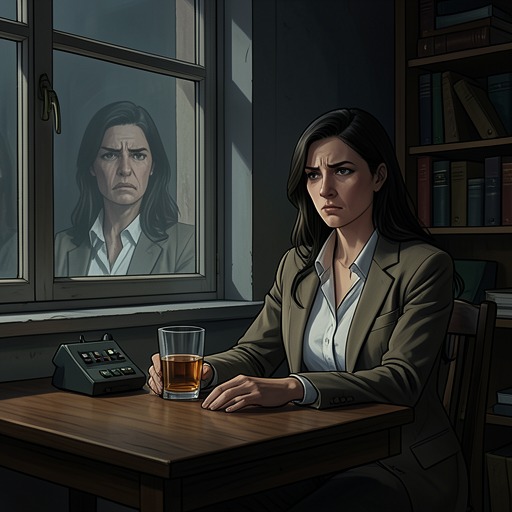
Driven by comparable distraction, Rose retrieves the hidden key to the liquor cabinet from the china cupboard. She stoops at the buffet, startled by her pounding heart, rises when she hears Lola on the stairs, and waits until Lola has passed into the kitchen before stooping again. She carries whiskey under her arm to the bathroom, locks herself inside, and drinks it. Afterward, she can regard herself calmly in the mirror; she judges the pain comparable only to childbirth, whose agony she remembers as less sharp and less lasting. The noon meal is pleasant. The sequence makes the whiskey’s effect unmistakable to Rose, but relief is inseparable from concealment: she uses a hidden key, listens for another person’s steps, and drinks behind a locked door.
Once Lola has cleared the table, Rose replaces the bottle and turns the key. She tells herself that deadening the pain was hardly worth the shame and resolves not to return to the bottle. Yet the judgment is made while she has no pain. The qualification exposes how fragile the resolve is: her decision comes in the calm interval, while the next attack will test it under the very distress that made the hidden whiskey seem necessary.
Recurrence and the Sagebrush Walks
When another attack arrives, Rose initially tries to meet it without drinking. She begins pointless walks over the sagebrush hill, hoping that fresh air and physical exertion will bring relief. At first they help. The walks are not a cure, however, and the narrative marks their limits by placing Peter Gordon just ahead of Rose on one of them, finding a path through the high sagebrush. He tells her that the brother makes her nervous. Rose is silent. She considers that Peter may have read in his father’s books that nervousness can split a head in two, but she does not want to burden him; he wishes to believe she is happy and respected.
The walks therefore do more than offer temporary physical relief. They provide a setting in which Rose can approach an explanation she has not voiced to Peter: the headaches are entangled with her experience of Phil. Each morning she worries about the noon meal and each afternoon about the evening meal, sick at the prospect of sitting with Phil. She experiences herself as the target of his silences and crudities, and is distressed by his scratching, snuffling, and habit of speaking past her to George. Even the way he pulls out his chair and steps over it has become an obsession for her; so has his reference to beef as “a piece of cow.” These repeated details give the meals a particular dread: they are not simply times before which pain happens, but occasions when Rose anticipates being trapped with Phil’s conduct and attention directed elsewhere.
Household Conflict and Significance
Rose’s understanding of the headaches develops alongside her sense that the household arrangement has no easy remedy. She believes it is unnatural for her and George to live in the same house as his brother, yet she cannot ask George to choose against his family or challenge his affection for Phil. She imagines Phil establishing a place of his own, perhaps nearby and better suited to his needs, then rejects the idea that she and George could move elsewhere while Phil remained alone in a sixteen-room house. Neither brother nor wife seems likely to leave. Against that impasse, Rose concludes that she must speak to Phil again and offer her friendship, insisting to herself that he is a human being even as she doubts what she can safely say about his behavior.
The recurrent pain thus follows a double pattern. Its timing before meals supports the doctor’s suggestion that hunger may contribute, and Rose herself confirms the pre-noon recurrence. At the same time, the attacks return within a daily routine organized by dread of meals with Phil, while George’s absence makes the approaching conversation especially frightening. Rose moves among medical advice, aspirin, attempts at exercise, and whiskey taken in secret; none resolves the household conflict. The headaches register the cost of that unresolved strain, while their repetition gradually makes Rose’s private distress harder for her to treat as an isolated bodily inconvenience.