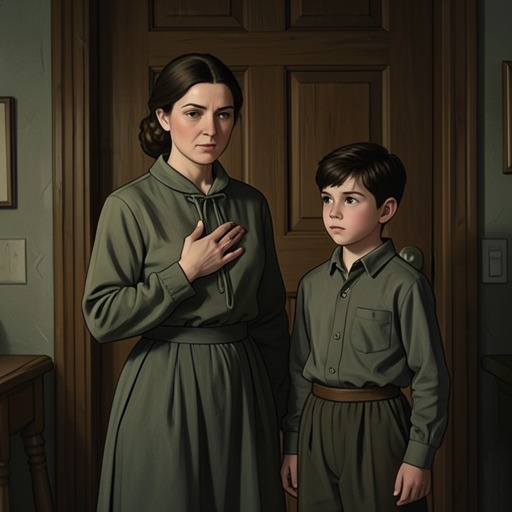
Rose Gordon—Peter Gordon: mother and son
The Power of the Dog (Thomas Savage Edition)Rose Gordon and Peter Gordon’s relationship is at once intimate and unusual: Rose protects a frail, solitary child, while Peter makes her the central figure in a private ideal of family life. His devotion is expressed less through easy conversation than through practical care and a sustained effort to imagine a future in which she is safe, admired, and free of the work that has burdened her.
Early Bond and Peter’s Difference
Peter’s arrival begins in a scene of tenderness. Johnny Gordon delivered his son himself, and afterward sat beside Rose as she nursed the child, reading Byron to her and marveling at the birth. The boy was named Peter after Rose’s father, whose name had once been shortened to Pete. This family inheritance gives the child’s name a connection to Rose’s past even as he becomes the focus of her new household.
Peter developed differently from other children. He walked and spoke late; when speech came, it had a measured, adult cadence, and at four he could read. His parents worried about his development but did not discuss their concern with each other. Illnesses and recurring fevers left him weak, and he grew up without joining ballgames, preferring books and solitude. Sunlight troubled him: when he went outdoors, he paused, squinted, and shaded his eyes. In Beech, where lamps were put out early, he sometimes left the house at night. When Rose or Johnny asked what he had been doing, he answered that he had done nothing. The child’s reserve did not mean that he was unaware of his surroundings; the narrative presents him as watching closely while remaining difficult for others to read.
Protection, Work, and Solitude
Rose’s care is clearest in the contrast between her distress at killing chickens and Peter’s willingness to take on the task. He raised the fryers and killed them because Rose could not bear to do it or even watch. During the work she went inside, shut the doors and windows, and sang or covered her ears. Peter handled the task quietly and efficiently, regarding his cleanliness and competence as preparation for the future. Once the chickens had been prepared, Rose could treat them as food to cook. Their different responses reveal a form of mutual accommodation: Rose avoids what she cannot face, while Peter assumes the practical responsibility that allows the household to continue.
That household depended on Rose’s labor at The Inn / Red Mill. When the Burbank family arranged to stay for supper and lodging, Rose moved out of her room to make space, and Peter moved into the shed with his father’s books. Rose prepared carefully for the visitors and hoped they might return each year, bringing business from other ranches. The arrangement makes visible the modest conditions around which mother and son had organized their lives. Peter’s books remain beside him even as the work of the inn reshapes their sleeping arrangements.
The Scrapbook and a Shared Future
At school, Peter met hostility from boys whose wealth and ease seemed to him to threaten the private image he held of the Gordons. He answered that threat inwardly, resolving to oppose those who insulted his family on his own terms. His scrapbook gave that image a material form. From old magazines—including Town and Country, International Studio, Mentor, and Century—he cut pictures of ocean liners, trains, jewels, country houses, fine luggage, Newport beachgoers, and expensive automobiles. These images offered more than luxury for its own sake: their human figures suggested Rose on a terrace overlooking a formal lawn and Johnny arriving at a grand hotel.
Peter turned the scrapbook into a plan for a different life. He imagined becoming a great surgeon, presenting a paper before learned men in France, and hearing strangers speak of Rose’s beauty and Johnny’s kindness. His ambition therefore joined professional achievement to the restoration of his parents’ dignity. When classmates said Johnny had spoken to a prostitute, Peter stood unmoved; the insult did not dislodge the ideal he had built. The scrapbook’s imagined prosperity was also his way of answering the family’s financial failure and the bleakness of their surroundings.
Rose’s Marriage and Peter’s Acceptance
By the time Rose considered marrying George Burbank, Peter’s attachment to her had become inseparable from this idealized future. His formal speech and habit of calling her Rose rather than Mother puzzled her. The name suited the image he cherished: she was not only his parent but the beloved, singular figure at the center of the scrapbook that had guided him for five years. After Johnny’s death, she was its remaining subject.
Rose sought to know whether Peter would be hurt by her marriage and whether he understood her decision. Peter smiled and said he understood. His acceptance was not indifference, nor was it presented as jealousy displaced onto George. Peter believed that marriage would give Rose what she deserved long before he could provide it himself. It would remove her from the Red Mill, where she had to earn a living among customers he despised and endure their drunken remarks and insinuations. He pictured her in fashionable clothes, traveling on an ocean liner, riding in a Lincoln or Pierce, and arranging fresh flowers. These details echo the images he had collected: the scrapbook’s dream begins to become a possible future for her.
Meaning of the Relationship
Peter’s bond with Rose combines dependence, protectiveness, and idealization. His early illnesses and isolation set him apart from other children, while his mother’s presence gives the world he imagines its purpose. He does not seek to keep her from George; instead, he interprets her marriage as the means by which she can escape insecurity and attain the life he has long wanted for her. Their relationship is conveyed through actions and objects—the nursing child, the chickens Peter prepares, the books he carries to the shed, and the scrapbook of a more affluent life. Together, these details show a son whose care for his mother takes the form of both daily responsibility and a carefully preserved vision of her future.