Rose’s Isolation in the Burbank Household
The Power of the Dog (Thomas Savage Edition)Rose’s Isolation in the Burbank Household is the condition of social and emotional confinement that develops around Rose Gordon Burbank after she enters the Burbank household. Phil Burbank rarely addresses her directly, and George Burbank’s apparent failure to confront that estrangement leaves her to endure it largely alone. Her isolation is not simply a lack of company: it takes shape in everyday silences, the strain of shared meals, and the growing gap between her wish to be respected and her perceived ability to protect herself.
A Household Divided by Silence
Rose experiences Phil’s presence as a disruption even when he says nothing. She wonders whether George understands that Phil has spoken directly to her only a couple of times, and then only at the table when he needed something beyond his reach. She cannot tell whether George assumes that the two have nothing in common because one is a man and the other a woman, or whether he recognizes the tension but bears it by ignoring it. That uncertainty makes her isolation more acute: she cannot be sure that her husband sees what she is living through, much less that he will intervene.
Her response is physical as well as social. When she speaks of Phil, her mouth dries and her tongue feels thick; thoughts that had seemed pleasant and coherent scatter. The scene makes the household’s silence active rather than empty. Phil need not openly argue with Rose for his presence to shape what she can say and think, while George’s quiet leaves her uncertain about where she stands with either brother.
Social Performance and Exposure
The governor’s dinner briefly makes Rose’s isolation public. Before the guests arrive, she wonders whether Phil’s appearance will be a problem for the formal occasion: his clothes, hair, and weather-worn hands seem to her difficult to explain beside the expectations of a dinner attended by important visitors. Yet his absence would also leave her exposed. George has criticized the ordinary conversation at other dinners, and Rose fears that if she cannot sustain more than commonplaces, the success of the evening will rest on her piano playing.
As the governor’s automobile appears on the distant road, Rose is relieved to have the arrival interrupt her thoughts of Phil. Her voice is frightened, and she begins with the kind of conventional conversation George has called dull. The scene places her between two pressures: the discomfort of presenting Phil to guests and the fear that, without him, the burden of entertaining will fall even more heavily on her. Her isolation thus persists in company. The formal gathering offers no assurance of ease; it gives her another role to perform while her private distress remains unspoken.
The Ranch’s Masculine Order
The ranch’s working arrangements help define the world in which Rose feels out of place. George handles the books, correspondence, buyers, telephone, and motorcar, while Phil oversees haying, equipment, irrigation, and the preparation of the camps. His responsibilities include inspecting eight mowing machines, several rakes and derricks, the cookshack and dining shack, and twelve large canvas tents. The division is practical, but it also marks out a male working sphere with established tasks and authority that Rose does not share.
The ranch hands’ customs further distinguish that sphere. Most wear gloves for work to protect their hands, while Phil refuses them and scorns such protection. When the men struggle with order forms and numbers, they often turn to a better-educated coworker to complete the paperwork or write letters to their families. During the ninety days of haying, seasonal workers arrive after Independence Day celebrations, and their work revolves around dangerous mowing equipment. The men who drive the machines receive extra pay and a measure of deference because they handle difficult horses and maintain the sharp cutter bars. These details do not explain Rose’s distress by themselves, but they show how firmly the ranch is organized around men’s labor, expertise, and shared routines. Against that established order, her position is less secure and her experience less readily acknowledged.
Fear, Headaches, and Retreat
Rose’s anxiety becomes difficult to set aside. After Peter Gordon says that Phil makes her nervous, she takes walks over the sagebrush hill, initially hoping that fresh air and exertion will bring relief. The walks help at first, but they also sharpen her recognition of the problem. She remains silent with Peter because she does not want to burden him, and because he wishes to believe that she is happy and respected. Even with her son beside her, she withholds the truth to protect him from it.
Meals turn into recurring ordeals. Rose worries each morning about the noon meal and each afternoon about supper, anticipating the strain of sitting with Phil’s silences and his mannerisms. She becomes fixated on small routines, including how he moves his chair and how he refers to beef. The repetition matters: the prospect of another meal renews her distress before the previous one has faded. She connects the resulting headaches to this unending domestic pressure, but sees no clear endpoint to it.
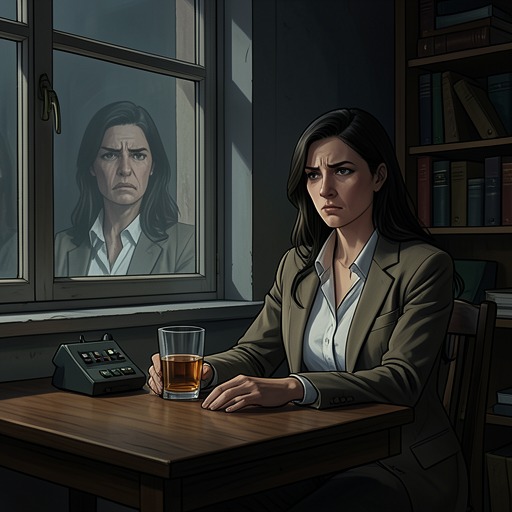
The headaches also accompany her secret drinking. When the pain becomes severe, Rose goes to the sideboard and wonders how to replace the whiskey, which is difficult to obtain. She waters one bottle and then another, fearing that George may notice if he offers a drink. Her concealment compounds her isolation: she is managing not only the strain of Phil’s presence but also the effort to keep her coping behavior hidden from her husband.
A Wider Pattern of Exclusion
The household’s treatment of Rose sits alongside a broader landscape of exclusion. The valley’s Indigenous people have been driven from their land and sent to a reservation; the government no longer treats its earlier agreements as meaningful, and permission is required for Indigenous people to leave the reservation. Rose notices an Indigenous cart again during a storm, while Phil tells Edward Nappo and his son to leave the ranch. These events are not the same as Rose’s domestic isolation, and the account does not equate their different causes or stakes. They do, however, place her unease within a setting where access, welcome, and belonging are unequally controlled.
Rose eventually describes the distance between what she intends and what she can do to protect Peter as suffocating, and her loneliness as shattering. That recognition gives the condition its clearest measure. She is a wife and mother within a populated household, yet she experiences little effective support: George’s silence remains ambiguous, Phil’s presence governs the emotional climate, and her concern for Peter encourages her to hide what she is suffering. Her isolation is therefore both relational and practical—the painful knowledge that wanting to protect someone does not mean having the power to do so.