U.S. federal government
The Power of the Dog (Thomas Savage Edition)The U.S. federal government is presented as the power behind the forced removal of the valley’s Indigenous people and the restrictions that govern life on the reservation. Its authority reaches into daily movement and access to resources, while its treatment of land is shaped by political calculation: as land grows more valuable, treaties lose force and officials have less reason to bargain. The consequences are visible in Edward Nappo and his son’s attempt to travel back toward the country Edward remembers, a journey constrained by both formal rules and the attitudes of white residents.
Removal and the value of land
The account of removal is blunt about the government’s changing priorities. Once the last Indigenous residents are driven from their lands and sent to the reservation, the government no longer pretends to believe in treaties. Land has become too valuable to exchange through bargains, and officials have less reason to fear Indigenous resistance than to fear the anger of white voters. The departing families, traveling in worn buggies and on old ponies, are not described as participants in a negotiated transfer but as people being sent away from a place they had lived.
The passage connects this dispossession to the altered landscape of the destination. The land in southern Idaho is described as dry and poor: few trees grow there, and shallow wells yield sulfurous water. The detail makes removal more than a change of address. The people lose their valley homeland and are sent to a place whose physical conditions make survival and return part of the same political story. The government’s decision controls where they may live while the value of the land they leave helps explain why their claims are disregarded.
Reservation rules and local enforcement
The reservation’s rules regulate several basic freedoms. Liquor may not be sold or consumed; residents may not leave without a permit; and firearms are prohibited. The restrictions are presented as official policy, but their justifications reproduce white assumptions: a prohibition on alcohol is defended through a generalization about Indigenous people, while the ban on firearms is paired with the claim that the government store supplies all meat. The rules thus make the government both a regulator of access and a provider of necessities.
The Indian agent administers this system locally. He lives in a neat, white-painted frame house and carefully raises and lowers the American flag, sometimes assisted by his two children, who have learned not to let it fly in a storm or touch the ground. The description gives the agent an orderly domestic life beside his public duties. Although the narrator says he is not a bad man, he considers it expedient to enforce reservation rules when officials from the Department of the Interior arrive. Local enforcement therefore reflects both administrative pressure and the agent’s own choices; the rules remain in force even when their application is intermittent.
The restriction on travel has particular force because permits are granted only for pressing reasons, while residents are said to have nowhere to go and no friends to shelter them. The policy does not merely require paperwork: it makes departure difficult in a world where safe destinations and assistance are scarce. Edward Nappo nonetheless decides not to report his plans to the agent, believing the man might make trouble. He and his son leave before daybreak, carrying food prepared by Edward’s wife, Jennie. Their departure is an act of deliberate noncompliance with a rule designed to keep movement under official control.
Edward Nappo’s return journey
Edward’s attempt to return is rooted in family history as well as in the loss of land. His father had been chief, and Edward sometimes thinks of himself as chief while describing to his son the country the boy has never seen. Edward also keeps a small rifle that belonged to his father and was the last of his possessions not burned at his death. The weapon violates the reservation’s ban on firearms, but its importance in the account is also familial: it is an inherited object connected to a father, a former status, and a past that the reservation regime cannot erase.
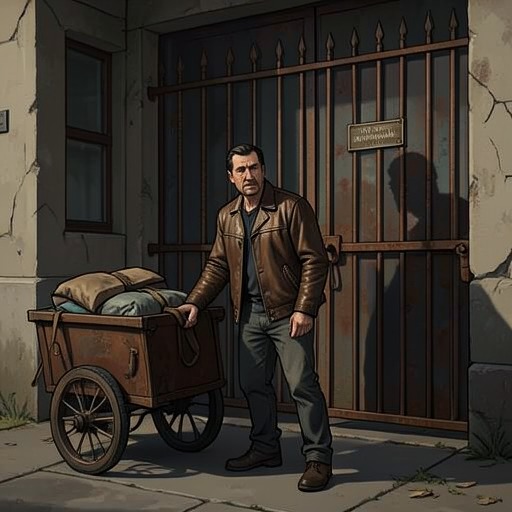
Edward and his son travel with an old horse and a cart. They walk when the road is clear and get into the cart when dust suggests an automobile is approaching; the boy’s school shoes are packed away, and Edward wears a checked shirt and a high-crowned black cowboy hat. Their preparations and pace show how little their journey resembles an easy visit. Edward estimates that the mountains are three days away, but the travelers reach a gate he cannot remember. The route toward the land held in Edward’s memory encounters boundaries that are not part of his recollection of the country.
At the gate, Phil Burbank stands between Edward and the opening. Edward identifies his father as chief and asks only to stay a couple of days so the old horse can rest. Phil dismisses both the family’s history and the request, ordering Edward and his son to leave. The scene establishes that formal restrictions are not the only obstacle to return: a private rancher can also deny passage or hospitality. Phil is not shown acting as a government official, and the account does not identify the gate as a reservation checkpoint; the distinction matters even as the refusal occurs within a landscape shaped by Indigenous removal and restricted movement.
Government infrastructure and white attitudes
The government’s power also appears as physical infrastructure. Phil encounters a massive government gate at a new line fence separating state land from forest. He regards the gate as absurdly heavy and costly for a simple barbed-wire fence, and imagines the paperwork and public expense involved in its design. His complaint is directed at bureaucracy and government spending, not framed as concern for Indigenous access. The gate’s presence nonetheless makes governmental authority visible in the terrain through which Edward and his son travel.
Phil’s views of Indigenous people supply a contrasting, explicitly prejudiced account of the same history. He rejects romantic depictions of them and recalls complaints about hiring Indigenous workers, sharing field tents, and thefts attributed to people who once camped outside Herndon. He treats these grievances as proof that the government was justified in sending the community away. These are Phil’s judgments, not neutral confirmation of the accusations; the narrative sets them beside Edward’s family history and desire to return. Phil’s confidence in his own account helps show how dispossession can be defended through everyday racial contempt as well as through official policy.
Later, Rose Gordon Burbank notices Edward’s cart again. She recounts seeing the travelers lead the horse, ride in the cart, and then resume walking as they moved along the road. Her observation confirms that the journey continues to be visible to people on the ranch, but the passage does not establish that Edward and his son reach their destination. The ending therefore leaves the return unresolved: government restrictions, the unfamiliar gate, and Phil’s refusal have all made the route uncertain, while Edward’s purpose remains tied to a homeland transmitted through memory.
Significance
The U.S. federal government’s role is shown through the linked mechanisms of removal, regulation, and infrastructure. Its policies dispossess Indigenous people of land, restrict their departure from the reservation, and prohibit possession of firearms, while the sparse material description of reservation life underscores the constraints under which those policies operate. Edward’s journey gives these structures a human and intergenerational dimension: his son has never seen the land Edward describes, yet the father continues to carry its history and his own inheritance toward it.
The narrative also distinguishes official power from private conduct without separating their effects. The agent enforces government rules; Phil, a rancher rather than an official, blocks the travelers at a gate and speaks from a worldview that treats their removal as deserved. Meanwhile, the government gate Phil resents stands as a different, concrete sign of authority in the landscape. Together, these details portray dispossession not as a single past decision but as an ongoing condition maintained by rules, boundaries, and the assumptions of those who control access.