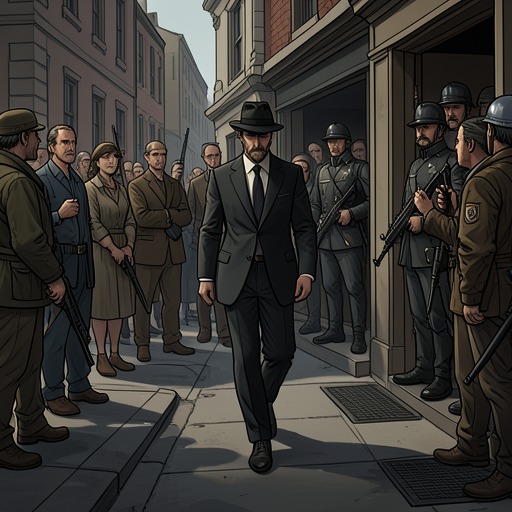
Dreamer
The Power of the DogDreamer is Flaco’s companion, a young man whose brief but consequential appearance moves from life beneath a bridge to a disputed death in custody. His story is bound to Flaco’s: the two are found together, endure the same ordeal, and are presented to the public as having died by mutual suicide. The discrepancy between that explanation and the unaddressed evidence makes Dreamer’s fate part of the novel’s account of how official stories can conceal violence rather than clarify it.
Identity and Introduction
Fabián Martínez finds Dreamer and Flaco living under the Laurel Street Bridge in Balboa Park. Their shelter places them at the edge of ordinary social protection, and their shared circumstances are established before the narrative supplies much individual history for either young man. Dreamer is defined chiefly through this companionship: he is not simply present beside Flaco, but remains the other person whose fear, voice, and fate become inseparable from his friend’s.
One night, while the two are dozing beneath the bridge, Fabián wakes them. Flaco first mistakes the person approaching for a threat, then recognizes Fabián. Dreamer’s uncertainty becomes audible in his brief responses. When the pair are confronted with the prospect of Mexican police, he can offer no reassurance; his hesitation conveys apprehension without explaining what he expects to happen. The scene establishes the imbalance between the vulnerable men and the authority now directing their movements.
Flight and Fear
As Fabián takes them toward the border, Dreamer and Flaco travel together in the back of the vehicle. Flaco’s fear is described in detail: his legs shake, his eyes fill with tears, and he feels ashamed even as he hears Dreamer sniffling nearby. The contrast matters. Flaco imagines his own fear as a private failure, but Dreamer’s distress shows that terror is shared, not a weakness belonging to one of them. Their companionship offers no protection from what is coming, yet it prevents either man from being entirely alone in the journey.
The exchange about the Mexican police remains spare. Dreamer says that he does not know what to expect, then begins to refer to the police without completing a fuller explanation. The narrative leaves the thought unfinished rather than providing a retrospective account of his knowledge or intentions. That limited speech gives the scene its uncertainty: Dreamer is not shown as possessing a plan or a way out, only as recognizing danger while events move beyond his control.
Captivity and Separation
Dreamer’s final hours are narrated through the men’s captivity and the separation imposed between them. With a hood over his head, he can still hear Flaco pleading. A gunshot follows, after which Flaco’s voice is no longer audible to him. The sequence establishes Dreamer’s perception of the moment, but does not by itself settle exactly what happened to Flaco or who caused the deaths that follow. Its emotional force comes from the abrupt break in their shared ordeal: Dreamer hears his companion, then hears nothing more from him.
The account also records the authorities’ treatment of the captive men in a manner that underscores their degradation without making it a spectacle. The federal officers hesitate to handle Flaco because he is filthy, and they make Dreamer remove his friend’s soiled clothing and clean him with a wet rag. In this circumstance, Dreamer is made to perform a basic act of care under coercive conditions, while both men remain in the hands of the authorities. The moment recalls their earlier dependence on one another, but now their companionship is being used within a process they cannot control.
Death and the Official Account
The men’s story reaches the newspapers the next morning. Later, Dreamer is found hanging beside Flaco, and the coroner returns a verdict of double suicide, attributing it to their supposed inability to live with guilt over Cardinal Juan Ocampo Parada’s death. The verdict supplies a motive and a neat explanation, but the narrative does not establish that the young men killed Cardinal Juan Ocampo Parada or that guilt drove them to die. Instead, the coroner’s account is presented as an official conclusion imposed on their deaths.
That conclusion leaves a conspicuous problem unresolved: the coroner does not address the unexplained blunt-trauma injuries to the backs of the two men’s heads. The discrepancy does not identify who harmed them or reconstruct exactly how they died, but it makes the suicide ruling inadequate as a complete account. Dreamer’s ending therefore has two layers: the reported finding that he died alongside Flaco, and the unresolved evidence that troubles the official explanation. The newspapers carry their story, but public circulation does not make that story reliable.
Narrative Significance
Dreamer’s limited characterization is integral to the episode’s effect. The narrative gives him little biographical detail, yet preserves several distinct traces of his experience: his uncertainty under threat, his fear during the journey, his voice reaching Flaco through the hood, and his forced care for his friend. These moments keep him from being reduced entirely to the coroner’s formulation of a guilty young man. His own words and actions reveal vulnerability and attachment, while the official account converts both into a claim about motive that the evidence does not confirm.
The contrast between the newspaper report and the unexplained injuries also makes Dreamer’s fate a test of authority and narration. The coroner’s verdict closes the case in public language, but the omitted evidence prevents closure for the reader. Dreamer remains connected to Flaco in death as in life, while the circumstances of that death stay unsettled. His story thus gives the episode its human cost and exposes the distance between an institutional explanation and what the narrative can actually establish.