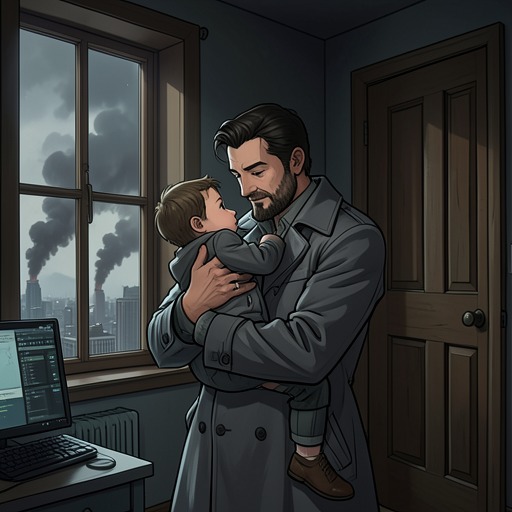
Gloria’s cystic lymphangioma
The Power of the DogGloria’s cystic lymphangioma is a congenital and eventually fatal condition that shapes her family’s life without being something her father’s money, influence, or faith can cure. The novel traces years of medical consultations and religious hope, but also gives Gloria a place in ordinary family life: she is taken on walks and outings, remembered in daily calls, and mourned as a daughter whose father could not be beside her at the end.
Condition and Medical Search
Gloria is born with cystic lymphangioma, a deformity affecting her head, face, and throat. The condition is incurable and eventually fatal. As she grows, her parents pursue possibilities across a broad range of specialties, consulting pediatric neurologists, neuropsychologists, psychoneurologists, endocrinologists, brain specialists, research chemists, herbal healers, and native healers. Their search extends from Mexico and Colombia to Costa Rica and several European countries, as well as specialists in the United States.
Don Adán Barrera cannot accompany Lucía and Gloria on their visits to Scripps in La Jolla or Mercy in Los Angeles. He sends written questions, notes, medical histories, records, and test results with them. Lucía, an American citizen, crosses the border under her maiden name and takes Gloria to appointments by herself; some trips last weeks or months. Each return brings the same answer: no new medical breakthrough, no newly discovered miracle, and ultimately nothing more the doctors can do.
On the visits he can make outside the United States, Don Adán goes with them. He studies the disease, asks questions, offers incentives and rewards, and makes substantial donations to research. He quietly encourages business partners to donate as well. His family lives comfortably, but the money devoted to doctors, research, religious observances, and charitable projects means they could have a larger home and more expensive possessions than they do. Lucía does not want the lavish mansions owned by other drug traffickers; both parents are prepared to give whatever they possess to anyone who might help their child.
Gloria’s Family Life
The account does not present Gloria only through medical appointments and prognosis. Don Adán does not hide her as though her condition were shameful. He takes her and Lucía on long walks in Tijuana’s Río district and brings her to parks, lunch, and the circus. In the city’s better neighborhoods, the three are a familiar sight. Shopkeepers know Gloria and give her small gifts, including candy, flowers, jewelry, hairpins, and bracelets.
When business takes Don Adán away, he calls Gloria several times a day. His regular journeys to Guadalajara and Culiacán, and a trip to Badiraguato, also become occasions to bring her presents and tell her jokes about things he has seen. These repeated calls and gifts place their relationship alongside the more visible work of pursuing treatment: he remains attentive to his daughter even when he is away on cartel business.
Lucía and Don Adán face the prognosis differently. She increasingly turns toward religion as medical efforts fail, attending church daily and bringing Father Esteban Rivera home for dinners, private prayer, counseling, and Bible study. She worries that doubt might impede a miracle and urges her husband to attend Mass, pray, give more to the Church, and speak with the priest. Don Adán goes to see Father Esteban Rivera to reassure her, though his faith is described as something he feigns more than possesses. He prays to Santo Jesús Malverde, yet places more hope in doctors than in religious intervention. Their shared hope and love persist even as the medical reports offer no promise of recovery.
Decline and Death
A little over four years before Gloria’s death, when she is twelve, her health worsens. With Don Adán’s approval, Lucía takes her to San Diego, where the Scripps clinics have leading specialists. After a month, Lucía calls Don Adán at his safe house in Mexico: the doctors believe Gloria has only days, perhaps hours, to live. Don Adán crosses the border concealed in the trunk of a specially outfitted car, smuggling himself as he would his own product, in order to reach his daughter.
Gloria dies in her sleep. Her condition has become fatal because the weight of her enlarged, misshapen head cuts off her breathing. She dies while Don Adán is not with her; his grief fixes on that absence as well as on the death itself. He blames Art Keller. The funeral is to take place in San Diego, the city where the family had sought the best available care when Gloria’s health failed.
Consequences and Narrative Significance
The disease exposes the boundary of Don Adán’s power. He can arrange consultations across countries, fund research, reward specialists, and provide a comfortable life, but none of these resources can secure a cure or a normal life for Gloria. The repeated journeys and the unchanged medical answer turn wealth from a measure of control into evidence of its limits. The family’s alternation between scientific treatment and religious hope records not a resolution but their continuing effort to live with an incurable illness.
Gloria’s illness also gives her father’s family attachments particular force. Elsewhere, Art Keller recognizes that becoming a father shattered his belief that he could live wholly alone; Don Adán’s devotion to Gloria similarly appears in concrete acts of care, including the daily calls and the effort to reach her in San Diego. Yet their stories do not resolve into the same outcome: Art describes fatherhood as a source of redemption, while Don Adán’s wealth and efforts cannot prevent his daughter’s death.
Her connection with her father also becomes vulnerable to the conflict surrounding him. Art’s team watches the household, monitors communications, and works to break the code used for messages between Don Adán and Gloria. Art later judges it comparatively easy to force Lucía to betray her husband and among the worst acts he has committed. The surveillance does not cause Gloria’s condition, but it shows how the family’s close ties and communications are drawn into the wider struggle. After her death, Don Adán’s grief joins his accusation against Keller, linking the loss of his daughter to the enmity that governs the story’s final events.