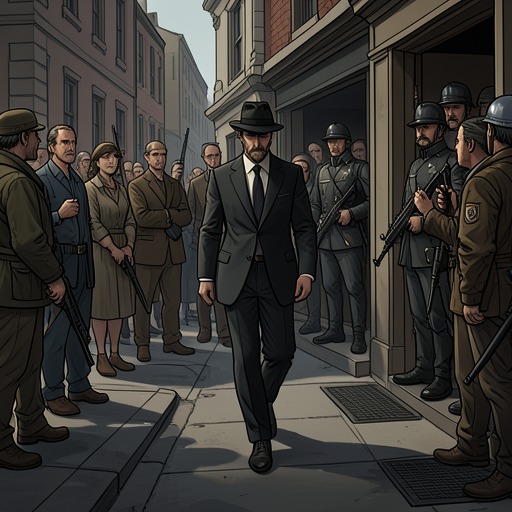
Hell’s Kitchen
The Power of the DogHell’s Kitchen is both the neighborhood Sean Callan grows up in and the local world whose loyalties, debts, and criminal authority shape his rise. In New York City in 1977, its streets are governed less by formal law than by memory and personal power: residents know who controls the neighborhood, who owes money, and who has crossed whom. The same streets that shelter Callan also make him visible, turning his violence into a public reputation and, eventually, a new source of neighborhood authority.
Setting and Inherited Memory
Callan’s Hell’s Kitchen childhood is framed by a dense inheritance of Irish Catholic nationalism and martyrdom. In the small West Side walk-up and at St. Bridget’s Elementary, images of execution and sacrifice surround him: Roddy McCorley hangs from the Bridge of Toome; James Connolly faces a British firing party; Wolfe Tone’s failed suicide ends before his hanging; and Christ is shown on the Cross. The sequence places Irish political memory beside Christian suffering, making martyrdom part of the neighborhood’s everyday visual and moral vocabulary.
The Stations of the Cross at St. Bridget’s extend that atmosphere from political history into religious instruction. Their scenes follow Christ’s whipping, crowning with thorns, and passage through Jerusalem under the Cross. As a child, Callan asks whether Christ was Irish; a nun answers that he was not, but might as well have been. The episode captures how the neighborhood’s religious and national histories merge in the imagination presented here. Its legends offer Callan a childhood world crowded with the dead, while the novel’s later criminal conflicts make violence a present-tense reality rather than an image on a wall.
A Neighborhood Governed by Matt Sheehan
At seventeen, Callan is already spending time in the Liffey Pub on Forty-seventh and Twelfth with O-Bop. A scene there shows how local life can gather around a single person’s trouble: Mickey Haggerty feeds roll after roll of quarters into the jukebox, playing Moon River for an hour while the other customers leave him undisturbed. He is drinking ahead of an appearance before a judge expected to send him away for eight to twelve years over a hijacking. The patrons’ silence is not ignorance; they understand the grievance behind his drinking. In Hell’s Kitchen, knowing when not to speak is part of knowing how the neighborhood works.
That local order has a powerful center. Matt Sheehan runs the neighborhood, the West Side Longshoremen’s Union, the local Teamsters, and operations including gambling, loan-sharking, and prostitution. He draws a line at drugs, and that prohibition is a point of pride as well as a source of popularity among older residents, who credit him with keeping their children away from dope. His authority therefore cannot be reduced to criminal control alone: it also presents itself as protection. The distinction is consequential, but fragile. The same man who claims to shield the neighborhood commands its illicit economy, leaving residents dependent on a power that is both protective and coercive.
Debts, Violence, and a Changed Balance
After the Rising of the Moon River, Callan’s position in Hell’s Kitchen changes. A month later he is still alive and has become a neighborhood hero. While Little Peaches is flushing Sheehan, Callan and O-Bop alter Sheehan’s little black book with a felt-tip pen. They erase some entries, reduce others, and preserve the debts they expect to yield the greatest return. The book makes neighborhood power tangible: authority is recorded not only in a name or reputation, but in obligations that can be canceled, revised, or enforced.
The consequences appear at the Liffey Pub, where Callan and O-Bop set themselves up as if they own it. People come to them grateful to be released from what they owed Sheehan, or afraid because they remain indebted to the men who took down Eddie Friel and Jimmy Boylan and may also have taken down Sheehan. The qualification matters: the account leaves Sheehan’s fate uncertain even as his authority has been disrupted. Callan and O-Bop have inherited leverage, but its practical reach still depends on what is written in the book and on what the neighborhood believes they can do.
Narrative Significance
Hell’s Kitchen is presented as a close-knit social system in which reputation travels farther than police knowledge. After Callan kills Kenny Maher, he sits sobbing in Forty-ninth Street, and O-Bop gets him away before the police arrive. The police never discover who killed Maher, while everyone else in the neighborhood learns the answer, including Eddie Friel. The contrast establishes a defining local asymmetry: official authorities can be outside the circle of knowledge even as neighborhood figures act on what is commonly known.
The neighborhood’s order thus changes hands without becoming an orderly or impersonal system. Sheehan’s protection, his prohibition on drugs, and his control of local debts give way to Callan and O-Bop’s selective rewriting of those debts and the fear or gratitude that follows. The Liffey Pub connects these stages: first it is where the seventeen-year-old Callan sits with O-Bop amid the neighborhood’s unspoken rules; later it becomes the base from which they exercise power. Hell’s Kitchen gives the book a specific measure of authority: who can act, who is protected, and who is believed are settled through personal knowledge and obligations, not simply through the law.