Liffey Pub
The Power of the DogThe Liffey Pub is a bar at Forty-seventh and Twelfth in New York City’s Hell’s Kitchen. It anchors two sharply contrasting moments in Sean Callan and O-Bop’s rise: first, an August afternoon of beer, resentment, and neighborhood memory; later, a month in which the pair use a dead gangster’s ledger to collect debts and exercise authority from the pub. The place’s significance lies in that change of function. It begins as a local gathering spot and becomes a provisional seat of power, without ever escaping the larger criminal hierarchy surrounding it.
Setting and Neighborhood
The pub is established through its address and its patrons. On a hot, humid New York afternoon, seventeen-year-old Sean Callan sits at the bar drinking beers with O-Bop. The heat gives the scene a close, irritable atmosphere, while the men’s attention returns to an older neighborhood grievance: what was done to Michael Murphy. O-Bop cannot let the matter go, and his insistence makes the pub a place where past injuries remain part of ordinary conversation rather than safely buried history.
The surrounding community is present in small, telling details. The only other customer besides bartender Billy Shields is Mickey Haggerty, drinking alone at the far end of the bar. He has fed a roll of quarters into the jukebox, repeatedly selecting E-5, so Andy Williams’s Moon River has played for about an hour. Callan and O-Bop do not interrupt him; they know about Mickey’s hijacking beef. The room’s relative quiet therefore does not mean that its customers are free of conflict. Personal histories and coming trouble sit alongside the beer and the music, understood by the regulars even when left unspoken.
Callan and O-Bop at the Bar
O-Bop’s anger over Michael Murphy is the immediate subject of the afternoon. He tells Callan that what happened to Murphy was wrong, then hunches over the bar and returns to his beer, turning sullen. About ten minutes later, Eddie Friel walks in, sees O-Bop, and loudly calls him a humiliating name. The pub thus becomes the setting where private resentment meets open provocation: O-Bop’s grievance is voiced before Eddie’s arrival, and the insult makes the room’s simmering antagonism immediate.
This early scene places the pub within the pair’s everyday life before their later elevation. Callan is only seventeen, and he and O-Bop are drinking rather than yet presiding over a neighborhood operation. The contrast matters: the same bar that first holds their youthful companionship and grievances will become the base from which they manage debts. Its continuity gives the change a physical measure. Their surroundings remain familiar even as their position within them alters.
The Pub as a Makeshift Headquarters
A month after the episode remembered as the Rising of the Moon River, Callan is still alive and has become a neighborhood hero. While Jimmy Peaches was flushing Matt Sheehan, Callan and O-Bop took a black felt-tip pen to Matt’s small black book and settled some of its debts. They removed some names, reduced other obligations, and kept the entries they believed would bring them the greatest returns. The pub becomes the place from which they administer those decisions.
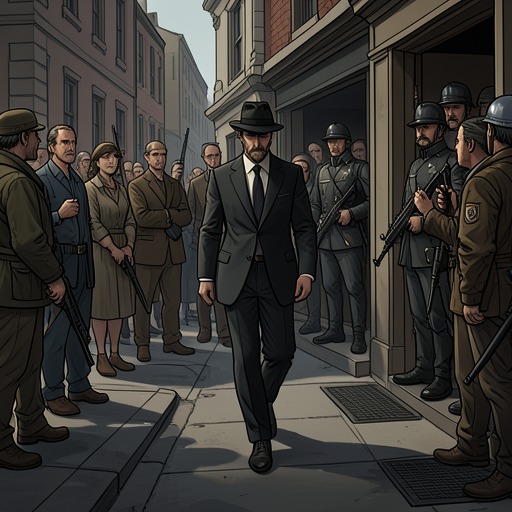
Callan and O-Bop set themselves up in the Liffey Pub as though they own it. The ledger gives that performance practical force: people come in to pay their vig or ask for favors. Some are grateful because Matt Sheehan is no longer collecting from them; others are afraid because the men behind the new arrangement are the ones who took down Eddie Friel, Jimmy Boylan, and probably Matt Sheehan himself. Their authority is therefore built from a mixture of relief, fear, and the reputation attached to violence. The pub does not simply shelter the pair; it makes their new role visible to the neighborhood, one payment or request at a time.
The arrangement also has limits. Callan and O-Bop can act like junior godfathers from a booth, and the black book gives them a claim on local debts, but their authority is not independent. Bobby is brought around and given a job whose new boss assumes he will not show up; he meets that expectation. Other people continue to arrive with payments or requests, so the pub sustains the pair’s brief routine of favors and collections. Yet the account of this period turns on the interruption that follows: the real godfather calls.
The Summons and the Pub’s Limits
Big Paulie Calabrese demands that Callan and O-Bop come to Queens and explain two things: why they are not dead, and why his friend and associate Matt Sheehan is. The summons exposes the difference between the boys’ local standing and the power that governs it. In the Liffey Pub they can receive payments, grant favors, and appear to control the neighborhood; elsewhere, a senior figure can require them to answer for the violence that made their position possible.
The pub’s arc is consequently one of provisional ascent rather than secure ownership. It witnesses Callan and O-Bop’s transition from young drinkers into neighborhood operators, and its familiar bar and booth give their authority a recognizable center. But Big Paulie’s demand makes clear that the ledger and the grateful or fearful customers cannot settle the larger question of who has the right to rule. The Liffey Pub remains their local base, while the summons to Queens pulls them back into a hierarchy they do not control.