Operation Condor
The Power of the DogOperation Condor is a Mexican-led military and aerial campaign against opium cultivation in the Sinaloan mountains. It brings together thousands of Mexican troops, federal police, and American-backed aircraft in an effort to destroy the source of Mexican heroin. Its decisive significance lies in the reversal that follows: the campaign disperses the Sinaloan trafficking network rather than ending it, helping push its members toward cross-border transportation and giving Tío the opportunity to build a larger organization. For Art Keller, who helps direct the operation, that reversal eventually means recognizing that his success against one drug network helped another take shape.
Campaign and Setting
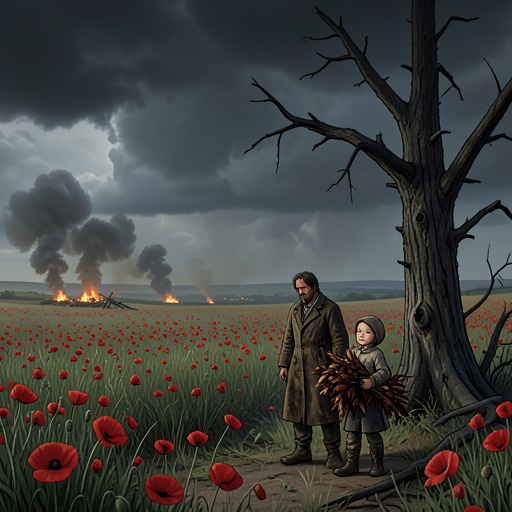
The operation advances through a valley near Badiraguato, where the crop being targeted is opium poppy rather than rice. The surrounding Sierra Occidental offers the altitude, rainfall, and soil conditions needed to grow the poppy. Its opium can be converted into Mexican Mud, a cheap and potent heroin reaching American cities. The campaign’s stated objective is to destroy this source by poisoning poppy fields, burning what remains, and scattering the growers, known as gomeros.
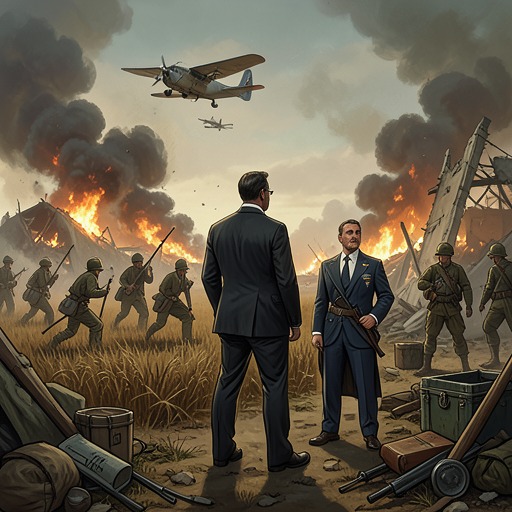
The ground operation is extensive: ten thousand Mexican Army troops push through the valley alongside units of the Municipal Judicial Federal Police, commonly called the federales, and a small group of Drug Enforcement Administration advisers that includes Art. Most soldiers travel on foot; others ride horses, moving through the terrain as if driving cattle. The scale makes Operation Condor a military sweep as well as an eradication effort, extending the American War on Drugs into Mexico under Mexican official command.
The aircraft make the operation’s joint character more complicated. They are officially Mexican, and the campaign is presented as a joint operation of the Ninth Army Corps and Sinaloa, Mexico. Yet the planes were paid for by the Drug Enforcement Administration and flown by its contract pilots, many of whom had previously worked for the Central Intelligence Agency in Southeast Asia. The arrangement recalls an earlier history of American aviation in the region: some of these pilots had once flown heroin for Thai warlords and now flew missions spraying Mexican poppy fields.
Aircraft, Chemicals, and Art Keller’s Role
Fixed-wing aircraft carry out the spraying while helicopters circle above them, helping protect the planes from occasional gunfire by growers who continue to resist. Art understands that even a brief, accurate burst from an AK-47 could bring down a helicopter. The aircraft have not been hit, but their exposure to fire makes clear that eradication is not a distant administrative procedure; it is conducted in contested terrain under armed protection.
The proposed use of Agent Orange meets Mexican resistance. The aircraft instead spray 24-D, a different compound that Mexican officials find more acceptable in part because growers already use it to kill weeds around their poppy fields. That detail links the eradication effort to the agricultural practices it is intended to defeat: a chemical familiar from cultivation becomes part of the campaign against it.
Art’s importance is not limited to advising the operation. He has a remarkably detailed understanding of the province’s poppy fields, processing sites, and laboratories, and he can direct forces toward their targets with something close to a personal map. Even as the broader sweep succeeds, however, the Drug Enforcement Administration remains focused on capturing Don Pedro Áviles. The campaign’s measurable destruction of fields does not displace the agency’s pursuit of the trafficker it considers its central prize.
The name gives the campaign an image that complicates its official purpose. Art reflects that no condor has been seen in Mexican skies for decades and learns that the bird is more scavenger than hunter, often feeding on an animal killed by something else. The name is meant to make an operation feel real, but its association with scavenging also shadows a campaign conducted amid death and destruction. Its airborne machinery and the book’s image of death from the sky give the eradication effort an echo of Vietnam, a memory Art recognizes in the sound of helicopter rotors and would rather leave buried.
Immediate Results and Hidden Advantage
From the authorities’ perspective, Operation Condor succeeds. Sinaloan fields are burned, the ground is poisoned, the gomeros are scattered, and Don Pedro Áviles is killed. American officials believe they have destroyed the source of the problem and can turn their attention elsewhere. The appearance of victory encourages complacency: they assume Mexico’s drug trade has been broken rather than driven into a different form.
Tío sees the result differently. With the old fields destroyed and a major rival removed, he recognizes that American confidence in the campaign’s success will give him time and freedom to organize. Art later understands the personal cost of his own role: during the Condor period, Tío used him to take out rivals, allowing Art to believe he was dismantling the network when his actions were helping Tío prepare a larger one. The operation’s military effectiveness and its political consequences therefore move in opposite directions. What appears to be a decisive defeat for trafficking becomes an opening for consolidation.
The transition takes organizational form in the Federación. Tío anticipates that the Americans will return to sleep as far as Mexico is concerned, while he uses their mistaken confidence to develop an organization they will be less able to reach. In Guadalajara, the new structure offers protection and connections in exchange for a fee, extending the logic of the group beyond field production and into business and political relationships. Operation Condor does not itself create every later arrangement, but the resulting diaspora and the false belief that the trade has been eliminated form part of the opportunity in which the federation expands.
From Cultivation to Transportation
Art later identifies the operation’s unintended consequence as a transformation of the Sinaloan network. Instead of remaining dependent on growing drugs in the mountains, its members learn to make use of their more durable advantage: the two-thousand-mile border with the United States. Fields can be burned, crops poisoned, and people displaced; the border remains. A commodity worth little on one side can be worth thousands on the other, making the ability to move it across the boundary more valuable than control of a particular growing area.
The Federación accordingly shifts from drug cultivation toward transportation. It makes an arrangement with the Medellín Cartel and Cali Drug Cartel under which Colombian traffickers pay the Mexicans for safely delivering cocaine inside the United States. The Mexicans receive the cocaine, move it to staging points near the border, take it across, and transfer it to safe houses and back to the Colombian organizations. Those organizations then process it into crack. The arrangement places the federation in the route between Colombian supply and the American market, turning geography and reliable movement into its principal commercial assets.
The later scale of the business exposes the limits of the operation’s official narrative. When Art reports evidence of Mexican cocaine trafficking, senior officials dismiss it as invention, insisting that Operation Condor destroyed the trade and that the cocaine comes from Colombia. The resulting gap between what the authorities claim and what Art observes is part of the campaign’s aftermath: success has become a reason not to recognize the network’s changed form. Operation Condor suppresses a crop, but its consequences help shift trafficking toward a border-based business capable of growing beyond the campaign’s original target.