Red Mist Network
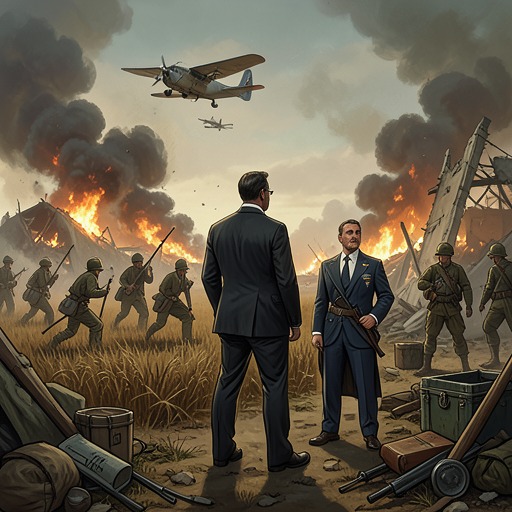
The Power of the DogThe Red Mist Network is the code name for a regional system coordinating operations to neutralize left-wing movements across Latin America. It is not presented as a single army or agency: its power comes from connecting forces that remain separately organized, and sometimes do not even know that their actions form part of a wider campaign. John Hobbs oversees the operation; Sal Scachi manages its daily coordination. The network’s covert reach makes it a hinge between anti-Communist policy and the armed, intelligence, political, and criminal actors used to pursue it.
Structure and Coordination
Red Mist functions as an information and logistics network. Scachi’s work is to share intelligence, distribute assets, ensure targets are acted upon, and keep participating operations from obstructing one another. The arrangement requires coordination across groups with distinct chains of command, rather than a single visible organization issuing every order. Some operations are unaware they are being coordinated under Red Mist at all, a concealment that lets the network align their actions without requiring them to share a public identity.
The system’s scale makes Scachi’s intermediary role consequential. Red Mist encompasses hundreds of right-wing militias and their drug-lord sponsors, about a thousand army officers and several hundred thousand troops, and dozens of separate intelligence agencies and police forces. The Church is also part of this landscape. Hobbs supplies overarching direction, while Scachi handles the day-to-day work of moving information and resources among otherwise dispersed participants.
Personnel and Institutional Alliances
Scachi embodies the network’s overlap of military, intelligence, criminal, and religious affiliations. He is a Green Beret, a sometime asset of the Central Intelligence Agency, and a made member of the Mafia. He can leave the army on detached duty and work for Hobbs, serving as a trusted intermediary across those worlds. His military and intelligence background is joined to an established place in organized crime, giving him access to relationships that do not fit neatly within official institutional boundaries.
His religious commitments reinforce the ideological side of that alignment. Scachi is a Knight of Malta and a member of Opus Dei, a conservative Catholic organization described as fervently anti-Communist. The novel places these affiliations within a divided Catholic Church: conservative leadership in the Vatican is opposed to liberation theologists, including left-wing and often Marxist priests and bishops working in the developing world. Knights of Malta and Opus Dei members work alongside right-wing militias, army officers, and, when necessary, drug cartels. Red Mist therefore operates in a setting where religious and political commitments can connect actors who also possess military or criminal power.
Reach and Human Consequences
The novel situates Red Mist within a wider, prolonged conflict between Marxist rebels and their opponents. Across Latin America, that conflict is described as a shadow war between the right and the left, with liberals caught between them. Its human toll includes more than 150,000 people killed and another 40,000 never found. The account names homeless children and college students among those murdered, as well as a university professor and American religious workers. These atrocities are not all assigned to Red Mist as individual operations; rather, the network is presented as a persistent coordinating presence within the broader campaign.
The role of the United States is part of that context. American soldiers provide training, advice, and equipment, including helicopters used to transport killers to killing grounds. By the end of the 1980s, President George Bush is so disgusted by the carnage that he cuts off funds and armaments for the Guatemalan military. The episode shows the gap between the network’s stated anti-Communist purpose and the violence carried out in its surrounding political and military landscape, as well as the eventual political cost of that violence.
Red Mist in the Wider Campaign
Scachi has participated in anti-Communist campaigns across several regions and theaters: Vietnam, Cambodia, and the Golden Triangle; Mexico; Central America through Cerberus; and South America through Red Mist. The distinction between operations matters. Red Mist is the South American network named here, while Cerberus is identified as the channel for the Central American campaign. Their appearance within Scachi’s career connects separate covert efforts without making them interchangeable.
The network’s reach also links political warfare to drug trafficking. Its militias have drug-lord sponsors, and its collaborators include cartels when needed. This is not simply an account of criminals exploiting a government campaign from outside: the alliances described place drug organizations within a field of anti-Communist cooperation involving military officers, police, intelligence services, and religious conservatives. Red Mist’s structure makes those connections possible while its compartmentalization obscures how the larger system works.
Exposure and Narrative Significance
Red Mist becomes a potential public scandal when Cardinal Juan Parada threatens to expose operations in which Scachi has served. Scachi is considering what to do with information Parada wants to pass to the Vatican, and he asks whether Cerro went to see the Cardinal. The threatened disclosure brings the network’s concealed history into direct conflict with the Church’s internal divisions: information about the campaign may travel through the same institution whose conservative members have cooperated with its forces.
The network’s significance lies in the combination of broad reach and fragmented responsibility. Hobbs’s oversight, Scachi’s coordination, and the many participating institutions make Red Mist more than a label for isolated actions, yet its compartmentalized structure makes accountability difficult to locate. Its recurring presence across the novel’s account of Latin American anti-Communist warfare exposes how an ostensibly political campaign can depend on covert coordination, military assistance, religious alliances, and criminal partners—and how the secrecy that enables that cooperation also becomes vulnerable when someone threatens to reveal it.