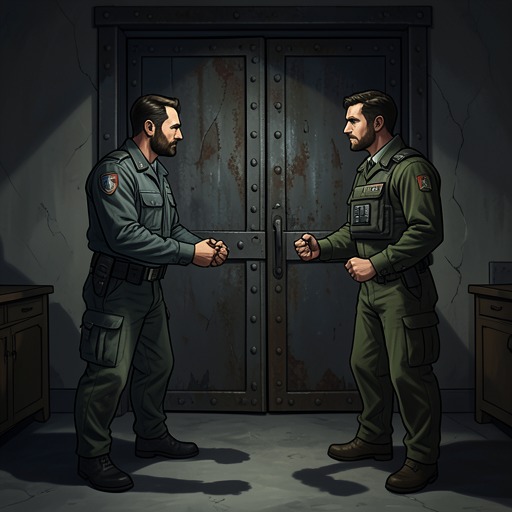
Russ Dantzler
The Power of the DogRuss Dantzler is a narcotics officer with the San Diego Police Department whose partnership with Art Keller converts covert intelligence into police action. Keller approaches him after they meet at an inter-agency conference, and Dantzler becomes both a practical ally and a reminder that even a clandestine arrangement must pass through the forms of law.
Identity and Introduction
Dantzler works on the San Diego Police Department’s narcotics squad. Keller remembers meeting him at an inter-agency conference a few months earlier and regards him as capable and willing to act. When Keller needs someone prepared to move on information that the federal authorities cannot be allowed to trace back to him, he chooses Dantzler.
The arrangement begins in a phone booth. Keller reflects on the reversal: in the United States, it is the police who must sneak around and use pay phones. That thought sets the tone for Dantzler’s role. He is not simply a recipient of a tip; he is the local officer Keller trusts to turn an informally delivered lead into an operation while keeping Keller’s involvement concealed.
Partnership with Keller
Keller warns Dantzler that the information may be false but believes it is worth pursuing. Dantzler responds with a practical question about what Keller expects from him. Keller asks to be kept both out of the investigation and informed of what it uncovers: Dantzler is to forget the tip came from him while sharing any intelligence that results. Dantzler agrees, but immediately sets a condition: he needs a warrant, invoking the protections of a democracy and the rights of its citizens.
The two men’s bargain therefore contains a tension from its beginning. Keller wants the benefit of an investigation without an official connection to it; Dantzler accepts the concealed-source arrangement but does not treat that as permission to dispense with legal process. Their understanding is neither a formal partnership nor a simple informant exchange. It depends on secrecy, reciprocal obligation, and a warrant that gives the police action an ordinary procedural basis.
The account also makes the mechanism of that basis explicit. Dantzler is expected to pass the information to one of his officers, who will give it to an informant; the informant will return it to Dantzler, who can then take it to a judge and establish probable cause. The circuitous chain allows Keller’s tip to prompt action without appearing as its direct source. Its careful construction shows how the boundary between intelligence work and police procedure can become a matter of managing the trail by which information reaches the court.
Seizures and Field Operations
The next day, Dantzler calls Keller at their prearranged time and reports that the operation has seized three hundred pounds of cocaine, which he values at six million dollars on the street. He promises Keller substantial credit for the result. Keller refuses public acknowledgment, telling him to forget the tip and remember the debt instead. Their exchange clarifies the terms of their cooperation: Dantzler can recognize Keller’s contribution privately, but Keller prefers an obligation that can be called in later to visible credit that could expose him.
The arrangement has further consequences beyond that seizure. Two weeks later, El Paso police owe Keller for the seizure of a trailer-truck full of cocaine, and a month afterward Keller brings Dantzler another tip, this time concerning a house in Lemon Grove. The narrative thus presents the original exchange as the beginning of a recurring channel for information, rather than a single favor. Dantzler is one of the officers through whom Keller can turn intelligence into enforcement results while remaining outside the official line of attribution.
Dantzler is also present in a more precarious operation involving a plane and a remote airstrip. As ten minutes pass, Keller imagines several ways the plan could fail: the pilot might turn back, the real airstrip might reach the plane by radio, or an earthquake might split the strip. The waiting makes the operation’s vulnerability palpable; its success depends on holding the aircraft to the intended landing place and preventing competing communications from redirecting it.
When the pilot sees a man approach, he appears relieved. The man then points a gun at him, and Dantzler identifies himself and begins reciting the pilot’s right to remain silent. The arresting words transform the pilot’s relief into speechlessness. Dantzler’s sudden appearance gives the operation its decisive turn: the carefully managed approach ends not in a safe landing but in the pilot’s confrontation with the law.
Procedure, Secrecy, and Narrative Role
Dantzler’s scenes connect two kinds of police work. In the phone-booth arrangement, he helps Keller conceal the source of intelligence while constructing a route toward probable cause and a warrant. At the airstrip, he is no longer merely the officer who receives a tip: he steps forward with a gun and asserts the familiar rights of an arrested suspect. The contrast makes his role concrete—he can participate in covert coordination, but the final encounter is expressed through the recognizable language of criminal procedure.
His relationship with Keller is defined by controlled mutual obligation. Dantzler promises Keller credit, but Keller rejects that recognition in favor of a private debt. Dantzler, for his part, agrees to cooperate without surrendering his insistence on a warrant. These details keep him from being only a convenient instrument in Keller’s hands: he has his own operational judgment and a stated procedural limit, even as he joins a scheme designed to obscure how its investigation began.
The book gives Dantzler little personal history beyond his police work and his earlier meeting with Keller. His significance lies instead in the practical link he supplies between information, an investigation, and an arrest. Through him, Keller’s private intelligence can produce measurable seizures, while the elaborate relay of sources exposes how secrecy and lawful procedure are made to coexist uneasily.