SETCO
The Power of the DogSETCO is a Honduran airfreight company that becomes a revealing point of contact between cocaine trafficking, cross-border transport, and the covert political networks surrounding Central America. Art Keller’s investigation traces its ownership to a drug-world veteran and a former intelligence operative; its aircraft then appear in scenes that complicate the supposedly straightforward story of commercial aviation. The company’s significance lies not in a fully documented account of its operations, but in the way its routes, owners, and cargo make the boundary between legitimate transport and clandestine power difficult to maintain.
Identity and Discovery
Art and Shag Wallace identify SETCO while following the paper trail for a DC-4 bearing the serial number N-3423VX. The trail runs through holding corporations, shell companies, and business names before ending at Servicios Turísticos, an airfreight company operating from Aguacate Airport in Tegucigalpa, Honduras. The corporate layers make the discovery more than a matter of locating an aircraft: the inquiry has to work through arrangements that obscure who owns and operates it.
The Honduran registration answers one practical question in Art’s investigation: where the DC-4s are refueling. Honduras’s longstanding place in regional drug commerce makes the location plausible to him, but the plane’s route raises a further problem. Art understands the official account to be that a major cocaine dealer owns an airline and uses it to fly cocaine to Miami. At least one SETCO aircraft, however, is flying to Guadalajara. That destination does not fit the account, and turns a seemingly settled explanation into a new line of inquiry.
Owners and Political Histories
SETCO’s two partners are David Núñez and Ramón Mette Ballasteros. Núñez, a Cuban expatriate living in Miami, is notable to Art not simply for his exile but for his past with Operation 40, a CIA operation that trained Cuban expatriates for political action after the Bay of Pigs invasion. The invasion failed; some members of the operation died or were executed, while Núñez returned to Miami. His biography places SETCO’s ownership within a history of intelligence work whose personnel and networks did not disappear when the original mission collapsed.
Mette has a different but equally consequential history. He had been a chemist for the gomeros during the heroin trade’s heyday, left before Operation Condor, returned to Honduras, and entered the cocaine business. Art also knows the report that Mette personally financed a recent coup against the Honduran president. Together, the partners’ backgrounds join drug commerce to political influence: one has experience in covert anti-Castro operations, the other is a drug chemist turned trafficker associated with the financing of regime change. The narrative presents these as histories that illuminate SETCO’s ownership, not as proof that every company flight served a political purpose.
Aircraft and the Cocaine Route
The wider trafficking system in which Art encounters SETCO depends on transport as much as production. The Federation’s arrangement with the Medellín and Cali organizations pays the Mexicans $1,000 for each kilo of cocaine safely delivered inside the United States. In that model, the Mexican organization shifts from growing drugs to moving them: cocaine travels from Colombia to border staging areas, crosses into American safe houses, and is handed back to Colombian traffickers for processing. The neglected route through Mexico matters because U.S. enforcement has heavily pressured the Florida routes.
SETCO enters this investigation through the aviation and documentary evidence around that system, although the novel does not reduce the whole route to the company alone. Chris Conti meets Art in Quepos, Costa Rica, deliberately keeping their discussion from Tim Taylor and others. Conti brings deposit slips from small-town banks in the Medellín area; they match cashier-check receipts recovered in a San Diego raid and provide documentary proof linking the Barrera organization with Colombian cocaine. That evidence broadens the investigation’s picture of the network, while the unexplained SETCO flight to Guadalajara keeps the company’s own role open to scrutiny.
Art later watches a SETCO flight arrive at the airfield. The white DC-4 is not an abstraction in a corporate file: its arrival makes the scale and persistence of the traffic visible to him. He reflects that seizures of drugs and cash cannot end the flow while the Mexican Trampoline remains in operation, carrying cocaine from Colombia through Honduras and Mexico into the United States, where it is processed into crack. The shipment’s destination is not simply a market of wealthy users; the novel emphasizes crack sold cheaply in poor Black and Hispanic communities, naming Harlem, Watts, South Chicago, East Los Angeles, Roxbury, and Barrio Logan. The aircraft is one part of a chain whose value and harm are realized far beyond the airport where it lands.
Cargo and the Covert Landscape
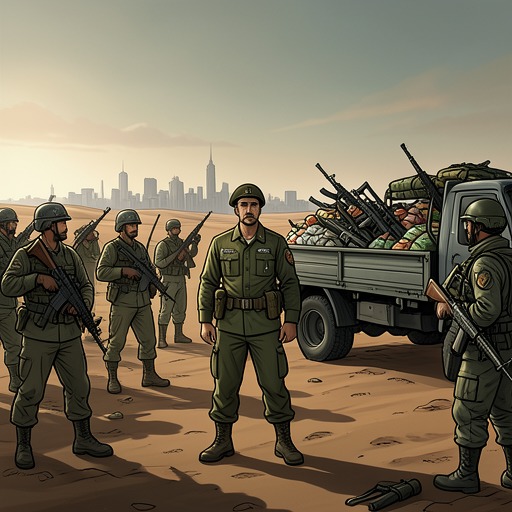
A SETCO plane also appears at a compound of numbered Quonset-style hangars. In Hangar 4, two dozen armed men, some in fatigues, unload cargo from the aircraft while three others stand apart and talk. Art reads the division between workers and observers as a clue to command: the men doing the talking are likely in charge. Among them he recognizes Núñez, SETCO’s partner and Operation 40 veteran. The scene gives the company’s aviation a material presence in an armed setting, linking its corporate identity to people and activity that cannot be explained by routine freight alone.
The surrounding political narrative sharpens that implication without establishing a simple, explicit chain of command from SETCO to every covert operation. John Hobbs argues that Central America is a strategic battleground, presenting Nicaragua’s proximity to Honduras, El Salvador, Guatemala, and southern Mexico as a threat requiring action. He describes Cerberus as authorized at the highest level, while Sal Scachi’s account of Red Mist depicts a coordination network spanning militias, drug-lord sponsors, military officers, intelligence agencies, police forces, and the Church. Later, U.S. military equipment intended to help Mexico suppress drug trafficking is quietly transferred for use against insurgents in Chiapas and Guerrero. In this political environment, an airfreight company owned by men with drug and intelligence histories sits at a suggestive junction of commerce and covert power; the text’s evidence supports that proximity, while leaving the precise function of each flight uncertain.
Narrative Significance
SETCO gives Art’s inquiry a corporate and logistical dimension. The company is not introduced through a dramatic declaration of allegiance but through a serial number, a maze of business entities, and an unexpected destination. Each finding changes the meaning of the previous one: Honduras explains the refueling, the owners’ pasts complicate the corporate profile, and the flight to Guadalajara refuses to fit the official account. The hangar scene then puts a partner beside armed men unloading a plane, making the distance between paperwork and force seem perilously small.
The contrast between the modest language of airfreight and the consequences of the cargo is central to SETCO’s role. The novel’s transportation network makes geography itself an instrument of profit: a product worth little at one point in the chain becomes vastly more valuable across a border, and the route survives individual seizures because it is distributed across countries and intermediaries. SETCO’s flights do not resolve Art’s investigation; they expose its deeper problem. The aircraft can be tracked, companies named, and receipts matched, yet the movement of drugs and the political arrangements surrounding it continue to exceed any single target.