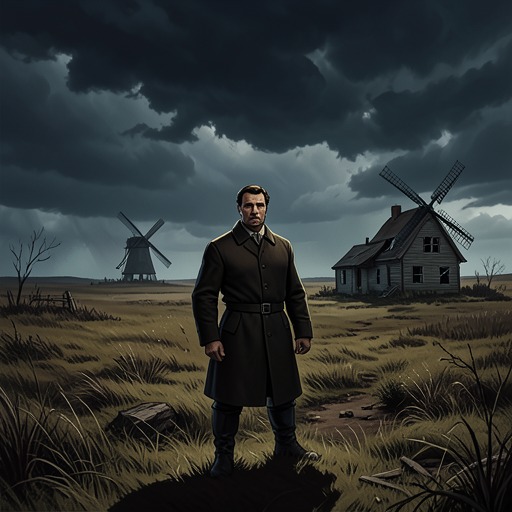
The power of the dog
The Power of the DogThe power of the dog is the novel’s recurring image for a force that overwhelms moral intention and draws people into violence. Anchored in Psalm 22:20, it frames Art Keller’s guilt at El Sauzal, resurfaces at moments when he confronts Tío and Don Adán Barrera, and ends beside a prayer he does not fully understand. Its force comes from repetition: what first appears as evil in the aftermath of one atrocity becomes a name for violence that travels through personal revenge, the drug war, and political intervention.
Scriptural Frame and First Appearance
The phrase appears first through the epigraph from Psalm 22:20, whose plea asks for deliverance from the sword and from the power of the dog. The wording establishes a contrast between a person seeking rescue and a force capable of threatening both life and love. The novel does not confine that force to a single antagonist. As it recurs, the phrase gathers associations from several different scenes, making it a connective motif rather than a simple label for one character.
At El Sauzal, Art Keller bends over a dead mother and child, thinks that he has brought this suffering upon the people there, and makes the sign of the cross. A Mexican police officer murmurs the Spanish phrase, which the narrative immediately renders in English as the power of the dog. The placement makes the image part of Art’s encounter with the consequences of violence, not merely a description of the violence itself. His gesture of prayer and his remorse coexist with the scene’s irreversible loss; neither undoes what has happened.
The novel later repeats this passage at the beginning of Part Five, after introducing the El Sauzal prologue earlier. That return gives the phrase a structural role: the reader meets the image again before the story moves into its final section. The repetition keeps the civilian dead and Art’s sense of responsibility present as the narrative advances. It also resists treating the episode as a closed prologue whose consequences can be left behind.
Art Keller and the Recognition of Evil
The phrase returns when Art confronts Tío. Tío tells Art that Ernie Hidalgo died in his place, appeals to old relationships, and demands that Art act. Art squeezes the trigger; Tío grins, and Art feels the presence of pure evil. The narrative names that feeling with the power of the dog. Here the motif attaches itself to a charged personal encounter, in which loyalty and sacrifice are invoked within a confrontation shaped by violence.
The scene complicates any reading of evil as something safely external to Art. Earlier, Art considers that the power may lie in everyone, then admits that it was in him. This reflection makes the phrase an accusation as well as a recognition. Art is not presented as untouched by the force he opposes: he has participated in a world whose actions have produced suffering, and he understands himself as implicated. The motif therefore marks not just the presence of a dangerous adversary but the difficulty of separating resistance to violence from one’s own capacity to enact it.
At the novel’s end, Art’s confrontation with Don Adán Barrera makes that tension explicit. Art holds Don Adán beneath the water while recalling the dead baby in its mother’s arms. He invokes El Sauzal and Father Juan Parada as reasons for what he is doing; the memory of the child shapes the scene even as Art acts in the present. The narrative again identifies what he feels as the power of the dog. The recurrence links his revenge to earlier losses, but it does not make revenge equivalent to justice or erase Art’s responsibility for his choice.
From Personal Violence to Political Systems
The phrase’s reach extends beyond the direct confrontations between Art and the men he pursues. In Colombia, Art questions the use of glyphosate mixed with Cosmo-Flux and asks whether spraying destroys food crops as well as coca. He sees wilted coca fields and presses his hosts about damage to beans, bananas, maize, and yucca. He also notes that spraying from above the recommended height risks drift onto other crops. The scene locates the costs of anti-drug action in the land and livelihoods of small campesinos, not only in the activities of drug organizations.
Art’s questions also expose the political frame around the spraying. He suspects that the campaign is directed not only at coca cultivation but at Communist guerrillas living and fighting in the jungle. The stated campaign against drugs thus sits alongside a conflict involving armed groups and state policy. In another exchange, Art demands to know whether the Americans are training AUC; the response is that the matter is restricted to those who need to know. His insistence that he needs to know makes the suppression of information part of the same moral problem: violence is carried out within relationships of authority that limit what can be acknowledged.
Don Adán’s account of Red Mist widens that pattern further. He argues that the bloodshed associated with American consumption reaches beyond drugs to oil, coffee, and security, and contrasts his own acknowledgment of wrongdoing with American denial. The evidence he has copied from Father Juan Parada’s briefcase includes material about Operation Cerberus, the Federation’s cooperation with Americans in the Contra drugs-for-arms operation, and Operation Red Mist. It also concerns assassinations of left-wing figures, efforts to fix Mexican presidential elections, and cooperation between Mexico City and the Federation. Don Adán additionally holds knowledge of the Colosio assassination and Art’s perjury before a congressional committee investigating Cerberus. The power invoked by the recurring phrase can therefore be read against a network in which criminal violence, covert action, political manipulation, and concealment intersect.
The Closing Prayer and the Motif’s Meaning
After the killing of Don Adán, Art watches water bead on flower petals and mutters a fragment of a prayer he once heard. The prayer asks for deliverance from the sword and for love to be saved from the power of the dog. Art does not fully understand the words, but they have remained with him. Their return at the close echoes the epigraph and the El Sauzal scenes, bringing the novel’s images of violence and pleading for rescue into the same frame.
The ending offers no simple release from the motif. Art’s prayer follows an act of revenge, not a restoration of the dead or an escape from responsibility. The phrase has accompanied his perception of evil in others, his recognition of its presence within himself, and his awareness of systems that distribute violence while obscuring who bears its costs. By returning to the prayer after Don Adán’s death, the novel leaves the plea for deliverance unresolved: the force has been named, but naming it has not made Art free of it.