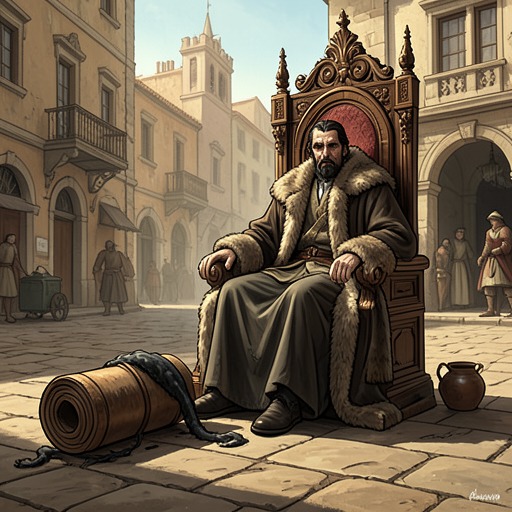
Ludovico Sforza
The PrinceLudovico Sforza appears in the political history of Milan as the force that twice displaced French rule. His importance lies less in a developed personal portrait than in the lesson attached to his actions: a conquest opened by local hopes can collapse when those hopes are betrayed, yet the same recovery becomes far more difficult once the new ruler has had time to punish opponents and consolidate authority.
Identity and Political Setting
Ludovico Sforza is identified as the Duke of Milan, and he is also referred to as Duke Lodovico. His appearance belongs to the discussion of mixed principalities, territories joined to an established dominion after conquest. Such states are unstable because the population often takes up arms against its ruler in the hope of improving its condition, only to discover that the new regime may leave it worse off. The conqueror must quarter troops, impose other burdens, and offend those whose position or expectations are damaged by the change.
Milan illustrates the resulting dilemma. The people who opened the gates to the French King expected future benefits, but when those hopes proved false they could no longer tolerate the insolence of their new ruler. The same inhabitants who had facilitated conquest therefore became a source of resistance. Ludovico Sforza exploited that fracture rather than attempting to defeat France by force alone.
Recovery of Milan from France
On the first occasion, Ludovico Sforza was able to take Milan from France with his own forces only. The decisive circumstance was not that France lacked military strength, but that French possession had failed to secure the goodwill of the population. Once the inhabitants felt deceived, the occupation lost the political support that had enabled it in the first place. Ludovico’s intervention converted that disaffection into a successful recovery.
The contrast between the first and second recoveries gives the episode its analytical force. At first, a duke raising alarms on the frontiers was enough to wrest Milan from France. After the city had rebelled and been brought again under French control, however, the French could use the rebellion as a pretext for punishing the guilty, trying suspected persons, and strengthening whatever parts of their position had been weak. Rebellion thus made a conquest harder to lose, because it supplied the ruler with justification for repression and administrative consolidation.
To recover Milan a second time, the whole world had to be ranged against France; its armies had to be destroyed and driven out of Italy. Yet Milan was lost to the French King again. The repeated reversals distinguish the two episodes: the first loss followed the immediate alienation of the population, while the second occurred despite the greater effort required to overcome a regime that had learned from the earlier revolt.
Milan as a Case of Mixed Rule
The discussion of Milan forms part of a broader distinction between territories sharing the conqueror’s province and language and territories differing in language, customs, and laws. Similar territories are easier to retain when the old ruling line is removed and existing laws and taxes are left unchanged. In that circumstance, the new acquisition can become incorporated into the hereditary dominion without a complete transformation of local life.
Where language, usages, and laws differ, the difficulties multiply. A prince may need to reside personally in the acquired province so that disorders can be detected at their beginning, officials cannot plunder the population unchecked, and inhabitants have direct access to the ruler. Colonies may also be established as strategic keys to the province, though this requires dispossessing a limited number of inhabitants and risks creating resentment among those who lose fields and houses. The alternatives are a substantial military presence or a carefully secured local administration.
Milan’s history demonstrates that conquest cannot be maintained by military capture alone. France gained the city quickly, but failed to preserve it because it did not manage the relationship between the occupying power, the local population, and the wider Italian balance of power. The episode is therefore connected to the general principle that a ruler entering a new province must obtain the inhabitants’ goodwill, not merely command an army strong enough to enter it.
Relations with France and Italian Power
Ludovico Sforza’s struggle with France also serves to expose the consequences of enabling another power’s rise. France’s interventions in Italy helped enlarge the power of the Church and Spain, while those same developments contributed to France’s ruin. The political axiom drawn from this sequence is that the person who causes another’s greatness may himself be undone, because the means used to raise a rival—diplomacy or force—creates distrust in the power that has been elevated.
The episode is set within a wider comparison of rulers and conquerors. Alexander the Great could secure the kingdom of Darius because its centralized structure resembled that of the Turk: once the sovereign and his family were removed and the main army defeated, there were few independent figures capable of carrying the population into revolt. France presented the opposite difficulty. A kingdom surrounded by ancient nobles could be entered through the discontent of a baron, but possession remained precarious because those same lords could later organize resistance.
This distinction clarifies Ludovico’s opportunity. Milan was not an isolated military prize but part of a political environment in which local rulers, foreign monarchies, ecclesiastical power, and shifting alliances competed for influence. His first recovery depended on the weakness produced by French misrule; the later struggle showed that every successful occupation altered the conditions of the next contest.
Historical and Thematic Significance
Ludovico Sforza functions as a historical counterexample to the belief that rapid conquest is equivalent to secure government. His recovery of Milan shows that the population’s expectations can open a city to an invader, while disappointment can turn those same expectations against the new ruler. It also shows that a ruler who survives an initial rebellion may use punishment and institutional strengthening to make a later revolt much less effective.
His case is paired with the broader contrast between Alexander the Great’s Asian conquest and the more difficult acquisitions of rulers such as Pyrrhus. The difference, the text argues, lies not simply in the merit of the conqueror but in the character of the state conquered. Ludovico’s Milan belongs to a world of competing powers and unstable loyalties, where possession depends on local consent, the treatment of existing institutions, and the management of external enemies as much as on battlefield success.
The result is an image of political success that remains provisional. Ludovico could recover Milan when French authority had alienated its inhabitants, but the repeated loss and recovery of the city reveal that no victory becomes permanent without foundations suited to the territory being ruled. Milan is consequently remembered not merely as a place captured twice, but as a test of the difference between taking a state and keeping it.