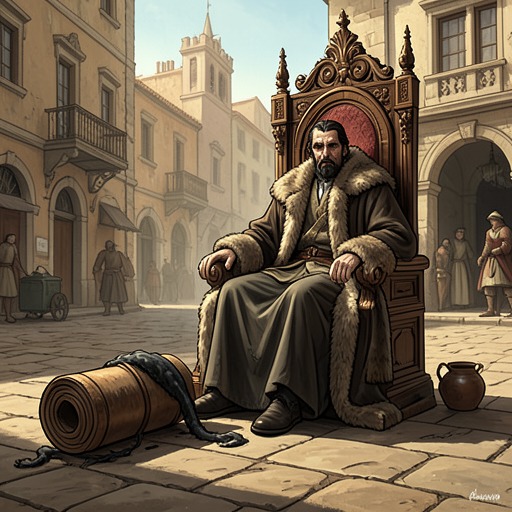
Milan
The PrinceMilan is presented as a decisive case study in the government of conquered territory. Its repeated passage between French and Italian control demonstrates that possession gained through local discontent, foreign arms, or inadequate statecraft is fragile, while durable rule depends on securing the inhabitants’ goodwill, respecting or deliberately remaking local institutions, and building power that belongs to the ruler rather than to his allies.
Milan as a Mixed Principality
Milan appears in the discussion of mixed principalities: a territory added to a ruler’s existing dominions rather than a wholly new state. Such acquisitions are especially unstable because inhabitants who expect better conditions readily change masters, only to discover that the new government brings its own burdens. A conquering prince must quarter troops, impose other demands, and offend those whose property or expectations stand in the way of consolidation. He therefore makes enemies among those he injures while also failing to satisfy the allies who helped him seize the state, since their rewards are usually smaller than they anticipated.
The general problem is sharpened when the acquired country differs from the ruler’s older dominions in language, customs, and laws. Where a newly acquired territory shares the conqueror’s province and institutions, retention is comparatively easy: the old princely line can be removed while laws and taxes remain unchanged, allowing the territory to become incorporated into the hereditary state. Where such continuities are absent, the ruler needs unusual good fortune and administrative skill. The recommended safeguards include personal residence in the province, which allows disorders to be detected early and prevents officials from plundering unchecked, or the establishment of small colonies that secure strategic points at lower cost than a permanent army. Milan’s history is used to show what happens when the political problem of incorporation is not solved.
French Conquest and First Loss
Louis XII of France gained Milan with remarkable speed, but lost it just as quickly. The people who had opened the gates to the French expected future benefits and a more favorable condition; when those hopes were disappointed, they could not endure the insolence of the new ruler. Their initial support thus became a source of instability. Local dissatisfaction supplied Ludovico Sforza with an opportunity to raise alarms on the frontiers, and he was able to recover Milan with his own forces alone.
The episode illustrates the difference between entering a province and keeping it. Military strength could secure the city in the first instance, but it could not replace the good will of its inhabitants. A new prince may be strong in the field and still remain politically exposed if the population regards his rule as a betrayal of the expectations that brought him there. Milan’s first loss therefore resulted not simply from an enemy’s attack, but from the internal weakness created by disappointed allies and offended subjects.
Once a state has rebelled and been reconquered, it is ordinarily harder to take from its ruler a second time. Rebellion gives the prince a pretext to punish the guilty, try the suspected, and fortify the points where his authority was weak. Milan consequently required a much greater effort to recover after its first revolt: the whole world had to be ranged against the French, and their armies had to be destroyed and driven out of Italy. The increased scale of the struggle reveals how political memory and measures of repression can alter the conditions of a second conquest.
The Second Loss and the Failure of Statecraft
Even after this wider effort, Milan was lost to the French a second time. The earlier causes of failure were therefore not sufficient to explain the whole history. The deeper criticism is that Louis XII failed to follow the methods used by rulers who acquired provinces with the intention of retaining them. His conquest did not mature into a stable political order, and the military success that restored French authority did not provide foundations strong enough to preserve it.
The judgment is connected to an exchange at Nantes with Georges d’Amboise, when Cesare Borgia was occupying Romagna. Georges d’Amboise remarked that the Italians did not understand war; the answer was that the French did not understand statecraft, since otherwise they would never have allowed the Church to become so powerful. The subsequent course of events made France’s contribution to its own decline plain: the enlargement of the Church and of Spain in Italy had been brought about by France, while France’s ruin was wrought by those powers. Milan thus belongs to a broader pattern in which a conqueror strengthens another actor and later discovers that the power it helped create has become its adversary.
The general lesson drawn from the French experience is that the person who causes another’s greatness is himself undone. Power raised through either political skill or force produces distrust in the person elevated, and the patron eventually faces the consequences of having enlarged a rival. Milan’s repeated reversals make this maxim territorial rather than abstract: the city is the prize in a contest whose alliances continually reshape the balance of power in Italy.
Fortifications, Reputation, and the Milanese Citadel
Milan also figures in the argument about fortresses. The citadel built by Francesco Sforza is described as more dangerous to the House of Sforza than any other disorder in the state. A fortress may offer refuge against a first assault and restrain subjects who are already inclined to obedience, but its value depends on the political relation between ruler and population. It cannot compensate for hatred, because once subjects take up arms, foreign powers are likely to assist them.
The broader comparison is between rulers more afraid of their subjects and rulers more afraid of strangers. The former may find fortresses useful as a curb; the latter may be better served by leaving them absent. Milan’s citadel therefore embodies an ambivalent instrument of rule. It promises security against rebellion while also testifying to the insecurity of a regime that relies on walls rather than on popular acceptance. The preferred fortress is ultimately the absence of hatred among the subjects, not the strength of masonry.
Milan in the Comparative Argument
Milan is set beside hereditary states, free cities, and conquered kingdoms to distinguish the effects of political memory and institutional continuity. Hereditary rule is easier to preserve because antiquity effaces the memories and causes that provoke innovation; one change, however, leaves an opening for another. A conquered city accustomed to its own laws and freedom is more dangerous still, since its old name and institutions can be revived whenever the ruler suffers misfortune. By contrast, a population accustomed to obeying a prince may be unable to agree on a leader after the princely line is extinguished, making it easier for a stranger to attach it to his cause.
The case of Milan contributes to this wider historical method by turning local experience into a general rule. The book repeatedly compares Alexander the Great’s conquest of Asia with the difficulties faced by Pyrrhus, and contrasts the French failure with Roman practice. The Romans anticipated distant disorders, humbled powerful neighbors, planted colonies, and refused to let formidable outsiders acquire influence. Their conduct illustrates the principle that political troubles should be treated while still remote and manageable, rather than postponed until they become obvious and incurable.
Milan’s significance consequently exceeds its role as a city captured and lost. It is the book’s concentrated image of unstable acquisition: a territory opened by expectation, alienated by disappointment, recovered through expanded force, and lost again because military possession was not converted into durable political authority. Its citadel, its shifting allegiance, and its place in the French-Spanish-Church struggle all reinforce the same conclusion: the secure ruler is not the one who merely enters a province, but the one who understands its institutions, anticipates its disorders, and prevents its inhabitants from becoming the allies of every foreign enemy.