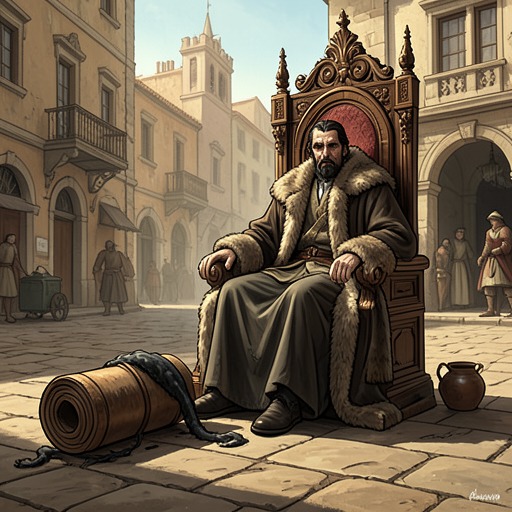
Pope Alexander VI
The PrincePope Alexander VI appears in the narrative as a forceful and opportunistic ruler who enlarged the temporal power of the Church through money, arms, diplomacy, and the ambitions of his son, Cesare Borgia. His decisive importance lies in the way his career joins two arguments: a prince must exploit political circumstances with exceptional flexibility, and the statesman who raises another power may eventually be ruined by the power he has made. Alexander’s methods repeatedly succeed because he understands both the weakness of divided Italian politics and the susceptibility of people to persuasive appearances.
Identity and Political Position
Pope Alexander VI is treated not simply as a religious officeholder but as a territorial prince operating within the unstable politics of Italy. Before his rise, the Pope faced the Roman Barons, divided between the Orsini and Colonnesi factions, whose armed rivalry kept the Papacy weak and insecure. Earlier popes could rarely overcome either faction permanently, because the short duration of a pope’s life allowed one pontiff to weaken one side only for a successor to revive it while attacking the other.
Alexander differed from his predecessors because he demonstrated what a pope could accomplish through money and arms. His authority was therefore both spiritual and temporal: he used the office of the Papacy as a source of political leverage while seeking territorial advancement for Cesare Borgia. Although his immediate purpose was to aggrandize his son rather than the Church itself, the consequences outlasted his personal project. The territories and political structures created during his pontificate eventually strengthened the Church as an institution.
Methods and Political Opportunity
Alexander’s project began from a structural difficulty. He could not easily make Cesare ruler of a state outside the Church’s territories, while taking land belonging to the Church risked opposition from the Duke of Milan and Venice. Faenza and Rimini were already under Venetian protection, and many of the military forces available in Italy belonged to the Orsini, the Colonnesi, or their followers, who had reason to fear the Borgia expansion and could not safely be trusted.
Alexander therefore needed to alter the existing political order before he could enlarge his son’s power. The opportunity came when the Venetians plotted to bring the French back into Italy. Rather than resist that design, Alexander assisted it by annulling the first marriage of the French King, thereby helping clear the way for Louis XII of France to enter Italy. This intervention was not a passive acceptance of events: Alexander used a foreign invasion to create the confusion in which the Church and Cesare could acquire new territory.
When Louis entered Italy at the invitation of Venice and with Alexander’s consent, the Pope immediately obtained French troops for the enterprise against Romagna. The province, impressed by the reputation of French arms, submitted at once. Alexander’s alliance with France thus supplied the military force that Cesare initially lacked, while the French intervention opened a path toward the transformation of the Papal position in central Italy.
Cesare Borgia and the Expansion of Power
Alexander’s political action was inseparable from his effort to advance Cesare Borgia. Cesare obtained his principality through the favorable fortune of his father, unlike Francesco Sforza, who rose from a private station through ability and effort. The book regards Cesare as an exceptionally instructive example of a ruler attempting to build durable foundations under a power initially granted by another person’s arms and fortune. His eventual failure is attributed not to a lack of prudence or effort, but to the extraordinary hostility of Fortune.
Alexander’s support enabled Cesare to enter Romagna with French auxiliary troops and take Imola and Forli. After Cesare judged the French forces unreliable, he shifted to mercenary troops, hiring the Orsini and Vitelli. Finding these forces equally fickle, false, and treacherous, he eventually dismissed them and turned toward troops raised under his own authority. His reputation grew as his dependence on foreign and hired forces diminished; he was never regarded as more powerful than when others saw that he was master of his own army.
Alexander’s assistance also helped Cesare quell the Colonnesi and begin extending his conquests. Yet the enterprise remained vulnerable because Cesare could not fully trust either the Orsini, whose arms he had used, or France, whose king might serve his own interests at Cesare’s expense. The political success produced by Alexander’s intervention therefore depended on unstable alliances even as it weakened rival forces and expanded the Borgia presence in Romagna.
The Church’s Inheritance
The immediate object of Alexander’s policy was his son, but the lasting beneficiary was the Church. Alexander’s use of Cesare Borgia and the French invasion achieved the territorial successes associated with the Borgia enterprise. After Alexander’s death, and after Cesare was removed from power, the Church inherited the results of their labor rather than allowing the gains to disappear entirely with the family that had created them.
Pope Julius II later found the Church in possession of the whole of Romagna, while the Roman Barons had been exhausted and their factions shattered by Alexander’s attacks. He also inherited a new route toward the accumulation of wealth, one that had not been followed before Alexander’s pontificate. Julius used and enlarged these advantages through the conquest of Bologna, the overthrow of Venice, and the expulsion of France from Italy.
Alexander’s political legacy thus contains a striking reversal. He sought to make Cesare powerful, but the Church became the durable heir of the power acquired. The episode illustrates the general principle that the person or state responsible for another’s greatness may ultimately be undone by it. France helped enlarge both the Church and Spain in Italy, and Alexander’s project similarly converted personal and familial ambition into institutional strength that survived its original author.
Deception, Appearance, and Political Reputation
Alexander is also the narrative’s clearest recent example of successful political deception. He is described as having no care but to deceive, while possessing an exceptionally effective manner of making assertions and promises. He offered solemn protestations yet observed them less than any other prince in the example. His frauds nevertheless succeeded because he understood how readily people respond to present needs and how easily outward assurances can conceal contrary intentions.
The point is not merely that Alexander lied. His political skill lay in making deception appear credible. The prince need not possess every quality conventionally regarded as good, but must appear merciful, faithful, humane, religious, and upright; Alexander demonstrates the power of that distinction. His conduct supplies the practical counterpart to the broader rule that a ruler must be prepared to change course when preserving the state requires opposition to good faith, charity, humanity, or religion.
Alexander’s career therefore gives political reputation an ambiguous foundation. His public promises and solemn manner created confidence even when his conduct violated them. The effectiveness of his fraud depended on the audience’s willingness to accept appearance as evidence, making political authority a contest not only over armies and territories but also over what people could be induced to believe.
Evaluation and Historical Significance
The narrative does not present Pope Alexander VI as a conventional model of virtue. It presents him as a remarkably capable political operator whose methods expose the tension between moral conduct and the preservation or enlargement of princely power. His use of French intervention, manipulation of Italian rivalries, cultivation of military opportunities, and support for Cesare Borgia reveal a ruler who understood how to turn disorder into authority.
At the same time, Alexander’s success is inseparable from the risks of personal rule. The project relied on family ambition, foreign arms, shifting alliances, and the ability of one pontiff to direct resources toward a chosen heir. Once Cesare was removed and Alexander had died, the political meaning of the enterprise changed: what had been designed as a Borgia dominion became the territorial foundation of a stronger Church.
His significance finally rests in this double image. Alexander VI is both the architect of an extraordinary expansion and an example of the danger involved in creating power for another. His career confirms that strategic flexibility, controlled appearance, and ruthless exploitation of opportunity can produce rapid political success, while also showing that the ultimate owner of such success may be an institution rather than the ruler who first conceived it.