Romagna
The PrinceRomagna is the province in which Cesare Borgia most fully demonstrated the methods by which a new ruler could convert conquest into government. It first submitted under the reputation of French arms, but Cesare Borgia then sought to make its obedience depend on his own authority. By suppressing faction, restoring order, reorganizing justice, and managing the appearance of cruelty, he made Romagna the strongest foundation of his projected power; even when his wider designs collapsed after the death of Pope Alexander VI, the province remained consolidated and waited for him rather than immediately abandoning him.
Conquest and Strategic Position
Romagna entered Cesare Borgia’s hands during the wider rearrangement of Italian politics engineered by Pope Alexander VI. The Pope needed the existing balance of power disrupted before he could enlarge his son’s dominion, while the Venetians were encouraging the return of French forces to Italy. Pope Alexander VI therefore supported the French king’s intervention, and Louis XII of France entered Italy with Venetian backing and papal consent. Once Louis XII of France had taken Milan, Pope Alexander VI obtained French troops for the campaign against Romagna, which submitted at once under the prestige of French arms.
This initial conquest exposed the province’s strategic importance as well as Cesare Borgia’s dependence on forces he did not control. After taking Romagna and suppressing the Colonnesi, Cesare Borgia wished to continue expanding, but the loyalty of the Orsini and the policy of France limited him. The Orsini had helped him, yet their reluctance became evident when he turned against Bologna after the capture of Faenza. France proved equally restrictive: after Cesare Borgia seized the Duchy of Urbino and prepared to attack Tuscany, Louis XII of France compelled him to abandon the design. Romagna was therefore not merely a territorial acquisition; it was the base from which Cesare Borgia learned that foreign troops and foreign favor could win a province without securely holding it.
Pacification and Administrative Reform
Before Cesare Borgia’s intervention, Romagna had been governed by weak lords who preferred plunder to correction and produced division rather than unity. The province was consequently overwhelmed by robbery, tumult, and other forms of violence. Cesare Borgia judged that conquest could not endure unless this disorder was replaced by peace and obedience, and he entrusted the task to Ramiro d'Orco, a stern and energetic governor with full powers.
Ramiro d'Orco restored tranquillity and order in a short time, earning considerable credit for the effectiveness of his rule. Yet the very authority that made him useful also threatened to make him hated. Cesare Borgia therefore replaced his unlimited powers with a civil tribunal established at the center of the province. The tribunal had an excellent president, and every town was represented by its advocate, giving the reformed administration a more regular and visibly judicial character.
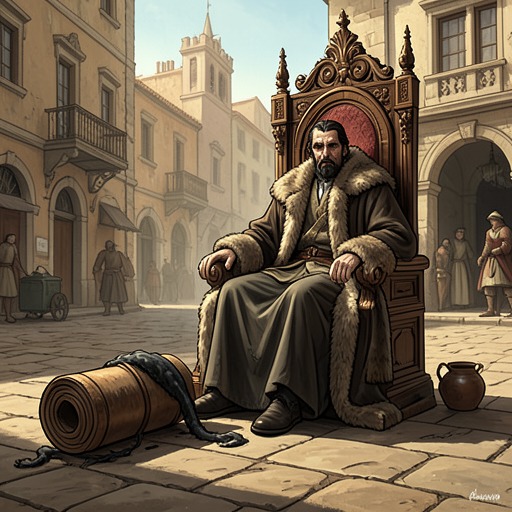
The change also served a political purpose. Cesare Borgia understood that earlier severities had generated resentment against him, and he sought to persuade the population that the cruelty had come from the harsh disposition of his minister rather than from the Duke himself. Using that explanation as a pretext, he had Ramiro d'Orco beheaded and displayed in the market place of Cesena, with a block and bloody axe beside the body. The spectacle both astonished and satisfied the populace: it announced that exceptional violence had ended, transferred blame for past oppression onto the minister, and allowed Cesare Borgia to appear as the ruler who had corrected his own instrument of repression.
From Factional Province to Personal Rule
Cesare Borgia’s consolidation of Romagna depended on weakening the political networks that might otherwise provide an alternative center of loyalty. He began by reducing the power of the Orsini and Colonnesi in Rome. Men of good birth connected with those factions were brought into his service as gentlemen, supplied with generous provisions, and given commands and offices appropriate to their rank. Within a few months, their old partisan attachments had faded and their hopes rested on the Duke alone.
When the Orsini recognized that the greatness of Cesare Borgia and the Church threatened their own survival, they assembled at Magione in the territory of Perugia. The resulting revolt of Urbino, disturbances in Romagna, and wider dangers placed Cesare Borgia under severe pressure. French assistance helped him overcome the crisis and restore his reputation, but he no longer wished to depend on France or any other external power. Instead, he used stratagem. Through the mediation of Paolo Vitelli, whom he won with clothes, money, horses, and friendly attention, he persuaded the Orsini leaders to enter his hands at Sinigaglia. Once the leaders had been removed and their followers made friendly, Romagna and the Duchy of Urbino formed the territorial core of a power that increasingly belonged to Cesare Borgia himself.
The same movement can be seen in Cesare Borgia’s military policy. He first entered Romagna with French auxiliary troops and used them to take Imola and Forli. Finding auxiliaries unreliable, he employed mercenaries from the Orsini and Vitelli family. When these forces also proved fickle, false, and treacherous, he dismissed them and turned to troops raised under his own authority. His reputation rose as he moved from French dependence, through mercenary dependence, toward command of his own forces. Romagna thus became the place where military autonomy and political consolidation reinforced one another.
Durability and Historical Meaning
Romagna was the one major part of Cesare Borgia’s project that had been securely consolidated when Pope Alexander VI died. Cesare Borgia had already killed nearly all the lords whose possessions he had usurped, won over the Roman nobility, and secured a majority in the College of Cardinals. He intended to extend his rule into Tuscany and already held Perugia and Piombino while exercising protection over Pisa. Had Pisa fallen, Lucca and Siena were expected to yield through jealousy of Florence and fear of the Duke. Romagna was the settled base from which this larger design might have been completed.
The death of Pope Alexander VI interrupted that development at its most vulnerable moment. After only five years from the beginning of his military career, Cesare Borgia was left with Romagna consolidated but his other territories unsettled, two hostile armies nearby, and his own body almost overcome by illness. The province nevertheless waited for him for more than a month. Even while he was half dead and under attack in Rome from the Baglioni, the Vitelli family, and the Orsini, his enemies achieved no success. His inability to secure the papal succession and his grave illness prevented him from exploiting the foundations he had laid, not an immediate collapse of Romagna itself.
The province therefore embodies the difference between acquiring a state and making it one’s own. Its first submission came through the reputation of French arms; its lasting obedience rested on the destruction or absorption of rival factions, the restoration of order, a revised judicial structure, the calculated punishment of Ramiro d'Orco, and the creation of forces answerable to Cesare Borgia. In the book’s comparative argument, Romagna stands beside the contrasting cases of Alexander the Great’s conquest of Asia and the Roman acquisition of free cities: political structures, local habits, and the ruler’s relation to military power determine whether conquest survives. Romagna’s significance lies in showing how a fragile acquisition could be given durable foundations, even when Fortune ultimately denied the conqueror the time and health needed to complete his design.