
The Teacher’s Movement from Hill to Harbor
The ProphetThis flow traces Almustafa’s changing position from solitary observer to public teacher and finally to a traveler who carries the people in memory.
increasing Bearing strength in each event
 decreasing
Bearing strength in each eventdecreasingA Solitary Observer

A Solitary Observer
Life at a Distance
Almustafa spends years in Orphalese in solitude, watching the people’s days and listening to the laughter and sorrow of their sleep. His attention is directed toward the lives around him even when he appears separate from them.
Distance as a Condition
He later says that he climbed hills and walked in remote places. From height and distance he sought a view of the people, suggesting that separation was both a burden and a way of seeing.
The Ship Calls Him Back

The Ship Calls Him Back
A Return Becomes Possible
Almustafa sees the ship that is to bear him to the isle of his birth. The long wait ends, and the future he has anticipated becomes an immediate demand.
Joy and Grief Together
He feels joy at the ship’s arrival but also sorrow at leaving the city. His destiny now requires him to hold two attachments at once: the home that awaits and the place he has learned to love.
The City Names His Place
The City Names His Place
Beloved Among Residents
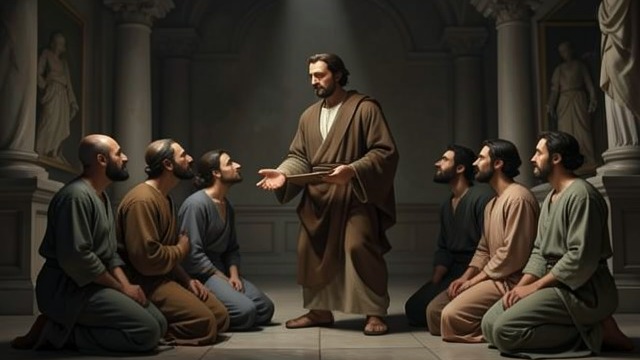
The elders call Almustafa their son, while the priests and priestesses reveal that they have loved him. Their words show him how deeply his presence has entered the city’s life.
A Role He Cannot Keep
The people’s recognition intensifies rather than resolves his decision. He is valued as a member of the community, yet that value cannot turn him into a permanent possession of the city.
The Teacher Answers
The Teacher Answers
A Public Calling
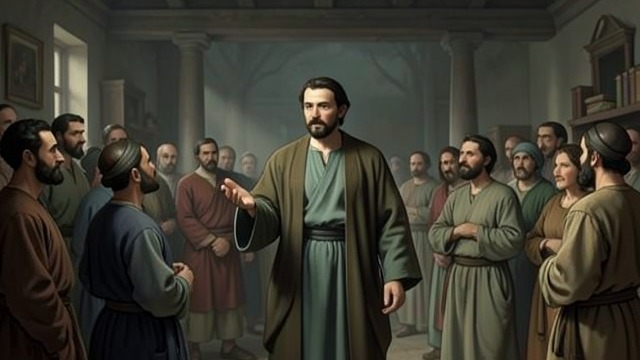
Almitra asks Almustafa to speak, and residents bring questions about the relationships and choices that shape their lives. The solitary observer becomes a public teacher through the needs named by the city.
Authority without Separation
His later claim that he was also a listener complicates the role of the teacher. He speaks from attention to other people, not from a position wholly outside their experience.
The Traveler Sets Sail

The Traveler Sets Sail
Readiness after Speech
Almustafa tells the captain that he is ready and that the stream has reached the sea. Having spoken to the people, he can now answer the departure he first met with mixed emotion.
A Changed Relation to Home
He sails eastward while retaining the people in his memory and describing the possibility of return. His movement ends his stay but not the significance of the life he shared with the city.
During his twelve-year stay before the ship appears
On the seventh day of Ielool in the twelfth year
As the elders and priests appeal to him
During the temple-square gathering
At the close of the book, at dusk
