
The Judges and the Roots of Harm
The ProphetThis flow traces the challenge to simple punishment, moving from an individual wrong to the social roots, remorse, and shared responsibility surrounding it.
increasing Bearing strength in each event
 decreasing
Bearing strength in each eventdecreasingThe Judge’s Question

The Judge’s Question
A Demand for Judgment
A city judge asks Almustafa to speak about crime and punishment. The question places the authority to condemn at the center of the gathering.
The First Reframing
Almustafa begins by describing wrongdoing as a spirit wandering unguarded, then immediately widens the subject beyond an offender alone. The answer unsettles the expectation that punishment can be discussed as a simple response to an isolated act.
The Offender Is Not a Stranger

The Offender Is Not a Stranger
A Shared Human Condition
Almustafa says that the righteous cannot rise beyond the highest in each person and the wicked cannot fall beneath the lowest in each. The offender is not outside the human community.
Condemnation Complicated
By placing both capacity and weakness within everyone, he resists a clean division between the innocent and the guilty. Judgment must begin with recognition rather than distance.
The Stumbling Stone

The Stumbling Stone
A Fall with Two Audiences
Almustafa says a fallen person warns those behind and implicates those ahead who failed to remove the obstacle. The act belongs to a social path as well as to the individual who fell.
Responsibility Expands
His image makes prevention part of justice. The community cannot be satisfied with identifying who stumbled if it has ignored the conditions that made the fall likely.
Roots Entwined in Earth
Roots Entwined in Earth
The Loom behind the Thread
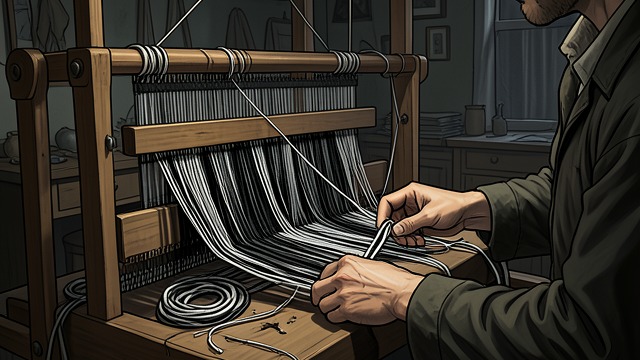
Almustafa compares good and bad to black and white threads woven together and says the weaver must examine the loom when a thread breaks. He asks judges to look to the roots of an evil tree.
Context before Sentence
The imagery turns attention from the visible offense to the conditions that nourish it. Justice requires examining relationships and circumstances without pretending that harm itself is imaginary.
Remorse and the Limits of Punishment

Remorse and the Limits of Punishment
An Inner Reckoning
Almustafa asks how judges should punish those whose remorse already exceeds their misdeeds. Remorse, he suggests, may be administered by an inward law that no court can impose or remove.
Fullness of Light
He concludes that justice requires seeing deeds in their fullness and recognizing people between their least and greatest selves. The lesson does not hand down an easy verdict; it changes what a just verdict must take into account.
During the public teachings, after the merchant’s question
Early in the crime and punishment teaching
At the center of the crime and punishment teaching
After Almustafa questions the separation of the just and unjust
At the close of the crime and punishment teaching
