
The City as Home and World
The ProphetThis flow follows the inhabitants’ attachment to the city and the teachings that challenge them to imagine homes and lives less confined by fear and comfort.
increasing Bearing strength in each event
 decreasing
Bearing strength in each eventdecreasingThe Walls of Orphalese

The Walls of Orphalese
A Place of Attachment
Almustafa remembers long days of pain and nights of solitude spent within the city’s walls. The streets also hold fragments of his spirit and the children of his longing.
Home as More Than Shelter
The city is a place he must leave precisely because it has mattered to him. Its walls hold both the comfort of belonging and the cost of becoming fixed in one place.
The Mason Asks about Houses

The Mason Asks about Houses
A Home Enlarged
A mason asks Almustafa to speak of houses. Almustafa calls a house a larger body, connecting constructed shelter to the life and dreams of its inhabitant.
The Wanderer Within
He asks the residents to imagine a bower in the wilderness before building within the city walls. The image suggests that people carry an inward restlessness no building can fully contain.
Comfort Becomes a Master

Comfort Becomes a Master
A Guest Takes Control
Almustafa warns that comfort can enter as a guest, become a host, and finally rule as a master. What first seems protective can tame larger desires and deaden the soul’s passion.
Shelter under Judgment
His criticism is not directed at having a house but at allowing comfort to make a person smaller. The teaching asks residents to distinguish a useful shelter from a life organized around avoiding risk.
A House Becomes a Mast

A House Becomes a Mast
Shelter for Movement
Almustafa imagines a house as a mast rather than an anchor and as an eyelid that guards the eye rather than a covering for a wound. Shelter should serve life without imprisoning it.
Beyond Walls
He says that what is boundless in a person abides in the mansion of the sky. The home’s proper scale is therefore limited: it may shelter the body, but it cannot contain longing.
The City Gives Way to the Sea
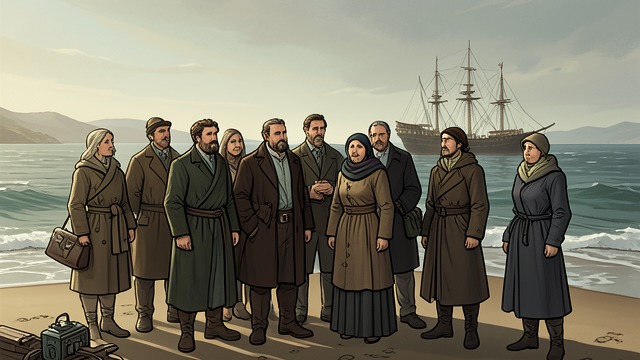
The City Gives Way to the Sea
A Journey Beyond the Walls
Almustafa and the sailors leave the city behind and move eastward. The journey gives physical form to the teaching that a home must not become an anchor.
A Wider Belonging
The people remain on shore, but the farewell describes them as part of a larger human presence that Almustafa carries in memory. Departure alters the relation between home and traveler without erasing it.
During Almustafa’s years in the city, recalled during the farewell
During the teachings, after questions about joy and sorrow
In Almustafa’s teaching on houses
At the conclusion of the houses teaching
At the end of the book, as the ship moves east
