Almitra
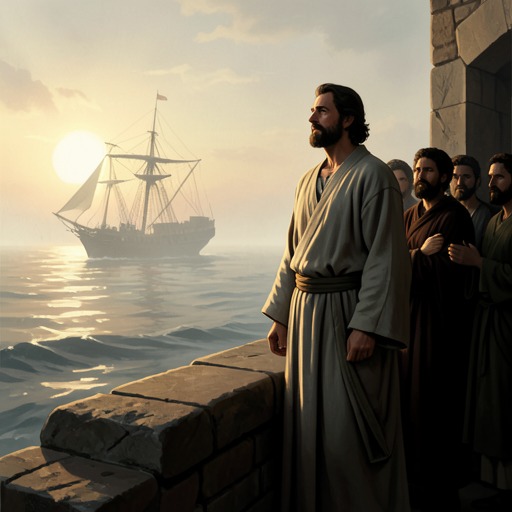
The ProphetAlmitra is the seeress who first sought and believed in Almustafa when he had been in Orphalese for only a day. At his departure, she stands apart from the people, watching his ship disappear into the mist and keeping his words in memory. Her role bookends his public teaching: she welcomes the figure whose presence she recognized early, asks him to speak for the community, blesses the day of his farewell, and remains after the crowd has dispersed.
Identity and First Recognition
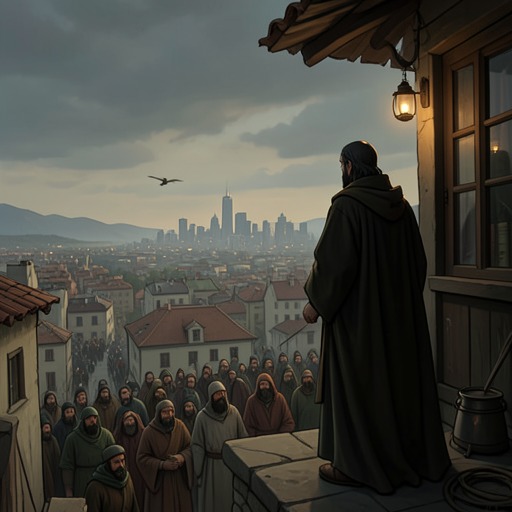
Almitra emerges from the sanctuary as Almustafa and the people approach the great square before the temple. The narration identifies her as a seeress, then gives her recognition a personal history: she was the first in the city to seek and believe in him, doing so when he had been there only a day. Almustafa looks upon her with exceeding tenderness. The detail distinguishes their meeting from a public exchange between a prophet and an audience; before the people gather to hear him, there is already a history of attention and belief between these two figures.
Her first words address Almustafa as a prophet searching for his ship. The greeting joins his spiritual identity to the immediate circumstance of his return voyage: the person who has spoken to the city is also a traveler whose time there is ending. Almitra thus recognizes both the authority with which he is received and the departure that makes the people’s questions urgent. The scene presents her not as the source of his teachings but as the first to recognize him and the person who opens the encounter in which those teachings will be heard.
The Community’s Request and the Form of Teaching
As the people ask Almustafa to disclose what he has learned of life, Almitra supplies the central request: he should disclose the people to themselves and tell them what has been shown to him of the span between birth and death. The phrasing makes the teaching more than an account of the speaker’s knowledge. Its purpose is self-recognition among those listening. Almitra speaks from within the community, asking for an understanding that concerns its shared human life, while the answers that follow take the form of successive teachings prompted by questions.
That dialogic structure recurs in the book’s later chapters. A man asks Almustafa to speak of Self-Knowledge, and an elder asks about Good and Evil. These are not Almitra’s questions, and the text does not make her the author of every topic. Her importance lies instead in having called for the broader disclosure that the question-and-answer sequence enacts: different members of the city bring subjects forward, and Almustafa answers them in turn. The distinction preserves her specific role as initiator and witness without confusing her with the other speakers.
Farewell and the Final Vigil
At evening, Almitra blesses the day, the place, and the spirit that has spoken. Almustafa answers by questioning whether he alone has spoken, asking whether he was not also a listener. The exchange closes the public teaching on a note of reciprocity. Almitra recognizes what has been given, while Almustafa’s response resists the idea that the occasion has consisted only of a single voice instructing a passive audience. Their last exchange recalls the earlier intimacy of recognition, now set within a gathering that has listened throughout the day.
When the ship departs, the people cry out together, their sound carried over the sea. Almitra alone remains silent. She watches the vessel until it vanishes into the mist, and only after the others have dispersed does she still stand alone upon the sea-wall. The contrast makes her farewell distinct from the crowd’s: the collective cry marks the moment of separation, while her continued gaze extends it beyond the public scene. The text identifies her silence and remembrance, not any further speech or action, as the ending of her part in the narrative.
Narrative Significance
Almitra’s appearances form a compact frame around Almustafa’s time of teaching. At the beginning, she is the first person in Orphalese to seek and believe in him; at the threshold of the farewell, she asks that he make the community’s life intelligible to itself; at evening, she blesses the occasion; and at the close, she is the last person shown watching the ship. Her position changes from first recognizer to public interlocutor to solitary witness, while her attention remains fixed on Almustafa and what his presence means.
The final memory returns to the book’s recurring image of temporary rest and renewed passage: Almitra remembers his saying that a little while of rest upon the wind will be followed by another woman bearing him. The remembered words place the departure within a larger movement rather than presenting the vanished ship as an absolute end. Yet the ending stays with Almitra on the sea-wall, where continuation is held alongside loss. Her silence does not explain or resolve that tension; it gives the book its last human image of remembrance after the people have gone.