Almustafa and the People of Orphalese Facing Farewell
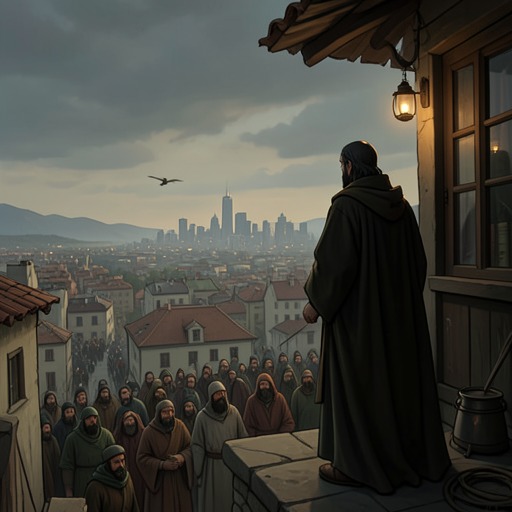
The ProphetAlmustafa and the People of Orphalese Facing Farewell is the painful transition from inward readiness to leave to an openly shared recognition of attachment. Almustafa’s joy had flown over the sea, but as he descends the hill sadness comes upon him: he cannot imagine departing in peace, without a wound in the spirit. The people’s plea that he remain gives that private pain a public form, while his bowed head and tears show how deeply the parting is felt on both sides.
From Joy to the Wound of Leaving
The farewell begins with a sharp emotional change. Almustafa’s heart has opened, and his joy has flown far over the sea; he has closed his eyes and prayed in the silences of his soul. Yet the descent from the hill brings sadness. His inward question is how he can leave peacefully and without sorrow, followed by the conviction that he cannot leave the city without a wound in the spirit. The contrast makes departure more than a practical change of place: even after a moment of expansive joy, leaving carries the pain of what has been lived and loved.
His thought turns toward the long days of pain spent within the city’s walls. The recollection keeps the farewell from becoming a simple celebration of departure. The city has held hardship as well as joy, and the pain belongs to the history he is leaving behind. The passage does not resolve that history into a single verdict; it places remembered suffering beside the present wound of separation.
The People Ask Him to Stay
The elders speak for the city when they urge Almustafa not to go yet. They describe him as a noontide in their twilight, and say that his youth has given them dreams to dream. Their appeal makes clear that his presence has meant more to them than companionship alone: they associate him with light and with renewed imaginative possibility. The plea also marks a reversal in the scene. Almustafa has been preparing to depart, but the people now give voice to what his leaving costs them.
Others come to entreat him as well. Their appeals gather around the same request, but Almustafa does not answer. He only bends his head, and those standing near see tears falling upon his breast. The restraint of this response matters: he neither debates the request nor gives a spoken reassurance. His bowed posture and tears are the visible answer the scene provides, registering grief without undoing the fact of departure.
Separation Makes Love Legible
The passage states that love does not know its own depth until the hour of separation. That claim gives the farewell its central meaning. The people’s insistence that Almustafa stay and his tears do not merely report sadness; they reveal the strength of a bond that becomes unmistakable as it is threatened by parting. The feeling is shown through opposed gestures: the elders speak and entreat, while Almustafa remains silent and bends his head.
The scene holds together two truths without reducing either one. Almustafa has experienced joy and prayer in anticipation of leaving, yet he also knows that departure will wound him. The people’s love is likewise expressed not as an abstract sentiment but as a direct request that he remain. Separation therefore deepens recognition rather than cancelling affection: the imminent absence makes the attachment visible to those who share it.
Toward the Great Square
After the appeals and Almustafa’s silent response, he and the people proceed toward the great square before the temple. The movement carries the private exchange into a shared public setting. The people do not disperse after learning that he will leave; they accompany him onward, their collective presence extending the farewell beyond the elders’ words.
At this point the scene has established the emotional terms of the parting but has not yet completed it. Almustafa’s departure remains ahead, while the people’s pleas, his tears, and their progress toward the square make the separation already present between them. The farewell’s decisive change is thus one of recognition: joy at the prospect of departure gives way to the acknowledged wound of leaving, and love becomes clearest at the moment it must face absence.