Almustafa's Solitude
The ProphetAlmustafa's Solitude is a state of painful separation that also becomes a way of perceiving the people of Orphalese. During his long stay within the city, loneliness marks both his nights and the prospect of leaving; beyond its walls, he climbs hills and walks in remote places. Those who see only withdrawal call him aloof, but he gives distance a different meaning: one must sometimes stand apart to see others clearly, and nearness is not always the same as understanding.
A Painful Attachment to the City
Almustafa describes his time within the city as prolonged rather than momentary: the days there have been days of pain, and the nights nights of aloneness. The pairing gives solitude a temporal breadth. It occupies not one dramatic scene but the ordinary passage of days and nights, so that leaving cannot simply erase it. He asks how anyone can depart from pain and aloneness without regret. The question makes separation from the city emotionally complicated: the conditions that have hurt him have also become part of the life he is being asked to leave.
That attachment is rendered through the image of fragments of the spirit scattered in the streets. The streets are not merely a setting from which he withdraws; they are places where parts of him have been left behind. The image makes departure feel like a further dispersal, not a clean escape from loneliness. His spirit is divided between the person who must go and the fragments that remain associated with the city. Solitude therefore includes a wound of attachment: separation matters because he has given something of himself to the place from which he is departing.
The Appearance of Aloofness
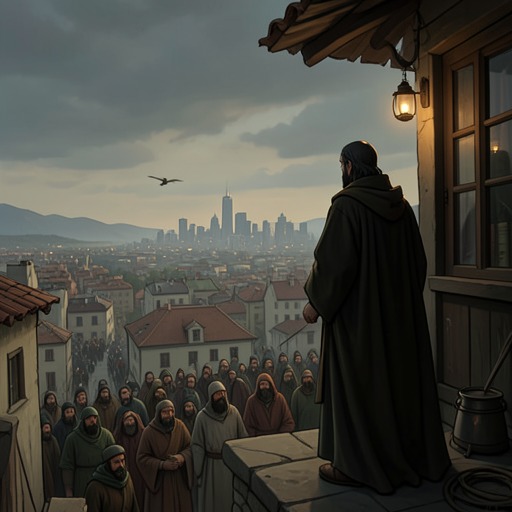
Some among the people of Orphalese call Almustafa aloof and characterize him as absorbed in his own aloneness. Their account turns his habits into evidence against him: he is said to commune with forest trees rather than people, to sit alone on hilltops, and to look down upon the city. The contrast is spatial and social at once. Trees and remote heights seem to occupy the place that human company should hold, while looking down suggests distance from the community and perhaps a judgment upon it.
Almustafa does not deny the observable part of their charge. He confirms that he has climbed the hills and walked in remote places. This concession matters because his answer does not depend on pretending that he has remained continually among the people. The disagreement concerns what such absence means. The observers interpret it as aloofness; Almustafa treats retreat as a position from which perception becomes possible. His solitude is real, but the accusation that it proves indifference is precisely what he contests.
Distance as a Condition of Nearness
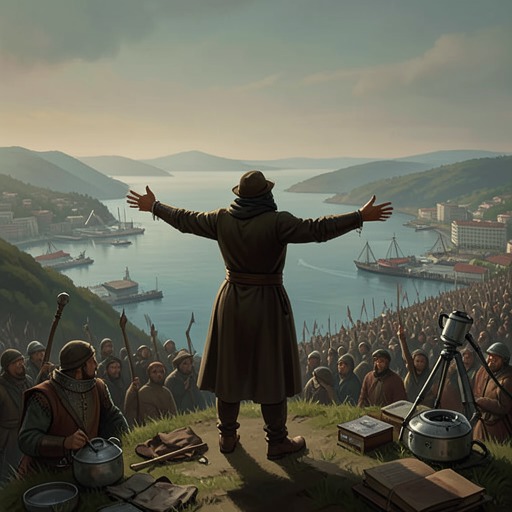
Almustafa answers the claim that he looks down on the city by asking how he could have seen its people except from a great height or distance. He then sharpens the paradox: genuine nearness may require being far away. Distance here is not simply a measure of separation. It is a changed vantage point, one that lets him take in the people and the city together rather than encounter them only from within their immediate surroundings.
The hills and remote places thus carry a double significance. They mark his withdrawal from ordinary company, yet they also enable the vision through which he addresses the people. His defense does not claim that distance removes loneliness or makes separation painless. Instead, it complicates the opposition between solitude and relation: physical or social closeness does not automatically produce understanding, while standing apart can make sustained attention possible. The people interpret the height as evidence that he is above them; Almustafa presents it as a means of seeing them.
Solitude at the Threshold of Departure
The account of solitude belongs to a moment of leave-taking, when Almustafa asks whether he can go without sorrow and answers that departure will wound his spirit. His remembered days of pain, lonely nights, and scattered fragments give the impending separation its emotional weight. In this setting, retreat to the hills is not a simple rejection of the city, just as regret at leaving does not cancel the pain experienced there. Both attachments and injuries remain present at once.
Solitude consequently shapes both how Almustafa is judged and how he explains his relation to the community. To those who watch him from within the city, his distance looks like a refusal of human company. In his own account, it is bound up with the effort to see the people clearly, while the city itself has entered him deeply enough that leaving cannot be painless. The state is therefore neither mere isolation nor a pose of detachment: it is an exposed condition of separation, perception, and attachment, held together by the unresolved paradox that one may need distance in order to be near.