Almustafa’s Farewell Teachings in Orphalese
The ProphetAlmustafa’s Farewell Teachings in Orphalese is the public exchange of wisdom that takes place as Almustafa prepares to depart. Prompted by Almitra and the people, his teachings transform an imminent separation into a final occasion for speaking and listening; their end is marked not by a reconciliation that cancels departure, but by the ship’s release from its moorings and Almitra’s solitary vigil as it vanishes into the mist.
Gathering Before the Temple
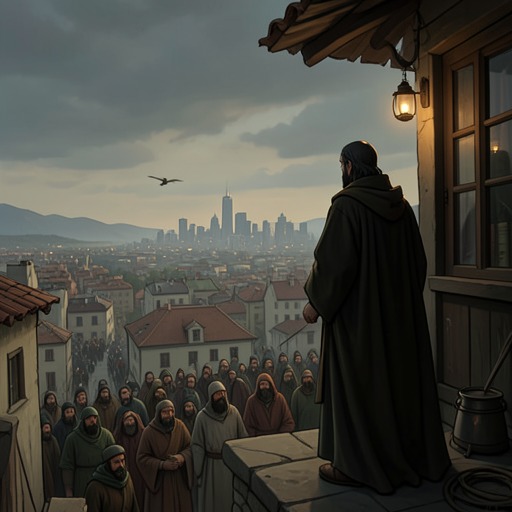
As the people move with Almustafa toward the great square before the Temple of Orphalese, he does not answer them at once. He bends his head, and those close by see tears fall upon his breast. The procession thus begins in a silence that makes the gathering more than a formal address: the departure is already felt, even before the teaching begins.
Almitra comes out of the sanctuary. She is a seeress, and her bond with Almustafa reaches back to the beginning of his time in the city: she was the first to seek him and believe in him when he had been there only a day. Her greeting acknowledges that he has searched the distances for his ship and that its arrival means he must go. She recognizes both his longing for the land of his memories and his greater desires, while insisting that the people’s love will not bind him and their needs will not hold him back. The farewell is therefore shaped by affection that accepts separation rather than claiming the right to prevent it.
The Request and the Teaching
Before he leaves, Almitra asks Almustafa to speak and give the people his truth. She gives the request a future beyond the assembled listeners: they intend to pass his words to their children, who will pass them on in turn. She also asks him to disclose what has been shown to him about the span between birth and death. The request makes the teaching both intimate and communal: it arises from their shared life in the city, but is meant to outlast the day and the speaker’s presence among them.
Almitra recalls that Almustafa has watched through their days and, wakeful while they slept, listened to their weeping and laughter. She asks him, in effect, to make the people legible to themselves. Almustafa answers that he can speak only of what is already moving their souls. His reply places the source of his teaching not solely in private authority or distant knowledge, but in the life and inward movement of the people before him. The scene establishes a pattern of invitation and response: a question opens a subject, and the people become still as he raises his head and speaks.
Love is one of the subjects explicitly introduced by Almitra’s request that Almustafa speak of it. Death is another, asked about later in the teaching sequence. These moments carry the broad opening request—from the realities between birth and death—into particular questions. The teaching is presented not as an uninterrupted pronouncement detached from its listeners, but as a series of addresses prompted by what they ask. The surviving frame also keeps the larger occasion in view: each subject is spoken within a meeting made possible by the time remaining before Almustafa’s departure.
Evening and Departure
By evening, Almitra blesses the day, the place, and Almustafa’s spirit for having spoken. Her words mark the close of the public teaching and return attention to the circumstances that occasioned it: the day is ending, and so is the people’s opportunity to hear him in person. The blessing does not detain him. Instead, it gives the departure a final communal acknowledgment before action replaces speech.
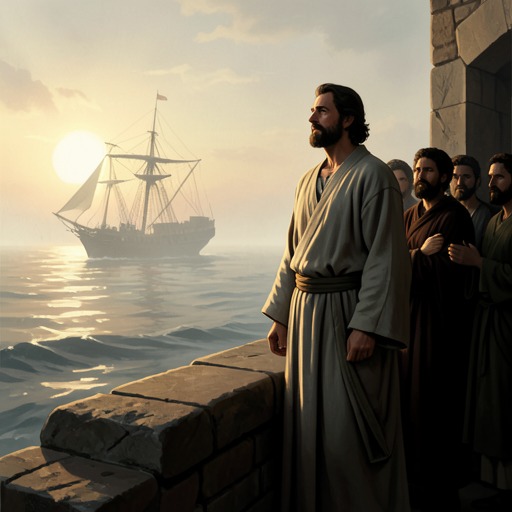
Almustafa signals to the seamen. They weigh anchor and cast the ship loose from its moorings, and it moves eastward. The people answer with a cry that rises like a single heart and carries out over the sea. The collective sound registers their response, but it cannot reverse the ship’s movement. The farewell’s emotional force rests in that contrast: the gathered people speak together, while the departing vessel continues away from them.
Almitra alone remains silent, watching until the ship has vanished into the mist. Even after the people disperse, she stands by herself upon the sea-wall. Her stillness provides the scene’s last human image, set against the ship’s disappearance and the crowd’s dispersal. The teachings end, then, not with the group’s cry but with one witness continuing to look after Almustafa when he can no longer be seen.
The Farewell as a Public Exchange
The event joins instruction to separation without treating either as a substitute for the other. The people ask for words that can be carried forward to their children; Almustafa speaks in response, and the subjects of Love and Death give the exchange distinct points of focus. Yet the frame repeatedly returns to the fact that he must leave. Almitra’s recognition of his freedom, the evening blessing, the signal to the seamen, and the ship’s eastward course form a sequence in which affection is expressed through listening and release rather than possession.
The gathering also changes scale as it proceeds. It begins with Almustafa’s tears and the people’s approach to the square, expands into a shared act of teaching, and closes with the crowd’s single cry before narrowing to Almitra alone at the sea-wall. That movement from assembly to solitude gives the farewell its shape: the words are offered to a community and intended for transmission, but the final sight of the departing teacher belongs to the seeress who first believed in him. The ship disappears; the scene leaves the people with what they asked to carry onward.