Almustafa’s ship
The ProphetAlmustafa’s ship is the vessel awaited for twelve years in Orphalese and the means by which Almustafa can leave the city and return toward the isle of his birth. Its arrival begins the book’s departure movement; its release from the harbor completes it. The ship matters not through any described construction or voyage at sea, but through this change in status: for years it is expected, then glimpsed, approached, and finally set loose, carrying Almustafa’s farewell toward action.
Identity and Purpose
The ship is introduced through its promised destination. It is to bear Almustafa back to the isle of his birth, making its return more than a harbor arrival: it reconnects him with a home beyond Orphalese. The account establishes the length of the wait—twelve years—before the ship appears, so its significance is shaped by prolonged expectation rather than by any description of its size, appearance, or history.
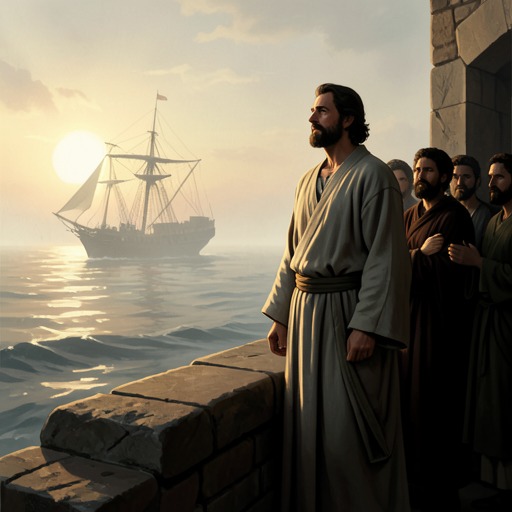
That expectation ends in the twelfth year, on the seventh day of Ielool, the month of reaping. From a hill outside the city walls, Almustafa looks seaward and sees the ship coming with the mist. The scene gives the vessel a strikingly gradual entrance: it is first seen at a distance, within the mist, before it approaches the harbor. The text supplies no further physical description, keeping attention on the fact of its return and on what that return makes possible.
Arrival and Recognition
The ship’s approach changes waiting into imminent departure. When Almustafa later reaches the foot of the hill and turns again toward the sea, he sees it approaching the harbor. On its prow are mariners, identified as men of his own land. The vessel is therefore linked not only to a destination but to people from the place to which Almustafa is returning. Their presence makes the return visible and human without changing the ship’s central function as the means of passage.
The two views of the ship mark different stages of arrival: first it comes through the mist, then it nears the harbor with its crew visible. This progression parallels the movement from possibility to immediate action. The vessel does not simply remain an object on the horizon; its approach brings Almustafa to the point at which departure can be enacted, even as the people of Orphalese remain gathered around him for his final leave-taking.
Departure and Release
Almustafa describes the sea as calling him and says he must embark. He contrasts leaving with remaining: to stay, even through the night, would be to freeze and crystallize, bound in a mould. The ship is thus the concrete means of a departure he presents as necessary. The account does not describe the voyage itself, but it makes clear that staying is not a neutral alternative for him; the approaching vessel gives form to his decision to go.
At the close, Almustafa signals to the seamen. They weigh anchor, cast the ship loose from its moorings, and move eastward. These actions complete the vessel’s passage from awaited return to departing ship. The people respond with a cry that rises together and carries out over the sea. Their collective farewell is the consequence of the ship’s movement: as the vessel leaves the harbor, Almustafa’s separation from Orphalese becomes an outward, shared event.
Narrative Significance
The ship gives the book’s departure a clear physical sequence: twelve years of waiting, a first sighting from beyond the city walls, an approach to the harbor, and the final loosening of its moorings. Each stage narrows the distance between Almustafa and the journey he has awaited. The mist marks the first appearance without obscuring the eventual direction of events; the crew on the prow confirms that the ship is arriving with a connection to his own land; the seamen’s actions turn that connection into departure.
Its significance also lies in the contrast between harbor and sea. The ship must be released from its moorings before it can move eastward, just as Almustafa’s time in Orphalese must end before he can set out. The account does not present the vessel as a permanent home or dwell on the conditions of travel. Instead, it serves as a threshold between the city where he has spent twelve years and the homeland toward which he is called. Its final movement carries the narrative from farewell into departure, while the people’s cry follows it out over the water.