Almustafa's Relationship with the People of Orphalese
The ProphetAlmustafa's Relationship with the People of Orphalese is a reciprocal bond shaped by love, teaching, and departure. The people welcome him not as a passing stranger but as family, and ask him to share what he has learned before he leaves. Almustafa answers their attachment without treating it as a claim upon him: their love does not bind him, yet their generosity changes what he carries away. Farewell thus becomes both an ending and a promise of renewed connection.
Welcome as Kinship
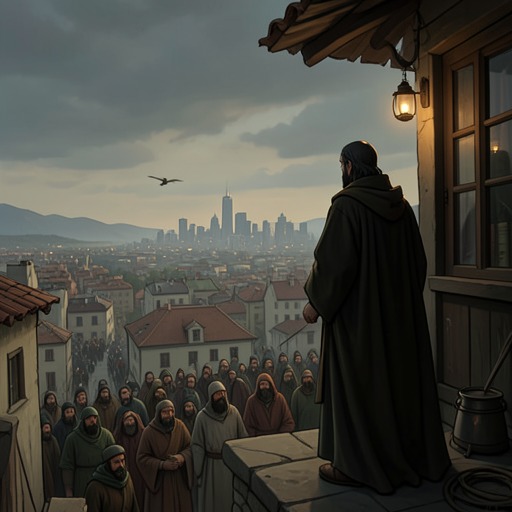
When Almustafa enters the city, the people come out to meet him and cry to him as with one voice. The collective greeting makes his arrival a public expression of attachment rather than a private encounter. The elders speak for the community, asking him not to depart yet and describing his presence as a noontide in their twilight. They credit his youth with giving them dreams to dream, presenting his influence as something that has enlarged their hopes.
Their appeal rests on belonging. They tell him that he is no stranger or guest among them, but their son and dearly beloved, and ask that their eyes not yet be made to hunger for his face. The language of family turns his time among them into an intimate relationship, while the image of absence makes departure bodily and immediate: what they fear losing is not simply a source of instruction, but the sight of someone they love. Their plea does not erase the approaching separation; it gives that separation its emotional weight.
A Parting That Does Not Possess
The people recognize that Almustafa longs for the land of his memories and the dwelling place of his greater desires. They explicitly acknowledge that their love will not bind him and their needs will not hold him. This qualification matters: their affection is intense, but the relationship is not presented as a right to command his staying. Their request is instead bounded by the moment before departure. They ask him to speak and give them his truth, making a final teaching the form their love takes when it cannot become possession.
They also place that request within a future extending beyond their own lives. The people say they will give his truth to their children, and that the children will pass it to theirs, so that it will not perish. The relationship therefore joins face-to-face affection to inheritance. Almustafa may leave the city, but what he shares can continue among its people through generations; their promise to preserve his words answers the physical absence with an ongoing communal act.
What the People Give Him
Almustafa describes the exchange as more than a teacher's gift to listeners. Wise men, he says, have come to give the people their wisdom, whereas he came to take their wisdom. His account reverses the expected direction of the relationship: the one asked to instruct them also presents himself as a recipient. He says they have been more generous to him than others who received riches, power, and glory in return for golden promises of faith.
What their generosity gives him is a deeper thirsting after life. The phrase makes their effect on him active rather than merely appreciative: their company has intensified his desire for life instead of satisfying it or bringing it to rest. His final teaching is consequently not a one-way repayment by a sage to a dependent audience. The people ask for truth to carry forward, while Almustafa leaves acknowledging that their response has itself become a gift to him.
Farewell and the Promise of Return
At the close of his address, Almustafa bids farewell to the people of Orphalese and says that the day has ended. The farewell marks a real boundary: the time of speaking together is closing. Yet his language repeatedly resists making that boundary final. If his voice fades in their ears and his love vanishes from their memory, he says he will come again; he also promises to return with the tide and seek their understanding even if death hides him and greater silence enfolds him.
The image of the stream reaching the sea gives the departure a second meaning: the great mother receives her son against her breast. In the same closing movement, Almustafa asks the people not to forget that he will come back, and imagines his longing gathering dust and foam for another body, with another woman bearing him. Return is thus expressed both as a direct promise to the community and as a larger image of life taking form again. The book does not show the people receiving him a second time; it leaves their bond at the threshold between the farewell they share now and the return Almustafa promises.
The Shape of Their Bond
The relationship is built from a tension that neither side resolves by denying the other: the people want Almustafa to stay, but recognize the pull of his remembered land and greater desires; he leaves, but refuses to describe departure as the extinction of love. Their appeals move from shared welcome, to kinship, to a request for words that can survive separation. His answer moves from gratitude for what they have given him to farewell and anticipated return.
That structure makes teaching part of the relationship rather than a substitute for it. The people ask for his truth because they love him and wish to transmit what he gives; Almustafa's account of their generosity shows that receiving their regard has also altered his own understanding of what he has gained. The bond is therefore neither simple dependence nor mere instruction. It is an exchange whose emotional force comes from the fact that affection remains real without giving either side ownership of the other, and whose future rests on memory, transmission, and the hope of meeting again.