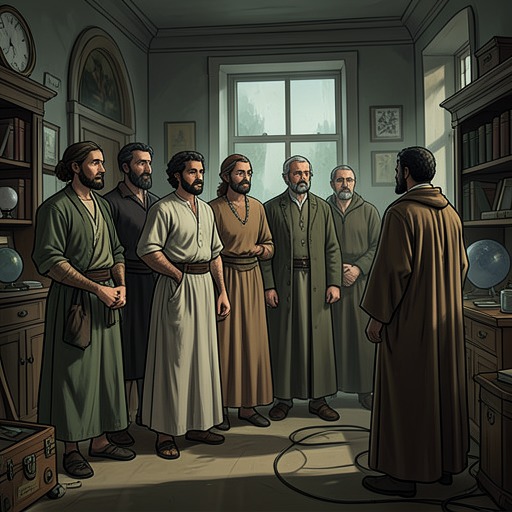
The god-self
The ProphetThe god-self is presented as a dimension of human nature that remains undefiled and reaches beyond its lesser, still-unformed counterpart. Its images suggest not a self that stands alone, but one pole of a divided human condition; the speaker’s account of justice ultimately asks that both poles be seen together.
Identity and Imagery
The god-self is likened first to the ocean, which remains undefiled, and then to the ether, which lifts only the winged. The images give this aspect of the self both depth and elevation: it is untouched by defilement, yet its upward movement is selective rather than universal. The comparison with the sun sharpens the distinction. The god-self neither knows the mole’s ways nor seeks the serpent’s holes; it is oriented away from hidden, low-reaching forms of life.
Coexistence with The pigmy-self
The god-self does not dwell alone within a person. Much in human nature is still human, while much has not yet become so and remains a shapeless pigmy-self, asleep in the mist. The contrast is therefore not simply between a pure inner nature and something outside it: both belong to the same being. The god-self’s oceanic purity and solar height stand beside an unfinished, drowsing self, making human nature internally divided rather than complete.
Justice and the Whole Person
This divided nature becomes a principle for judging others. The speaker says that justice requires looking upon deeds in the fullness of light; only then can the upright and the fallen be recognized as one person standing in twilight between the night of The pigmy-self and the day of the god-self. Neither aspect alone defines the person under judgment. The accompanying image of the temple’s cornerstone, which is not higher than its lowest stone, extends this insistence on relation and proportion: the elevated cannot be understood as wholly separate from what lies lowest.