You are the way and the wayfarers
The ProphetThe expression “You are the way and the wayfarers” compresses a teaching about shared moral life into a paradox: people do not merely travel toward a better condition but help constitute the path by which it is reached. Its image of journeying makes responsibility communal, while its balance of road and traveler gives each person a role in both shaping and undergoing that progress.
Meaning and Image
The sentence joins two usually separate ideas. A way exists as something to follow; wayfarers are those who move along it. By placing both within the same human community, the expression presents moral progress not as a route laid down independently of human conduct, but as something people make through their actions toward one another. Its compact parallel form gives the teaching the force of a maxim: the road and those who walk it belong to one another.
Shared Responsibility
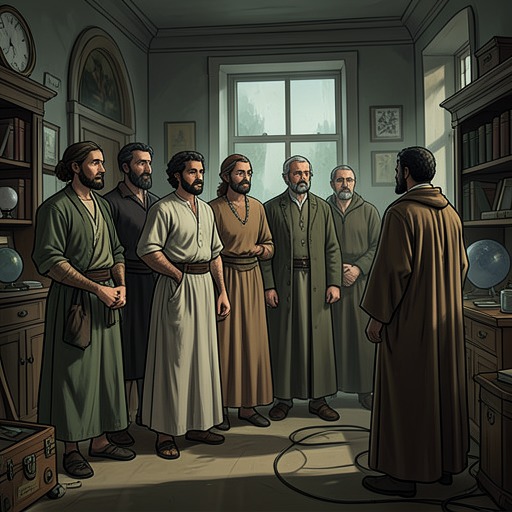
The image appears amid a discussion of wrongdoing and collective responsibility. The teaching says that a wrongdoer cannot act without the hidden will of the community, then pictures people moving together toward The god-self. When someone falls, the fall serves as a warning to those behind. In this sequence, the way is neither an abstract ideal nor a private achievement: the community’s conduct helps shape it, and one person’s failure can become knowledge for others. The expression therefore links shared implication in wrongdoing with shared capacity for learning and forward movement.
Relation to Other Teachings
The maxim’s balance between individual and collective life echoes the teaching on love, which calls for closeness without a binding bond: love should move like a sea between the shores of two souls, with space remaining between people. Togetherness is real, but it need not erase the distinctness of those who share it. The road-and-wayfarer image similarly holds connection and individual movement in tension: the path is shared, yet people travel it as separate persons.
Other teachings extend this pattern of transformation through contrast. Joy is described as sorrow unmasked, and sorrow’s depth as enlarging the capacity for joy; experience changes what a person can contain. Likewise, reason alone confines, while passion left unattended burns toward destruction. These images do not describe the expression’s immediate subject, but they share its structural insistence that human life develops through relationships among forces that cannot simply be separated. The maxim’s distinctive contribution is to make that interdependence social: people shape the conditions through which others advance, stumble, and learn.
Form and Significance
The expression’s balanced nouns make its argument memorable without turning it into a detailed rule. Its apparent paradox resolves through the surrounding image of a procession: the community advances together, and the conduct of its members gives that movement its direction. The phrase thus presents moral life as both journey and shared construction, making responsibility inseparable from participation.