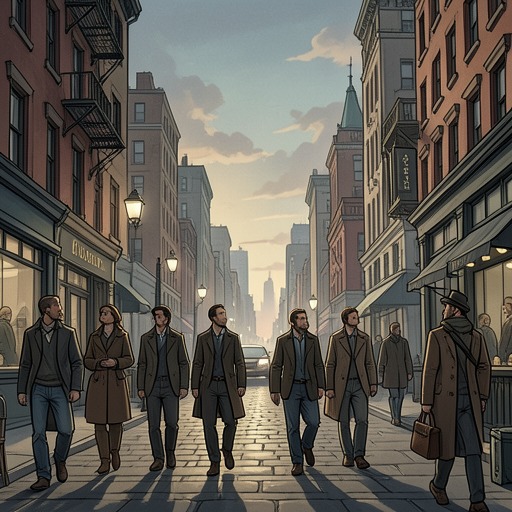
Your house is your larger body
The ProphetThe expression “Your house is your larger body” turns the dwelling into an extension of human life rather than a passive enclosure. The house shares the body’s rhythms of growth and rest, and its dream carries it beyond the city toward groves and hilltops. In a further image, the speaker wishes to scatter houses like seed across forests and meadows, loosening the bond between home and urban setting.
The House as a Living Extension
The comparison begins with scale: the house is a larger body. It then becomes more than a likeness. The house grows in the sun and sleeps in the stillness of night, receiving a daily rhythm that parallels the living body’s own relation to light, activity, and rest. Architecture is imagined as participating in life, not simply surrounding it.
The text also gives the house an interior life of its own. It is not dreamless; in dreaming, it leaves the city for a grove or hilltop. The movement enlarges the metaphor: the house is at once attached to human habitation and capable, in imagination, of escaping its fixed place.
Home, Wandering, and Landscape
The image appears beside a reflection on homecomings and the distant, solitary wanderer within. That nearby contrast gives the house’s dream a particular resonance: home is associated with return, yet its imagined journey carries it away from the city. The dwelling thus holds both rootedness and departure, answering the inward figure of the wanderer with a journey of its own.
The speaker extends that possibility in a wish to gather houses and scatter them like seed in forest and meadow. The image replaces settled urban placement with dispersal through the natural landscape. Houses remain houses, but their imagined destination changes; the familiar form of home is released into a wider world.
Significance of the Expression
By giving the house bodily rhythms and the capacity to dream, the expression makes domestic space continuous with the life of its inhabitant while also granting it imaginative movement. The house is not presented only as a possession or a structure: it grows, rests, and departs in dream. The resulting image holds together intimacy and distance, shelter and wandering, the settled city and the open landscape.