15 Lowfield Close
The Radleys15 Lowfield Close is Jared Copeland and Eve Copeland’s home, a flat reached by communal stairs and marked by ordinary household details: keys on a hall shelf, a water-company letter, band posters, clothes, makeup, and hairspray. Those domestic traces frame two sharply different visits. First, Jared returns to a flat that feels wrong because Eve is missing; later, carrying her gravely injured in his car, he passes the entrance to the Close without stopping and drives on toward the Radley home. The address links a threatened household to the violence beyond it, while the familiar room becomes an index of Eve’s absence and independence.
Setting and domestic details
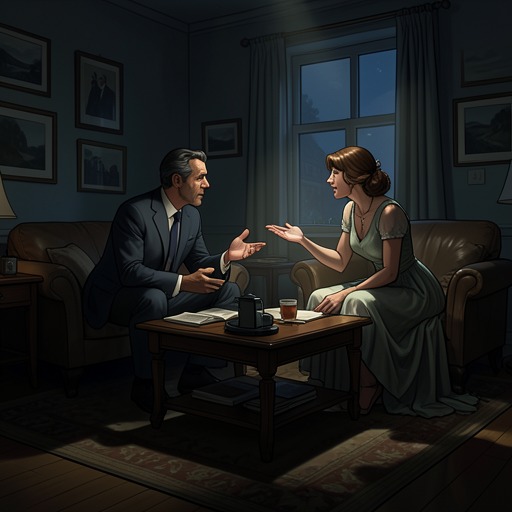
The address is introduced through Jared’s return to the flat. He turns the keys to 15 Lowfield Close, goes inside, and climbs the communal stairs. The route from the entrance to the home is practical rather than grand: his keys go onto a shelf in the hall beside a red letter from Yorkshire Water. The mundane letter and the repeated action of coming home establish the Close as part of a recognizably ordinary domestic life, sharply unlike the danger that occupies Jared’s thoughts.
The flat’s most particular space is Eve’s room. Jared finds her band posters, narrow bed, and open wardrobe, with familiar clothes still hanging there. Makeup is out on the dresser, and the air retains the sweet chemical smell of hairspray. These details establish that Eve has recently been preparing to go out, but they cannot tell Jared where she has gone. Her belongings are present; she is not. The room’s ordinary evidence therefore intensifies, rather than resolves, his alarm.
Eve’s absence
Jared reaches the flat already preoccupied with whether killing Will Radley would make him feel better. He is uncertain about the answer, but certain that the situation has gone on too long, that Eve has been made to suffer too much, and that it must stop. The thought follows him through the front door. Before he is inside the flat, he senses something wrong, and the silence confirms his unease: he calls Eve’s name, receives no answer, and calls again.
Finding her room empty turns that first impression into a specific fear. It is Monday night, and Eve has gone out. Jared’s immediate question is where she is; he runs to the phone and calls her mobile, again without an answer. Only then does he notice the note on the living-room table. It says that Eve has gone to the cinema with Rowan Radley and adds that she seriously doubts he is a vampire. The note identifies both her destination and her companion, but its casual confidence cannot reassure Jared, whose thoughts are already fixed on the danger surrounding the Radleys.
The note also makes the flat more than a place of refuge. It records Eve acting on her own judgment and leaving Jared a brief explanation rather than waiting for him. The details of her room show the practical preparation for an outing; the note supplies her decision in her own voice. For Jared, however, that ordinary independence is inseparable from the risk he fears. The home becomes the point at which his concern for his daughter meets the limits of his knowledge: he can see the evidence she left behind, but he cannot reach her by phone or know what is happening at the cinema.
The Close on the road to Orchard Lane
The address returns in a different form when Jared speeds into Bishopthorpe with the injured Eve lying on the back seat. He has taken her from the scene at Thirsk Palace Cinema and drives with the wind and rain entering through the car’s smashed window. As he pleads with her to stay awake, he passes the entrance to Lowfield Close on his right. He does not turn in. The fish-and-chip restaurant, the drugstore, the deli, and the man leaving The Plow flash past as he continues through the village; he slows only as he nears Orchard Lane.
That passing is a consequential reversal of the earlier homecoming. Before, Jared’s fear began at the flat when Eve was absent and unreachable. Now she is physically beside him, but unconscious, and the home he passed is not where he takes her. He continues toward the Radleys’ house, waits in the car for several seconds when he reaches it, and tries once more to speak to her. The Close thus serves as a point on the route between the ordinary life Jared wants to protect and the crisis that has overtaken it.
Narrative significance
The location’s importance rests on a contrast between familiar domestic signs and the danger that makes them newly charged. A shelf, a red water bill, an open wardrobe, and makeup on a dresser are not extraordinary objects; their force comes from the person missing from the room and from Jared’s inability to make contact. The flat gives the reader concrete evidence of Eve’s departure before the note explains it, letting unease build through absence rather than through a visible threat.
The later drive gives the address a second, compressed significance. Jared passes the entrance to 15 Lowfield Close while carrying Eve toward the Radley home, so the route itself marks how far the danger has crossed into family life. At first, the flat is where Jared searches for his daughter; later, it is a turn he cannot take. Across those scenes, the home remains an ordinary place, but its relation to safety changes: it is no longer enough simply to return there.