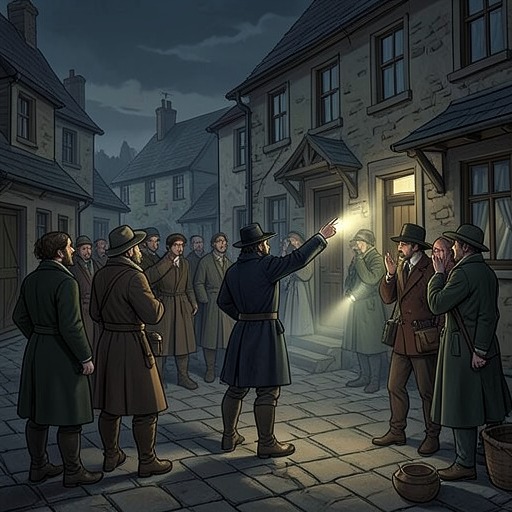
Alison Glenny
The RadleysAlison Glenny, deputy commissioner of Greater Manchester Police and head of its countervampirism operations, is the official who turns the Radleys’ private crisis into a matter of police jurisdiction and vampire policy. Her pursuit of Will Radley is shaped by years of hostility, but her role extends beyond hunting him: she investigates Clara Radley’s killing of Stuart Harper, pressures those who might obstruct the operation, and later helps establish conditions intended to prevent Clara from killing again.
Identity and Institutional Role
Alison leads a police unit devoted to countervampirism. The scale of that responsibility is not initially apparent to officers outside her force. When she enters the investigation being handled by Detective Chief Superintendent Geoff Hodge, he has never met a Manchester police officer in person; Manchester is roughly fifty miles beyond his jurisdiction. He treats her unexpected arrival and claims with disbelief, even as she insists that his local team must leave the case to her. Her authority is therefore both substantial and difficult for outsiders to recognize: she is not simply a senior officer joining an ordinary murder inquiry, but the representative of a specialized operation addressing a concealed supernatural reality.
The gap between conventional policing and Alison’s work becomes explicit when Hodge asks what counterterrorism has to do with the body under investigation. Alison identifies the subject as countervampirism. Hodge initially receives the explanation as a joke, a response that exposes the institutional and evidentiary barrier her unit faces. She does not persuade him through an ordinary investigative briefing; the force of her claim depends on information and authority he does not yet share.
Alison’s position also connects the police operation to the Sheridan Society, whose arrangements had previously given Will a place on a list. Fifteen days before the relevant present-day events, while Alison was briefing a new recruit to the Unnamed Predator Unit, she received a call from a man whose cold, tired whisper was familiar to her. The caller told her that Will was off the list. The account does not identify the caller, but Alison’s response makes clear that Will’s removal mattered: she had considered him a good friend, or at least a friend of her sister. Will rejects that personal description. His response leaves the former closeness unresolved while establishing that the change in his status has brought additional pressure to bear on him.
Pursuit of Will Radley
Will understands Alison as a long-standing threat. During his encounter with a petrol-station cashier, he thinks of her as the head of the Manchester police unit that has wanted him dead for years. His thought that the police are always on their way expresses how persistent her pursuit has become in his mind. The contrast is telling: he can dismiss the cashier’s attempt to stop him, but Alison represents an organized force whose attention he has reason to expect.
Alison’s pursuit is also rendered through Will’s dream in the camper van. As bodies gather around his boat and the danger seems to close in, he looks to the shore expecting Helen Radley, but sees Alison in her place. She nods as if events are proceeding according to plan. He wakes in the van with its blackout blinds drawn. The dream does not establish that Alison is physically present or directing the imagined attack; instead, it places her among the threats Will cannot escape even in sleep. For him, the police operation is no longer an outside complication but part of the pressure surrounding his return.
When Alison takes over the Harper investigation, she seeks information about Bishopthorpe and asks for a list of its residents, specifying Jared Copeland as someone she is looking for. Her interest in Jared brings the local murder case into contact with her wider pursuit of Will. At the surveillance operation outside number seventeen on Orchard Lane, she keeps Hodge at the scene and warns him that leaving and telling anyone would have consequences. Hodge remains skeptical and wonders why the police are not searching the camper van, but Alison tells him that they will. Her decision to control the timing and information around the operation shows how firmly she manages access to the case, even when her colleague doubts its premise.
Alison prepares for the possibility that Will will attack her. She arranges for five members of her unit to wait in a small lorry disguised as an online florist’s delivery vehicle, equipped with protective clothing and crossbows. The cover is sufficiently ordinary that Hodge thinks nothing of the lorry. The contrast between its harmless appearance and its specialized contents captures the operational world Alison inhabits: an unremarkable street can conceal a response team prepared for a threat that ordinary policing does not anticipate.
Jared Copeland and the Limits of Disclosure
Alison’s connection with Jared is marked by an earlier attempt to suppress what he believed about his wife’s death. Jared remembers her telling him that proof of vampires amounted to proof of his own madness. She also warned that if he spoke to anyone about whom he believed had killed his wife—even his daughter—he would be returned to hospital and kept there. The account presents this not as a neutral explanation of procedure but as a threat that constrained Jared’s ability to speak. His later contact with Alison takes place against that history of enforced silence.
Jared eventually sees Will emerge from the camper van and fly away, defeating the apparent purpose of the surveillance. He goes to Alison’s car and tells her that her plan has failed. A detective beside her looks upward in disbelief, but Alison does not withdraw the deadline she has imposed on Helen Radley. She says that Helen has until midnight and that the deadline still stands. Jared knows Will will remain alive at midnight and regards the effort as futile. Alison’s insistence shows the distance between the family’s immediate knowledge of Will’s escape and the police operation’s continuing timetable; the failed observation does not, in her view, cancel the ultimatum.
Clara Radley and Vampire Policy
Alison’s work is not confined to Will. When Stuart Harper’s body is found, she tells Helen that the police know Clara killed him. Helen has only recently felt relief because the news has not yet reported the discovery; Alison’s disclosure ends that reprieve. The accusation changes the family’s situation from fear that Harper’s disappearance may be exposed to direct knowledge that the police have connected Clara to his death.
Later, Alison advises that Clara should consume some blood from time to time to reduce the risk of another overwhelming blood-thirst episode. She also warns Clara that another killing would leave no second chance. These two parts of her approach sit in deliberate tension: the police officer responsible for countervampirism advocates limited blood consumption as a preventive measure while defining renewed lethal violence as an intolerable boundary. Jared agrees to an arrangement proposed by Helen under which Clara can travel to Manchester every Friday night for blood, provided she does not bring it home or drink it in the flat. Alison’s intervention thus leads not simply to surveillance or punishment, but to a controlled routine intended to manage the danger that Clara might kill again.
Personal Life and Narrative Significance
Alison’s life outside the operation receives a brief but distinct glimpse through her recollection of Chris, a soft-spoken history teacher from Middlesbrough who liked hiking and regularly made her laugh. She had imagined a connection with him, but understood it as companionship rather than the intense love celebrated in poems and pop songs. The detail gives her a private measure separate from rank and pursuit: she values the prospect of someone making her large house feel less lonely, even while the major action presents her as an officer accustomed to issuing orders and maintaining pressure.
Across the investigation, Alison embodies the uneasy conversion of a hidden danger into official policy. She can deploy a covert team, claim jurisdiction over a local case, seek Jared by name, and impose a deadline on Helen; she can also advise a family to regulate Clara’s blood consumption as a means of preventing another killing. Her methods do not resolve the conflict between vampire need and human safety. Instead, they make that conflict administratively visible, binding private grief and family secrecy to a police system that recognizes the supernatural threat even as its ordinary officers struggle to believe it.